
An older universe could give unexpectedly mature early galaxies billions more years to grow, according to a model that also reproduces galaxy rotation without dark matter.
To explain how galaxies rotate, the standard model of the universe relies on dark matter, an unseen source of gravity. A new paper published in Monthly Notices of the Royal Astronomical Society reports that an alternative model can reproduce the rotation curves of all 175 galaxies in the SPARC database without dark matter. These curves show how orbital speeds change with distance from a galaxy’s center, giving researchers a way to test the gravity their model predicts.
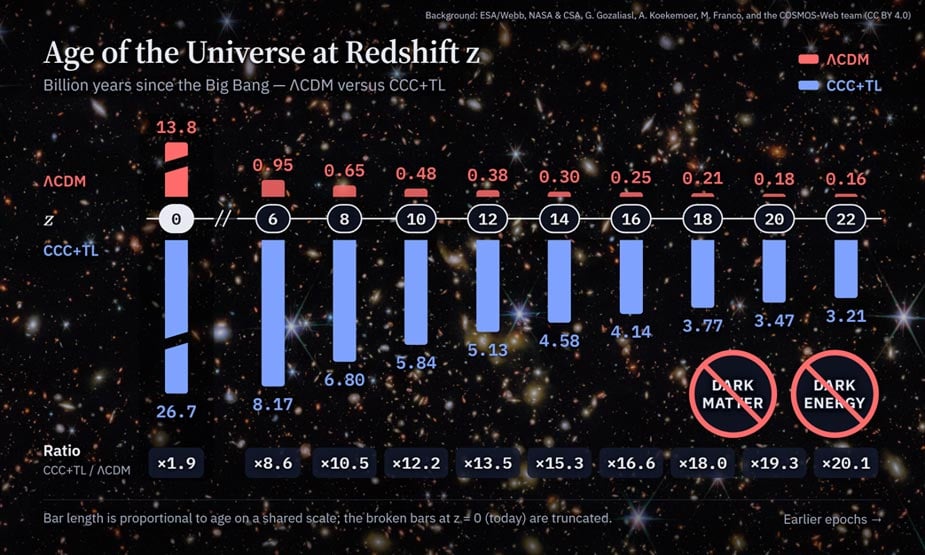
The galaxy study is part of a series of tests conducted during 2025 and 2026 by Rajendra Gupta, an adjunct professor in the University of Ottawa’s Department of Physics, and postdoctoral researcher Dr. Nikolaos Samaras. They compared important astronomical observations with predictions from CCC+TL, a model that puts the universe’s age at 26.7 billion years and proposes that neither dark matter nor dark energy is needed.
Replacing dark matter with changing constants
The standard cosmological model is called ΛCDM, short for lambda cold dark matter. Lambda, written as the Greek letter Λ, represents the cosmological constant associated with dark energy, which accounts for the universe’s accelerating expansion. “Cold” means that the dark matter moves slowly compared with light. Scientists have searched for dark matter and dark energy for decades, but neither has been directly detected.
CCC+TL stands for “covarying coupling constants plus tired light.” It combines the idea that fundamental quantities governing forces and particle interactions evolve together over time with the proposal that light loses energy as it travels. Under this framework, changing fundamental constants could produce effects usually attributed to dark matter and dark energy.
Putting that proposal to the test required more than adjusting the settings in existing cosmology software. CCC+TL changes the Einstein and Friedmann equations, which describe gravity and the universe’s expansion. For each test, Gupta and Samaras developed equations and computer code consistent with their model.
Beyond individual galaxies, the researchers examined the Bullet Cluster. There, the extra gravitational effect predicted by CCC+TL tracks the galaxies rather than the hot, X-ray-emitting gas. The team describes this result as an early proof of concept that needs further study.

“Observations attributed to dark matter and dark energy likely originate from covarying coupling constants,” says Gupta, whose paper on the origin of dark matter and dark energy explores this idea.
More time for early galaxies to grow
An older universe would also change how astronomers interpret the large, mature galaxies they keep finding early in cosmic history. Those observations have raised questions for ΛCDM because galaxies need time to grow. How much time they had depends on the model used to interpret their redshift, a measure of how much their light has shifted toward longer, redder wavelengths.
For observations during cosmic dawn that correspond to a universe about 300 million years old under the standard model, CCC+TL gives an age of about 4.6 billion years at the same observed redshift. That leaves much more time for galaxies to develop. In calculations reported in Galaxies 13, 115, early galaxies come out about 12 times larger in size and mass than the standard model predicts.
“Impossible early galaxies become predictable galaxies,” Gupta explains. “We predict that galaxies exist well beyond the distances the James Webb Space Telescope has reached.”
The James Webb Space Telescope’s GLIMPSE program plans to search for galaxies at redshifts that may exceed 50, potentially providing a test of that prediction. At those redshifts, the standard model may leave too little time for massive galaxies to form. CCC+TL does not impose the same time constraint.
Early element predictions match the standard model
The researchers also tested whether their framework could account for evidence from much earlier in cosmic history. Its predictions for the amounts of hydrogen, helium, and other light elements formed shortly after the Big Bang matched those of the standard model. It also agreed with cosmic-chronometer measurements, which use galaxy ages to estimate how quickly the universe has expanded over time.
A separate study of time dilation in supernova observations also supports CCC+TL, although that paper remains under review. Time dilation here refers to the stretching of the observed timescale of a stellar explosion. The team’s work also extends to the cosmic microwave background, the radiation left over from the early universe.
“Most emerging models explain only a limited set of observations,” Gupta says. “A new model must not conflict with the pillars of cosmology and astrophysics, and our findings meet that challenge, including the yet-to-be-published Cosmic Microwave Background challenge.”
“The success should encourage astronomers to take the new model seriously. It is challenging to understand and apply, but we believe it extends the physics of the Universe beyond ΛCDM limits,” concludes Gupta.
Reference: “A Big Bang Nucleosynthesis Consistency Test of the CCC+TL Cosmology” by Rajendra P. Gupta and Nikolaos Samaras, 25 June 2026, Universe.
DOI: 10.3390/universe12070193
Never miss a breakthrough: Join the SciTechDaily newsletter.
Follow us on Google and Google News.