
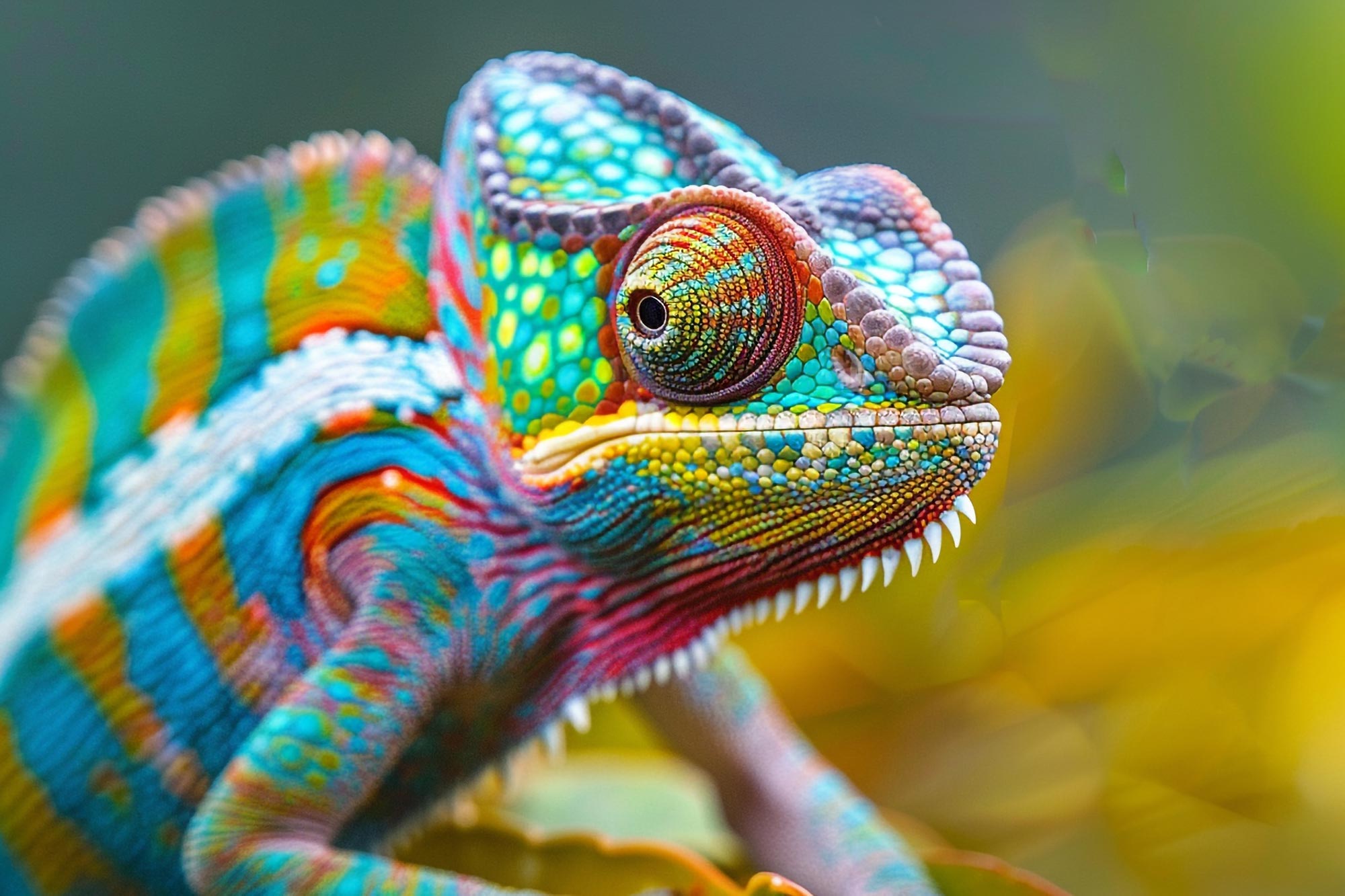
After centuries of fascination and speculation, scientists have finally uncovered the secret behind chameleons’ mesmerizing, independently moving eyes.
Chameleons’ roaming eyes have captivated and mystified scientists since ancient Greece. After thousands of years of speculation, modern imaging technology has finally uncovered the secret behind their near 360-degree vision and remarkable ability to look in two different directions at the same time. Hidden behind each of their protruding eyes are two long, spiraled optic nerves, a feature not found in any other type of lizard.
“Chameleon eyes are like security cameras, moving in all directions,” explained Juan Daza, associate professor at Sam Houston State University and author of a new study describing the trait. “They move their eyes independently while scanning their environment to find prey. And the moment they find their prey, their eyes coordinate and go in one direction so they can calculate where to shoot their tongues.”
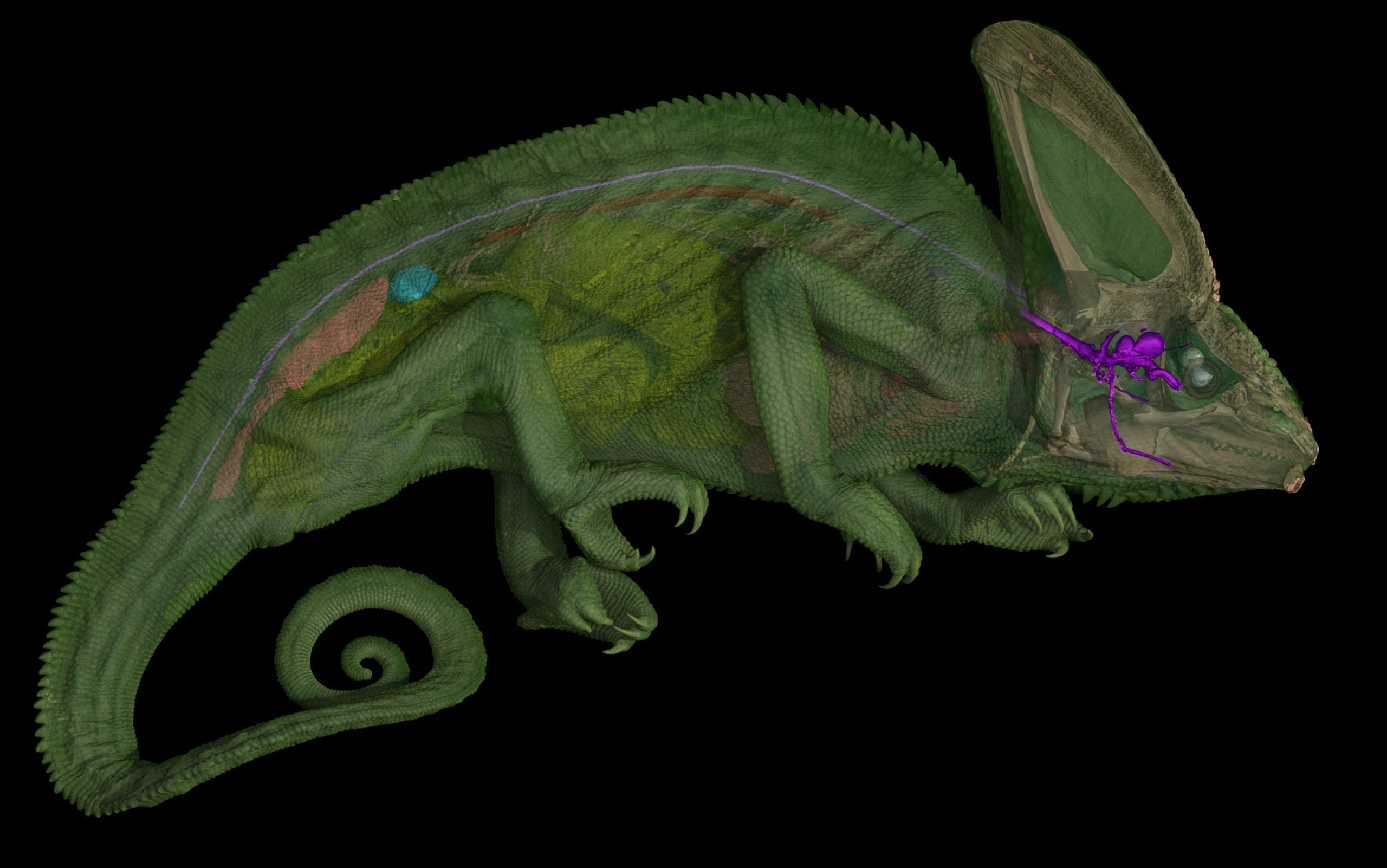
Although the chameleon’s quick, darting gaze is easy to see, the internal mechanism that enables such movement has long remained a mystery. In 2017, Edward Stanley, director of the Florida Museum of Natural History’s digital imaging laboratory, noticed something extraordinary while visiting Daza’s lab. A CT scan of the tiny leaf chameleon (Brookesia minima) revealed an unusual, coiled structure within the optic nerves that he had never encountered before.
Even so, both researchers were hesitant to draw conclusions at first. Given how extensively chameleons have been examined over the centuries, they doubted they could be the first to recognize this hidden feature.
“I was surprised by the structure itself, but I was more surprised that nobody else had noticed it,” Daza said. “Chameleons are well studied, and people have been doing anatomical studies of them for a long time.”
Masters of Adaptation
Chameleons are found across Africa, Europe, and Asia, where they have evolved a remarkable set of adaptations for life in the trees. Their prehensile tails act as stabilizers, helping them maintain balance, while their mitten-like feet allow them to grip branches with precision as they move slowly and deliberately through their habitat.
Speed is not their strength, but it isn’t needed. Equipped with a powerful, spring-loaded tongue, a chameleon can strike at prey with incredible force, accelerating from zero to 60 miles per hour in just one hundredth of a second. This sticky, elastic tongue can extend to more than twice the reptile’s body length, allowing it to capture unsuspecting insects in the blink of an eye.
Charismatic and unique, it’s no wonder that chameleons have long captured human attention. Their distinct form and curled tail are even distinguishable among ancient Egyptian petroglyphs. Convinced there must be a published description of these coiled optic nerves out there, the team went deep into the stacks of research in search of evidence, even bringing in language experts to decipher old texts published in French, Italian, and Latin — and sometimes a confounding mix of multiple languages.
Over two thousand years ago, the Greek philosopher Aristotle erroneously theorized that chameleons lacked optic nerves altogether, instead declaring the eyes were directly connected to the brain, which allowed their independent movements. In the mid-1600s, Roman physician Domenico Panaroli challenged Aristotle’s views, arguing that chameleons do have optic nerves, but — unlike in most other animals — they do not cross. This cross causes the image viewed in the right eye to be processed on the left side of the brain, and vice versa. Panaroli rationalized that without this crossing structure, chameleon eyes could move freely.
Isaac Newton, also intrigued by the strange structure of chameleon eyes, propagated Panaroli’s theory and mentioned the animal multiple times in his 1704 book Optiks, which covers three decades of this work and theories on light and color. In contrast, French anatomist Claude Perrault sketched the animal’s two optic nerves crossing before continuing in straight line in his 1669 book on chameleon anatomy. While overlooked by Newton and many others, this was one of the earliest and most accurate renditions at the time.
The Missing Coil
As years passed, scientists’ observations came close but ultimately fell short of capturing the true shape of the optic nerves in their published research. In his 1852 treatise on the brains and nerves of lizards, Johann Fischer illustrated a section of the chameleon’s optic nerve that included part of the coil, but the rest was cut from the figure and the coil itself was never described. Over a century and a half later, in 2015, Lev-Ari Thidar, a master’s student at the University of Haifa, described a section of the chameleon’s optic nerve as C-shaped in their thesis. Only after an exhaustive search could the scientists confirm that no published description of the coil yet existed.
So how, after centuries of interest and study, could the true structure of a chameleon’s optic nerves remain hidden? The answer lies in the power of CT scanning and open data. In past publications, scientists relied on dissections to get a look at the inner workings of the chameleon’s anatomy, but the practice often displaced or destroyed the optic nerves and obscured their true structure.
“Throughout history, people have looked at chameleon eyes because they’re interesting,” Stanley said. “But if you physically dissect the animal, you lose information that can tell the full story.”
Today, CT scanning technology is ubiquitous in medicine and becoming increasingly common in research collections. X-ray CT allows scientists to visualize structures hidden within specimens, including the space beneath a chameleon’s skull.
Seeing the coiled nerve optic nerve in a single species of chameleon was informative, but the scientists had plenty more data at their fingertips thanks to oVert (short for openVertebrate). This initiative, launched by a coalition of 18 U.S. institutions and led by the Florida Museum of Natural History, provides free, digital 3-D vertebrate anatomy models and data to researchers, educators, students, and the public.
“These digital methods are revolutionizing the field,” Daza said. “Before, you couldn’t discover details like this. But with these methods, you can see things without affecting the anatomy or damaging the specimen.”
The research team downloaded and analyzed the CT scans of over thirty lizards and snakes, including three species of chameleons representing the family’s diverse clades. They created 3D brain models for 18 of these lizards and measured their optic nerves. All three chameleon species studied had significantly longer and more coiled optic nerves than their fellow lizards. The results confirmed what Stanley had seen in Daza’s lab was no fluke.
The team dove further into their research to observe how these unique optic nerves form during the chameleon’s development. They measured the optic nerves across three embryonic stages of the veiled chameleon (Chamaeleo calyptratus). At the earliest stage, the embryo’s optic nerves were straight, but before hatching, they lengthened and began forming the loops seen in adults. By the time a chameleon hatchling emerges, it already has two fully mobile eyes.
On an evolutionary timescale, however, pinpointing when chameleons first developed this trait is more challenging. The oldest known chameleon fossils date back to the early Miocene, roughly 16 to 23 million years ago, after many of their tree-dwelling adaptations had already evolved. These fossils do not offer many clues about the order or timing in which these specialized traits evolved, but this new observation can help scientists start to infer why they developed the unique structure in the first place.
Adaptation for Mobility
Across vertebrates, animals with large eyes tend to employ one of two strategies to broaden their field of view: move their necks or move their eyes. Owls and lemurs are famous for the first approach, swiveling their heads to scan their surroundings while their eyes remain fixed. Others, like humans, have developed stretchy optic nerves that let the eyes move like telescopes. Rodents, similarly, have wavy nerve fibers that allow for greater flexibility.
Because chameleons have limited neck mobility, they likely needed another way to reduce the physical strain of moving their eyes. The solution appears to be the coiled optic nerve, which is an adaptation seen in only a few other invertebrates, such as the stalk-eyed fly. Chameleons may have evolved this feature to give their eyes extra slack, easing the tension created by their remarkable range of motion.
“You can compare optic nerves with old phones,” Daza said. “The first phones just had a simple, straight cord attached to the headset, but then someone had the idea to coil the cord and give it more slack so people could walk farther while holding it. That’s what these animals are doing: They’re maximizing the range of motion of the eye by creating this coiled structure.”
Even after thousands of years of observation, the natural world still has more to reveal. Scientists are now curious whether other tree-dwelling lizards have developed similar adaptations, and Stanley and Daza plan to investigate further.
“These giants we’ve cited—Newton, Aristotle, and others—have inspired natural historians for centuries,” Stanley said. “It’s exciting to be the ones taking the next step along the long road to understanding what on earth is going on in chameleons.”
Reference: “A new twist in the evolution of chameleons uncovers an extremely specialized optic nerve morphology” by Emily Collins, Aaron M. Bauer, Raul E. Diaz Jr., Alexandra Herrera-Martínez, Esteban Lavilla, Edward L. Stanley, Monte L. Thies and Juan D. Daza, 10 November 2025, Scientific Reports.
DOI: 10.1038/s41598-025-20357-3
The study was funded by the U.S. National Science Foundation.
Never miss a breakthrough: Join the SciTechDaily newsletter.
Follow us on Google and Google News.
1 Comment
Now, how does its brain decide to set the skin colors like in the top photo?
Wouldn’t it be cool if we humans could get a genetic mod that would allow us to change skin color like a chameleon? People wouldn’t need tattoo’s any longer.