
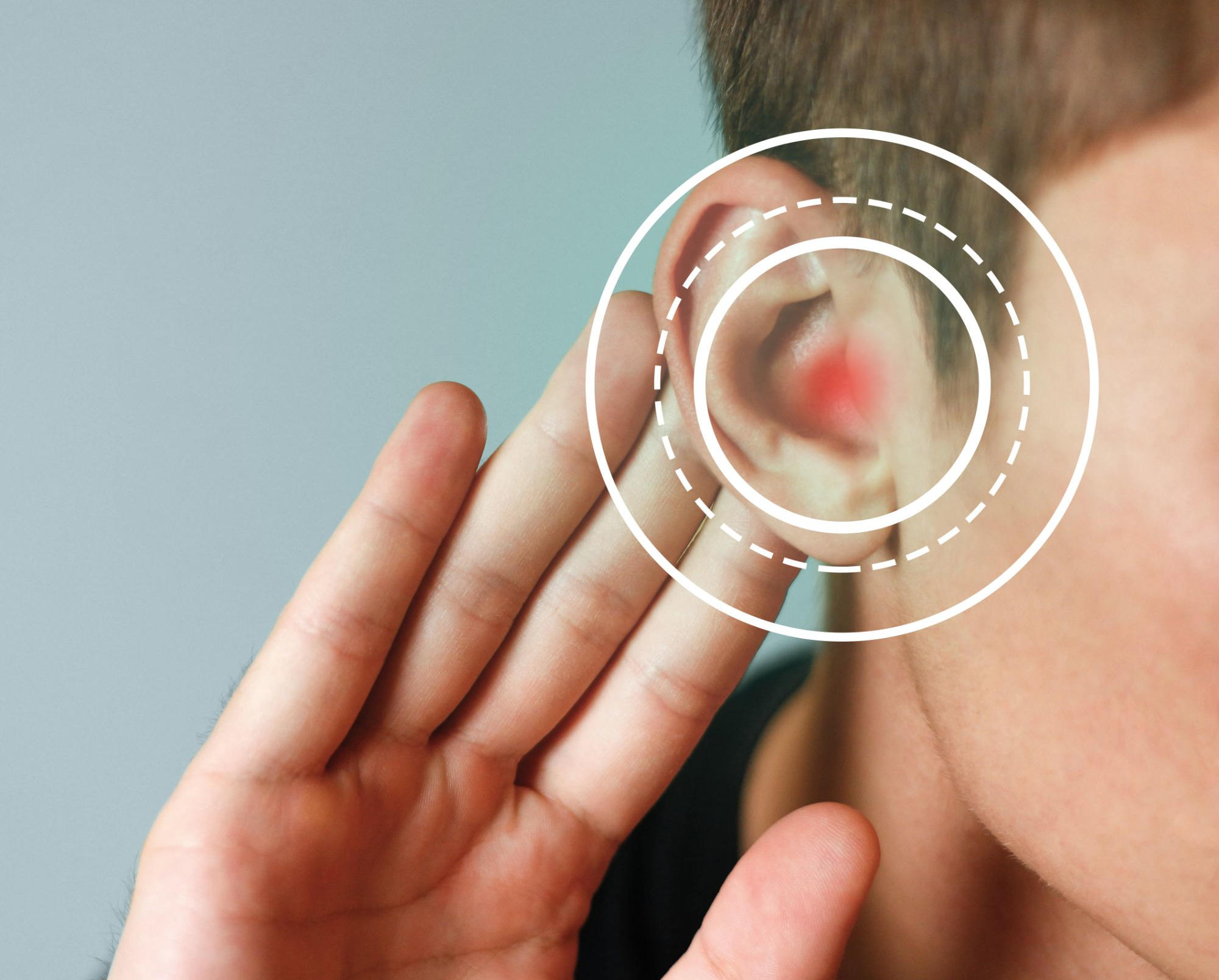
The auricular muscles, which enabled our distant ancestors to move their ears for better hearing, activate when people try to focus on competing sounds.
If you can wiggle your ears, you’re using muscles that once helped our distant ancestors listen more attentively. These auricular muscles altered the shape of the pinna—the outer shell of the ear—funneling sound toward the eardrums. Millions of years ago, our ancestors stopped relying on them, leaving humans with only vestigial auricular muscles. However, scientists studying these muscles have recently discovered that they still activate when we try to focus on competing sounds.
“There are three large muscles which connect the auricle to the skull and scalp and are important for ear wiggling,” explained Andreas Schröer of Saarland University, first author of the study in Frontiers in Neuroscience. “These muscles, particularly the superior auricular muscle, exhibit increased activity during effortful listening tasks. This suggests that these muscles are engaged not merely as a reflex but potentially as part of an attentional effort mechanism, especially in challenging auditory environments.”
Straining your ears
It’s difficult to test how hard someone is listening without self-reported measures. But electromyography, which measures electrical activity in a muscle, can help identify activity in the auricular muscles linked to listening closely. Similar research has already shown that the largest muscles, posterior and superior auricular muscles, react during attentive listening. Because they pull the ears up and back, they are considered likely to have been involved in moving the pinna to capture sounds.
“The exact reason these became vestigial is difficult to tell, as our ancestors lost this ability about 25 million years ago,” Schröer said. “One possible explanation could be that the evolutionary pressure to move the ears ceased because we became much more proficient with our visual and vocal systems.”
To test whether these muscles are more active during more difficult listening tasks, the scientists recruited 20 people without hearing problems. They applied electrodes to participants’ auricular muscles and then played them an audiobook and distracting podcasts from speakers in front of or behind them. Each participant underwent 12 five-minute trials, covering three different levels of difficulty.
On easy mode, the podcast was quieter than the audiobook, and the speaker’s voice was a stronger contrast to the audiobook. To create two more difficult modes, the scientists added a podcast that sounded more like the audiobook and made the distractors louder. However, the researchers were careful to make even the most difficult condition achievable: if the participants gave up, no physiological effort would register.
Then, the scientists asked the participants to rate their effort levels and to estimate how often they lost the thread of the audiobook in each trial. They also quizzed the participants on the audiobook’s content.
Hearsay
The scientists found that the two auricular muscles reacted differently to the different conditions. The posterior auricular muscles reacted to changes in direction, while the superior auricular muscles reacted to the difficulty level of the task. Participants’ self-reported measures of effort and how often they lost track of the audiobook rose in line with the difficulty of the task, and the accuracy of their responses to questions about the audiobook dropped noticeably between the medium and the difficult mode.
This correlated with the superior auricular muscles’ activity levels: they didn’t activate more during the medium mode than during the easy mode, but were very active during the difficult mode. This suggests that the activity of the superior auricular muscles could provide an objective measure of listening effort, although it’s unclear if the muscle activity helps people hear.
“The ear movements that could be generated by the signals we have recorded are so minuscule that there is probably no perceivable benefit,” said Schröer. “However, the auricle itself does contribute to our ability to localize sounds. So, our auriculomotor system probably tries its best after being vestigial for 25 million years, but does not achieve much.”
The scientists pointed out that more work will be necessary to confirm these results and develop practical applications. Like many hearing studies, their sample was relatively small and composed of young people without hearing problems. Larger, more diverse participant groups, in more realistic conditions, are needed.
“Investigating the possible effects of muscle strain itself or the ear’s minuscule movements on the transmission of sound is something we want to do in the future,” said Schröer. “The effect of these factors in people with hearing impairments would also be interesting to investigate.”
Reference: “Electromyographic correlates of effortful listening in the vestigial auriculomotor system” by Andreas Schroeer, Farah I. Corona-Strauss, Ronny Hannemann, Steven A. Hackley and Daniel J. Strauss, 13 November 2024, Frontiers in Neuroscience.
DOI: 10.3389/fnins.2024.1462507
Funding: German Federal Ministry of Education and Research, European Regional Development Fund, Center for Digital Neurotechnologies Saar
Never miss a breakthrough: Join the SciTechDaily newsletter.
Follow us on Google and Google News.
1 Comment
lol! Another piece of human anatomy that evolutionists thought was useless proven to have a use. Evolution is fantasy.