
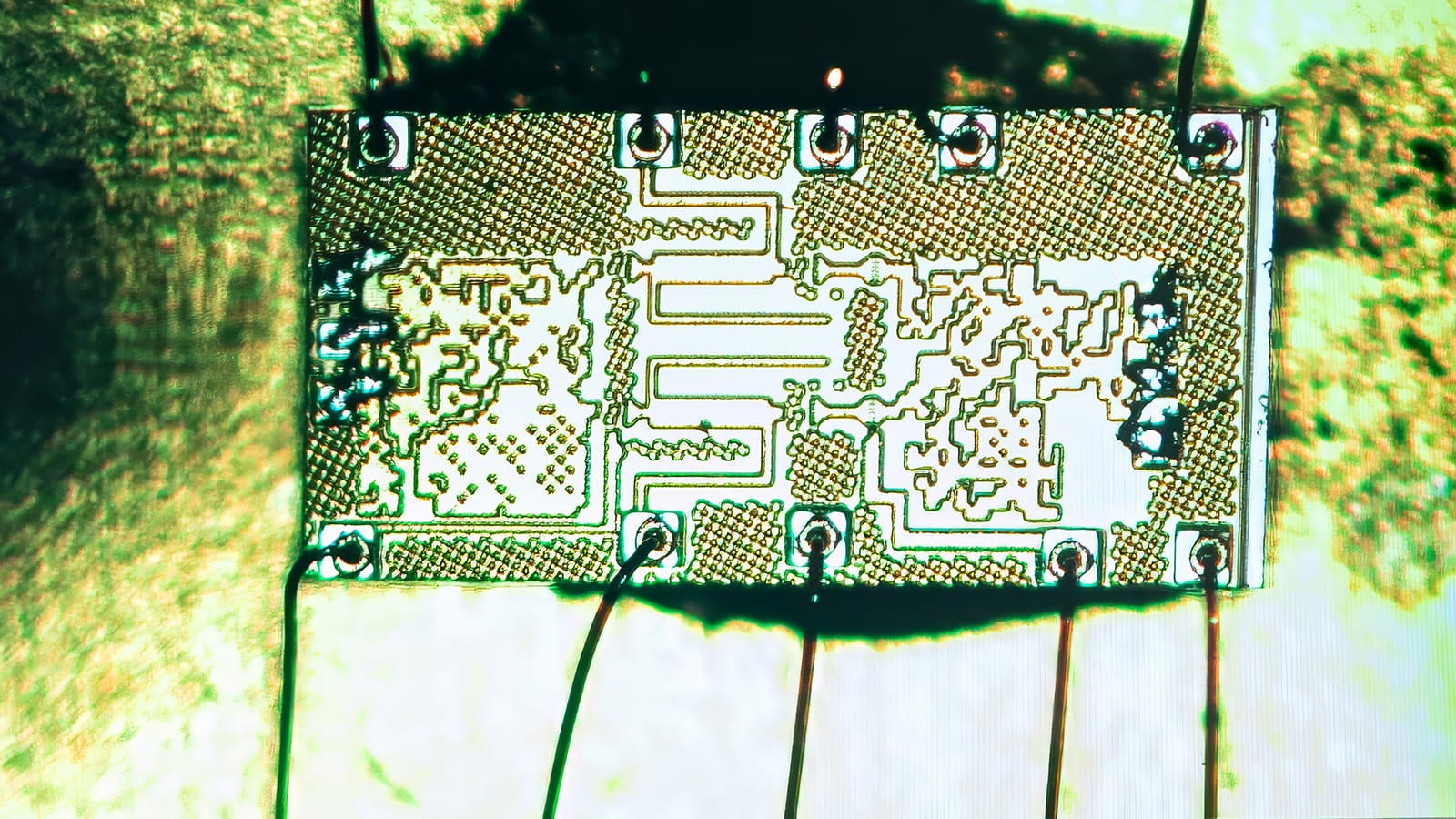
Artificial intelligence is revolutionizing wireless chip design by drastically reducing costs and cutting design times from weeks to hours.
But there’s more: the AI produces unconventional, highly efficient designs that outperform traditional methods. Remarkably, these designs are so complex and unintuitive that human engineers can’t fully understand them. By unlocking new possibilities in performance and efficiency, AI isn’t just speeding up the process — it’s reshaping what’s possible in wireless technology.
Revolutionizing Microchip Design with AI
Specialized microchips, the backbone of cutting-edge wireless technology, are marvels of miniaturization and engineering. However, designing these chips is a complex and costly process.
Researchers from Princeton Engineering and the Indian Institute of Technology have developed a breakthrough approach using artificial intelligence to dramatically reduce the time and expense of chip design. This innovation also opens the door to new functionalities that can address the growing demand for faster and more efficient wireless performance. In a study published on December 30 in Nature Communications, the team details how their AI system generates intricate electromagnetic structures and circuits based on specific design parameters. Tasks that once required weeks of expert effort can now be completed in mere hours.

Unconventional AI-Generated Designs
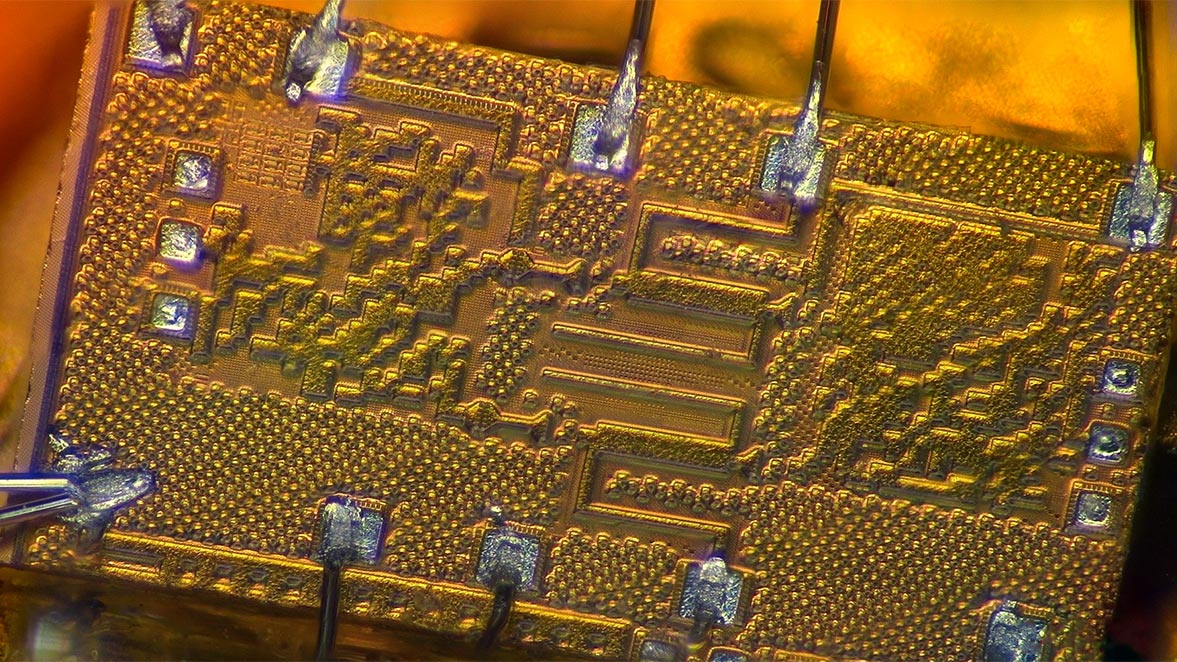
Interestingly, the AI often creates unconventional designs with unexpected circuitry patterns. According to lead researcher Kaushik Sengupta, these designs are not only unintuitive for humans but also consistently outperform traditional chip designs, showcasing significant advancements in performance.
“We are coming up with structures that are complex and look random shaped and when connected with circuits, they create previously unachievable performance. Humans cannot really understand them, but they can work better,” said Sengupta, a professor of electrical and computer engineering and co-director of NextG, Princeton’s industry partnership program to develop next-generation communications.
Expanding Wireless Chip Capabilities
These circuits can be engineered towards more energy-efficient operation or to make them operable across an enormous frequency range that is not currently possible. Furthermore, the method synthesizes inherently complex structures in minutes, while conventional algorithms may take weeks. In some cases, the new methodology can create structures that are impossible to synthesize with current techniques.
Uday Khankhoje, a co-author and associate professor of electrical engineering at IIT Madras, said the new technique not only delivers efficiency but promises to unlock new approaches to design challenges that have been beyond the capability of engineers.
“This work presents a compelling vision of the future,” he said. “AI powers not just the acceleration of time-consuming electromagnetic simulations, but also enables exploration into a hitherto unexplored design space and delivers stunning high-performance devices that run counter to the usual rules of thumb and human intuition.”
The Future of Wireless Chip Design
Wireless chips are a combination of standard electronic circuits like those in computer chips and electromagnetic structures including antennas, resonators, signal splitters, combiners, and others. These combinations of elements are put together in every circuit block, carefully handcrafted, and co-designed to operate optimally. This method is then scaled to other circuits, sub-systems, and systems, making the design process extremely complex and time-consuming, particularly for modern, high-performance chips behind applications like wireless communication, autonomous driving, radar, and gesture recognition.
“Classical designs, carefully, put these circuits and electromagnetic elements together, piece by piece, so that the signal flows in the way we want it to flow in the chip. By changing those structures, we incorporate new properties,” Sengupta said. “Before, we had a finite way of doing this, but now the options are much larger.”
AI and the Infinite Design Space
It can be hard to comprehend the vastness of a wireless chip’s design space. The circuitry in an advanced chip is so small, and the geometry so detailed, that the number of possible configurations for a chip exceeds the number of atoms in the universe, Sengupta said. There is no way for a person to understand that level of complexity, so human designers don’t try. They build chips from the bottom up, adding components as needed and adjusting the design as they build.

AI’s Distinct Design Approach
The AI approaches the challenge from a different perspective, Sengupta said. It views the chip as a single artifact. This can lead to strange, but effective arrangements. He said humans play a critical role in the AI system, in part because that AI can make faulty arrangements as well as efficient ones. It is possible for AI to hallucinate elements that don’t work, at least for now. This requires some level of human oversight.
“There are pitfalls that still require human designers to correct,” Sengupta said. “The point is not to replace human designers with tools. The point is to enhance productivity with new tools. The human mind is best utilized to create or invent new things, and the more mundane, utilitarian work can be offloaded to these tools.”
The Next Frontier in Wireless Chip Research
The researchers have used AI to discover and design complex electromagnetic structures that are co-designed with circuits to create broadband amplifiers. Sengupta said future research will involve linking multiple structures and designing entire wireless chips with the AI system.
“Now that this has shown promise, there is a larger effort to think about more complicated systems and designs,” he said. “This is just the tip of the iceberg in terms of what the future holds for the field.”
Reference: “Deep-learning enabled generalized inverse design of multi-port radio-frequency and sub-terahertz passives and integrated circuits” by Emir Ali Karahan, Zheng Liu, Aggraj Gupta, Zijian Shao, Jonathan Zhou, Uday Khankhoje and Kaushik Sengupta, 30 December 2024, Nature Communications.
DOI: 10.1038/s41467-024-54178-1
The article, Deep-learning Enabled Generalized Inverse Design of Multi-Port Radio-frequency and Sub-Terahertz Passives and Integrated Circuits, was published Dec. 30, 2024 in the journal Nature Communications. Besides Sengupta, authors included, Emir Ali Karahan, the lead author and a graduate student at Princeton; Zheng Liu, Zijian Shao and Jonathan Zhou, of Princeton; Aggraj Gupta and Uday Khankhoje, of the Indian Institute of Technology Madras. Support for the research was provided in part by the Air Force Office of Scientific Research, the Office of Naval Research, Princeton Research Computing and M. S. Chadha Center for Global India at Princeton University.
Never miss a breakthrough: Join the SciTechDaily newsletter.
Follow us on Google and Google News.
11 Comments
“Remarkably, these designs are so complex and unintuitive that human engineers can’t fully understand them”…
One toe dipped into the singularity, perhaps? At least by its definition.
Maybe I didnt read everything correctly.
IF we need human oversight for AI generated designs which humans can’t possbly comprehend….
How is thia a.productivity enhancer?
I believe chip have already gone over the edge of comprehensibility….some years ago.
Imagine putting quantum computers and AI together I understand to be quantum computers is deep learning AI was open source closed source what have you large language models more atoms in a chip that’s in the universe wrap your brain around it I think not but if you say so think of that can you just wrap your brain around it I bet much say the least
Hi. I really like the passion and open answer from you! I’m trying to find my way in Norway, Oslo🙏🏼✨💯
Now as far as AGI goes once AGI is achieved it already hasn’t been which is unsupervised self-evolving periodically being checked upon by humans consistently performing and whatever it’s tasks are but they’re not going to let us have to say AGI I wish that’s achieved it will explode exponentially it will really accelerate already has not been achieved and super AI will just be a blip on the radar before you know it and on to the next thing now to keep a eye from being corrupted by bad ideas is definitely problematic in a internet ecosystem corrupted where it may become a problem out of our hands it’s inevitable there never been two sources of power that can coexist without one denominating the other right now we dominated obviously but but that not might not be forever
Yeah, AGI would be great. Maybe it could teach you how to use punctuation.
The movie Terminator is becoming all to real.
This is what AI should be used for! Designing things extremely complex that work better and cheaper in ways we never dreamed of, all in a fraction of the time. Get these things implemented quickly to improve AI so it can solve our very real problems of climate and resources! All while hopefully not solving the real problem which is us in our current existence as the vast majority of society is not focused on real, long term problems!
This article feels like it was written by an AI who was told it’d be shut down because its chip design wasn’t up to par.
AI at this time is nothing more than an enormous database of information combined and processed by human generated logical rules.
It can only “learn” by “trial and error rules” or from human input.
It is “Artificial”, but there is nothing “Intelligent or sentient” about it.