

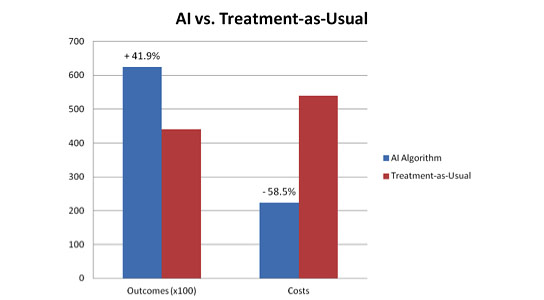
Researchers at Indiana University have shown that an artificial intelligence framework that employs sequential decision-making could reduce healthcare costs by over 50 percent while also improving patient outcomes by over 40 percent.
New research from Indiana University has found that machine learning — the same computer science discipline that helped create voice recognition systems, self-driving cars, and credit card fraud detection systems — can drastically improve both the cost and quality of healthcare in the United States.
Using an artificial intelligence framework combining Markov Decision Processes and Dynamic Decision Networks, IU School of Informatics and Computing researchers Casey Bennett and Kris Hauser show how simulation modeling that understands and predicts the outcomes of treatment could reduce healthcare costs by over 50 percent while also improving patient outcomes by nearly 50 percent.
The work by Hauser, an assistant professor of computer science, and Ph.D. student Bennett improves upon their earlier work that showed how machine learning could determine the best treatment at a single point in time for an individual patient.
By using a new framework that employs sequential decision-making, the previous single-decision research can be expanded into models that simulate numerous alternative treatment paths out into the future; maintain beliefs about patient health status over time even when measurements are unavailable or uncertain; and continually plan/re-plan as new information becomes available. In other words, it can “think like a doctor.”
“The Markov Decision Processes and Dynamic Decision Networks enable the system to deliberate about the future, considering all the different possible sequences of actions and effects in advance, even in cases where we are unsure of the effects,” Bennett said.
Moreover, the approach is non-disease-specific — it could work for any diagnosis or disorder, simply by plugging in the relevant information.
The new work addresses three vexing issues related to health care in the U.S.: rising costs expected to reach 30 percent of the gross domestic product by 2050; a quality of care where patients receive correct diagnosis and treatment less than half the time on a first visit; and a lag time of 13 to 17 years between research and practice in clinical care.
“We’re using modern computational approaches to learn from clinical data and develop complex plans through the simulation of numerous, alternative sequential decision paths,” Bennett said. “The framework here easily out-performs the current treatment-as-usual, case-rate/fee-for-service models of health care.”
Bennett is also a data architect and research fellow with Centerstone Research Institute, the research arm of Centerstone, the nation’s largest not-for-profit provider of community-based behavioral health care. The two researchers had access to clinical data, demographics and other information on over 6,700 patients who had major clinical depression diagnoses, of which about 65 to 70 percent had co-occurring chronic physical disorders like diabetes, hypertension and cardiovascular disease.
Using 500 randomly selected patients from that group for simulations, the two compared actual doctor performance and patient outcomes against sequential decision-making models, all using real patient data. They found great disparity in the cost per unit of outcome change when the artificial intelligence model’s cost of $189 was compared to the treatment-as-usual cost of $497.
“This was at the same time that the AI approach obtained a 30 to 35 percent increase in patient outcomes,” Bennett said. “And we determined that tweaking certain model parameters could enhance the outcome advantage to about 50 percent more improvement at about half the cost.”
While most medical decisions are based on case-by-case, experience-based approaches, there is a growing body of evidence that complex treatment decisions might best be handled through modeling rather than intuition alone.
“Modeling lets us see more possibilities out to a further point, which is something that is hard for a doctor to do,” Hauser said. “They just don’t have all of that information available to them.”
Using the growing availability of electronic health records, health information exchanges, large public biomedical databases, and machine learning algorithms, the researchers believe the approach could serve as the basis for personalized treatment through the integration of diverse, large-scale data passed along to clinicians at the time of decision-making for each patient. Centerstone alone, Bennett noted, has access to health information on over 1 million patients each year.
“Even with the development of new AI techniques that can approximate or even surpass human decision-making performance, we believe that the most effective long-term path could be combining artificial intelligence with human clinicians,” Bennett said. “Let humans do what they do well, and let machines do what they do well. In the end, we may maximize the potential of both.”
“Artificial Intelligence Framework for Simulating Clinical Decision-Making: A Markov Decision Process Approach” was published recently in Artificial Intelligence in Medicine. The research was funded by the Ayers Foundation, the Joe C. Davis Foundation, and Indiana University.
Never miss a breakthrough: Join the SciTechDaily newsletter.
Follow us on Google and Google News.