

A cutting-edge AI acceleration platform powered by light rather than electricity could revolutionize how AI is trained and deployed.
Using photonic integrated circuits made from advanced III-V semiconductors, researchers have developed a system that vastly outperforms traditional silicon GPUs in both energy efficiency and speed. This technology could not only lower energy costs but also scale AI to new levels of performance, potentially transforming everything from data centers to future smart systems.
The AI Boom and Its Infrastructure Challenges
Artificial intelligence (AI) is rapidly transforming a wide range of industries. Powered by deep learning and vast datasets, AI systems require enormous computing power to train and operate. Today, most of this work relies on graphical processing units (GPUs), but their high energy consumption and limited scalability pose significant challenges. To support future growth in AI, more efficient and sustainable hardware solutions are needed.
A Leap Forward: Photonic Circuits for AI
A recent study published in the IEEE Journal of Selected Topics in Quantum Electronics introduces a promising alternative: an AI acceleration platform built on photonic integrated circuits (PICs). These optical chips offer better scalability and energy efficiency than traditional, GPU-based systems. Led by Dr. Bassem Tossoun, Senior Research Scientist at Hewlett Packard Labs, the research shows how PICs that incorporate III-V compound semiconductors can run AI workloads faster and with far less energy.
Unlike conventional hardware, which uses electronic distributed neural networks (DNNs), this new approach uses optical neural networks (ONNs), circuits that compute with light instead of electricity. Because they operate at the speed of light and minimize energy loss, ONNs hold great potential for accelerating AI more efficiently.
Advantages Over Traditional Silicon
“While silicon photonics are easy to manufacture, they are difficult to scale for complex integrated circuits. Our device platform can be used as the building blocks for photonic accelerators with far greater energy efficiency and scalability than the current state-of-the-art,” explains Dr. Tossoun.
The team used a heterogeneous integration approach to fabricate the hardware. This included the use of silicon photonics along with III-V compound semiconductors that functionally integrate lasers and optical amplifiers to reduce optical losses and improve scalability. III-V semiconductors facilitate the creation of PICs with greater density and complexity. PICs utilizing these semiconductors can run all operations required for supporting neural networks, making them prime candidates for next-generation AI accelerator hardware.
How the Platform Was Fabricated
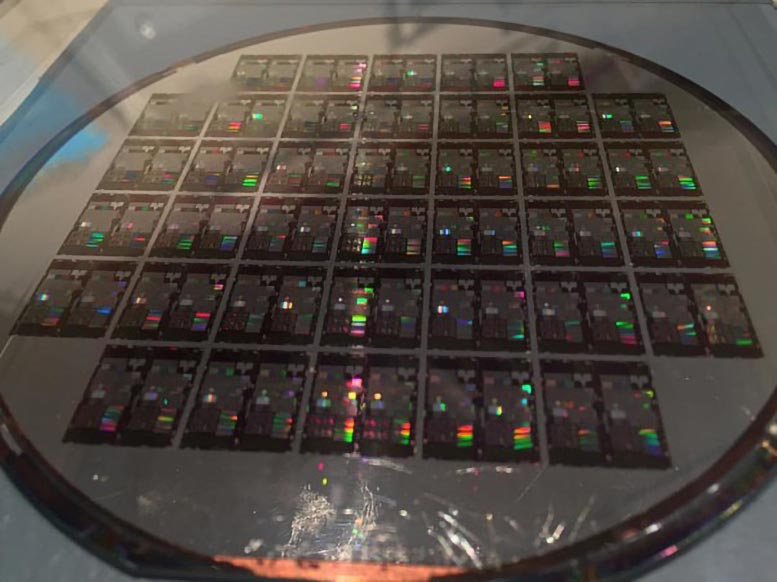
The fabrication started with silicon-on-insulator (SOI) wafers that have a 400 nm-thick silicon layer. Lithography and dry etching were followed by doping for metal oxide semiconductor capacitor (MOSCAP) devices and avalanche photodiodes (APDs). Next, selective growth of silicon and germanium was performed to form absorption, charge, and multiplication layers of the APD. III-V compound semiconductors (such as InP or GaAs) were then integrated onto the silicon platform using die-to-wafer bonding. A thin gate oxide layer (Al₂O₃ or HfO₂) was added to improve device efficiency, and finally a thick dielectric layer was deposited for encapsulation and thermal stability.
A New Frontier in AI Hardware
“The heterogeneous III/V-on-SOI platform provides all essential components required to develop photonic and optoelectronic computing architectures for AI/ML acceleration. This is particularly relevant for analog ML photonic accelerators, which use continuous analog values for data representation,” Dr. Tossoun notes.
This unique photonic platform can achieve wafer-scale integration of all of the various devices required to build an optical neural network on one single photonic chip, including active devices such as on-chip lasers and amplifiers, high-speed photodetectors, energy-efficient modulators, and non-volatile phase shifters. This enables the development of TONN-based accelerators with a footprint-energy efficiency that is 2.9 × 10² times greater than other photonic platforms and 1.4 × 10² times greater than the most advanced digital electronics.
Transforming AI with Light-Speed Efficiency
This is indeed a breakthrough technology for AI/ML acceleration, reducing energy costs, improving computational efficiency, and enabling future AI-driven applications in various fields. Going forward, this technology will enable datacenters to accommodate more AI workloads and help solve several optimization problems.
The platform will be addressing computational and energy challenges, paving the way for robust and sustainable AI accelerator hardware in the future!
Reference: “Large-Scale Integrated Photonic Device Platform for Energy-Efficient AI/ML Accelerators” by Bassem Tossoun, Xian Xiao, Stanley Cheung, Yuan Yuan, Yiwei Peng, Sudharsanan Srinivasan, George Giamougiannis, Zhihong Huang, Prerana Singaraju, Yanir London, Matěj Hejda, Sri Priya Sundararajan, Yingtao Hu, Zheng Gong, Jongseo Baek, Antoine Descos, Morten Kapusta, Fabian Böhm, Thomas Van Vaerenbergh, Marco Fiorentino, Geza Kurczveil, Di Liang and Raymond G. Beausoleil, 9 January 2025, IEEE Journal of Selected Topics in Quantum Electronics.
DOI: 10.1109/JSTQE.2025.3527904
Never miss a breakthrough: Join the SciTechDaily newsletter.
Follow us on Google and Google News.
1 Comment
nice topic thank you