

A new kind of memristor mimics how the brain learns by combining analog and digital behavior, offering a promising solution to the problem of AI “catastrophic forgetting.”
Unlike traditional deep neural networks that erase past knowledge when learning something new, this innovative component may retain previous learning, just like our own brains.
Understanding “Catastrophic Forgetting” in AI
Deep neural networks often face a challenge known as “catastrophic forgetting” – when they’re trained on a new task, they tend to overwrite what they previously learned. In contrast, the human brain seems to avoid this problem by adjusting how strongly synapses change during learning. Researchers refer to this ability as “metaplasticity,” the brain’s capacity to regulate its own plasticity. This dynamic adjustment is believed to help us learn new information without erasing old memories.
“Its unique properties allow the use of different switching modes to control the modulation of the memristor in such a way that stored information is not lost,” says Ilia Valov from the Peter Grünberg Institute (PGI-7) at Forschungszentrum Jülich.
What Makes Memristors Unique
As computer hardware advances, memristors, short for memory resistors, are emerging as promising components for neuromorphic computing. Unlike conventional resistors, memristors change their resistance based on the voltage applied to them, and crucially, they remember that resistance even after the power is turned off. This memory effect stems from physical changes within the device, such as atoms migrating and altering the structure of the electrodes.
“Memristive elements are considered ideal candidates for learning-capable, neuro-inspired computer components modeled on the brain,” says Ilia Valov.
The Challenge of Commercialization
Despite considerable progress and efforts, the commercialization of the components is progressing slower than expected. This is due in particular to an often high failure rate in production and a short lifespan of the products. In addition, they are sensitive to heat generation or mechanical influences, which can lead to frequent malfunctions during operation. “Basic research is therefore essential to better control nanoscale processes,” says Valov, who has been working in this field of memristors for many years. ”We need new materials and switching mechanisms to reduce the complexity of the systems and increase the range of functionalities.”
It is precisely in this regard that the chemist and materials scientist, together with German and Chinese colleagues, has now been able to report an important success: “We have discovered a fundamentally new electrochemical memristive mechanism that is chemically and electrically more stable,” explains Valov. The development has now been presented in the journal Nature Communications.
A New Mechanism for Memristors
“So far, two main mechanisms have been identified for the functioning of so-called bipolar memristors: ECM and VCM,” explains Valov. ECM stands for ‘Electrochemical Metallization’ and VCM for ‘Valence Change Mechanism’.
- ECM memristors form a metallic filament between the two electrodes—a tiny “conductive bridge” that alters electrical resistance and dissolves again when the voltage is reversed. The critical parameter here is the energy barrier (resistance) of the electrochemical reaction. This design allows for low switching voltages and fast switching times, but the generated states are variable and relatively short-lived.
- VCM memristors, on the other hand, do not change resistance through the movement of metal ions but rather through the movement of oxygen ions at the interface between the electrode and electrolyte—by modifying the so-called Schottky barrier. This process is comparatively stable but requires high switching voltages.
Combining the Best of Both Worlds
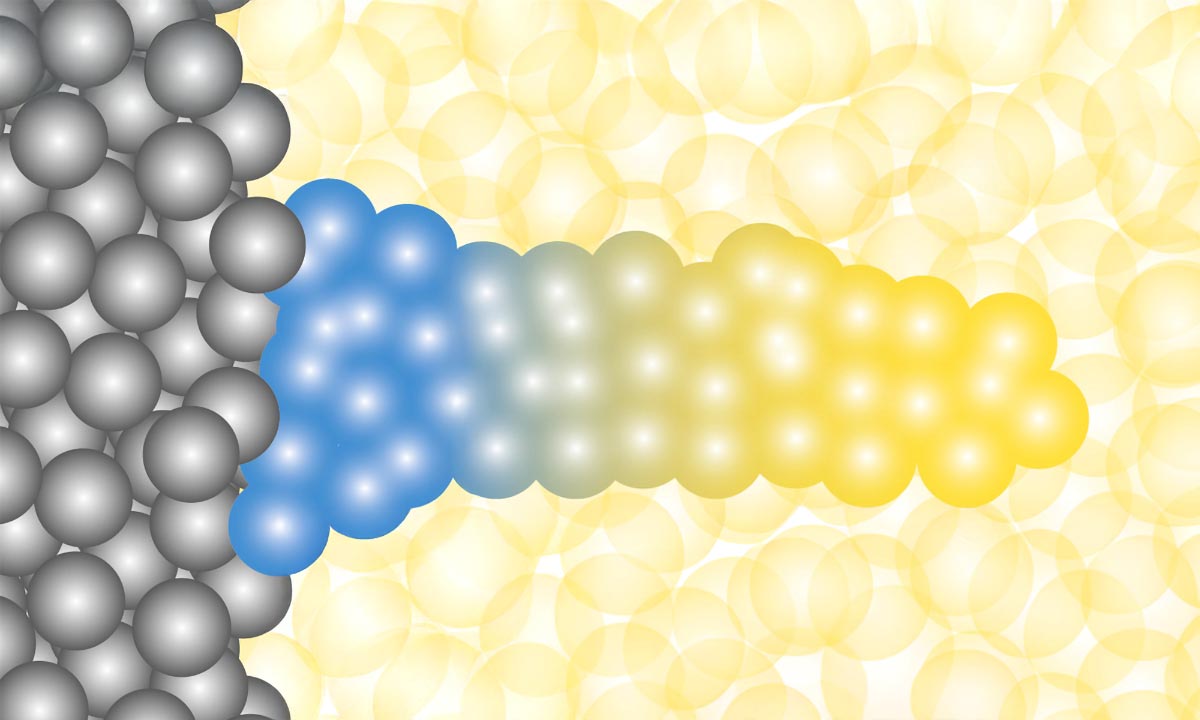
Each type of memristor has its own advantages and disadvantages. “We therefore considered designing a memristor that combines the benefits of both types,” explains Ilia Valov. Among experts, this was previously thought to be impossible. “Our new memristor is based on a completely different principle: it utilizes a filament made of metal oxides rather than a purely metallic one like ECM,” Valov explains. This filament is formed by the movement of oxygen and tantalum ions and is highly stable—it never fully dissolves. “You can think of it as a filament that always exists to some extent and is only chemically modified,” says Valov.
The novel switching mechanism is therefore very robust. The scientists also refer to it as a filament conductivity modification mechanism (FCM). Components based on this mechanism have several advantages: they are chemically and electrically more stable, more resistant to high temperatures, have a wider voltage window and require lower voltages to produce. As a result, fewer components burn out during the manufacturing process, the reject rate is lower and their lifespan is longer.
Toward Smarter, More Reliable AI
On top of that, the different oxidation states allow the memristor to operate in a binary and/or analog mode. While binary signals are digital and can only output two states, analog signals are continuous and can take on any intermediate value. This combination of analog and digital behavior is particularly interesting for neuromorphic chips because it can help to overcome the problem of “catastrophic forgetting:” deep neural networks delete what they have learned when they are trained for a new task. This is because a new optimization simply overwrites a previous one.
The brain does not have this problem because it can apparently adjust the degree of synaptic change; experts are now also talking about a so-called “metaplasticity.” They suspect that it is only through these different degrees of plasticity that our brain can permanently learn new tasks without forgetting old content. The new ohmic memristor accomplishes something similar. “Its unique properties allow the use of different switching modes to control the modulation of the memristor in such a way that stored information is not lost,” says Valov.
From Simulation to Application
The researchers have already implemented the new memristive component in a model of an artificial neural network in a simulation. In several image data sets, the system achieved a high level of accuracy in pattern recognition. In the future, the team wants to look for other materials for memristors that might work even better and more stably than the version presented here. “Our results will further advance the development of electronics for ‘computation-in-memory’ applications,” Valov is certain.
Reference: “Electrochemical ohmic memristors for continual learning” by Shaochuan Chen, Zhen Yang, Heinrich Hartmann, Astrid Besmehn, Yuchao Yang and Ilia Valov, 8 March 2025, Nature Communications.
DOI: 10.1038/s41467-025-57543-w
Never miss a breakthrough: Join the SciTechDaily newsletter.
Follow us on Google and Google News.