
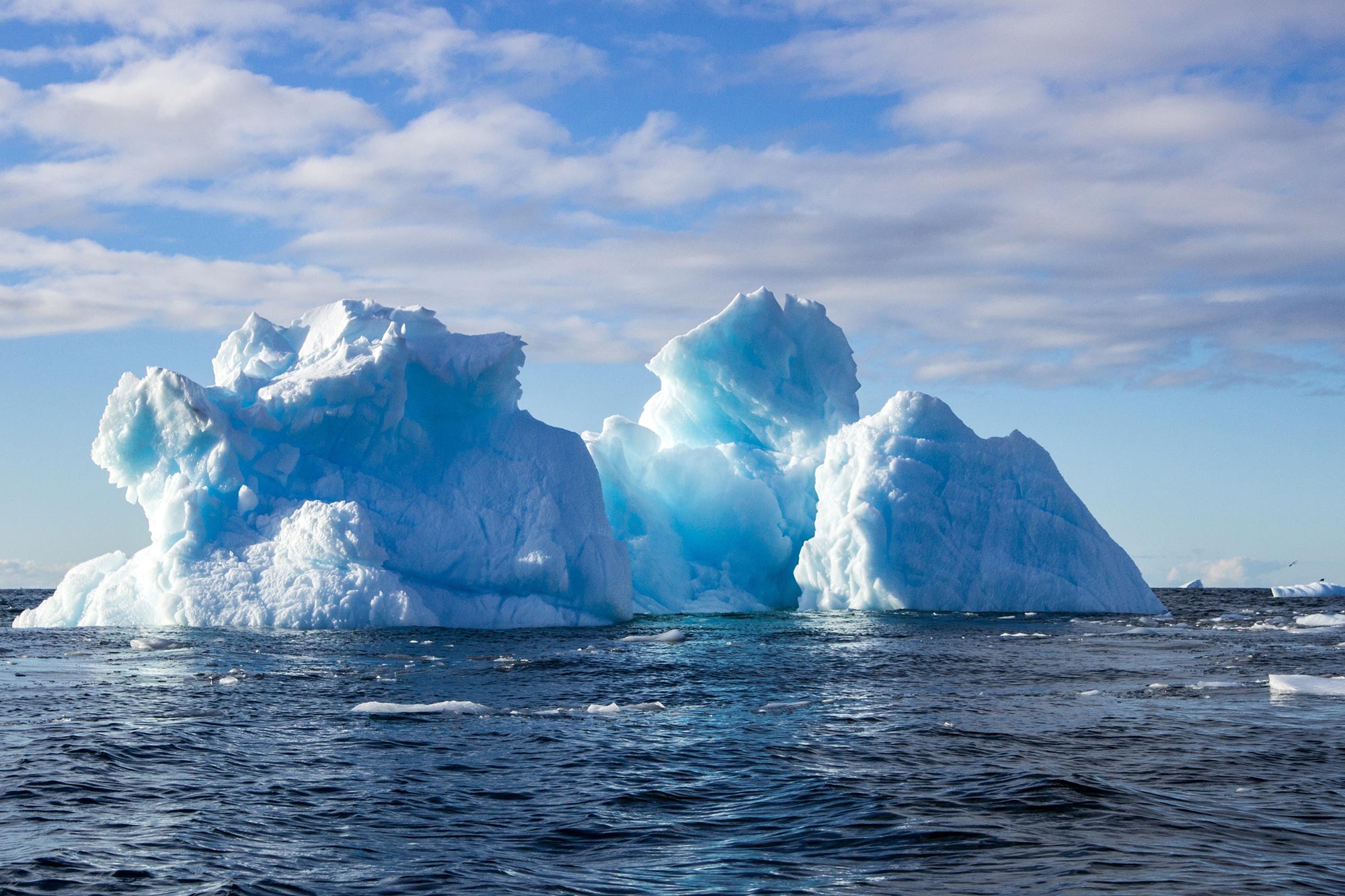
The future of Atlantic circulation will hinge on the balance between Greenland’s diminishing ice flux and its rising freshwater runoff.
A great armada entered the North Atlantic, launched from the cold shores of North America. But rather than ships off to war, this force was a fleet of icebergs. And the havoc it wrought was to the ocean current itself.
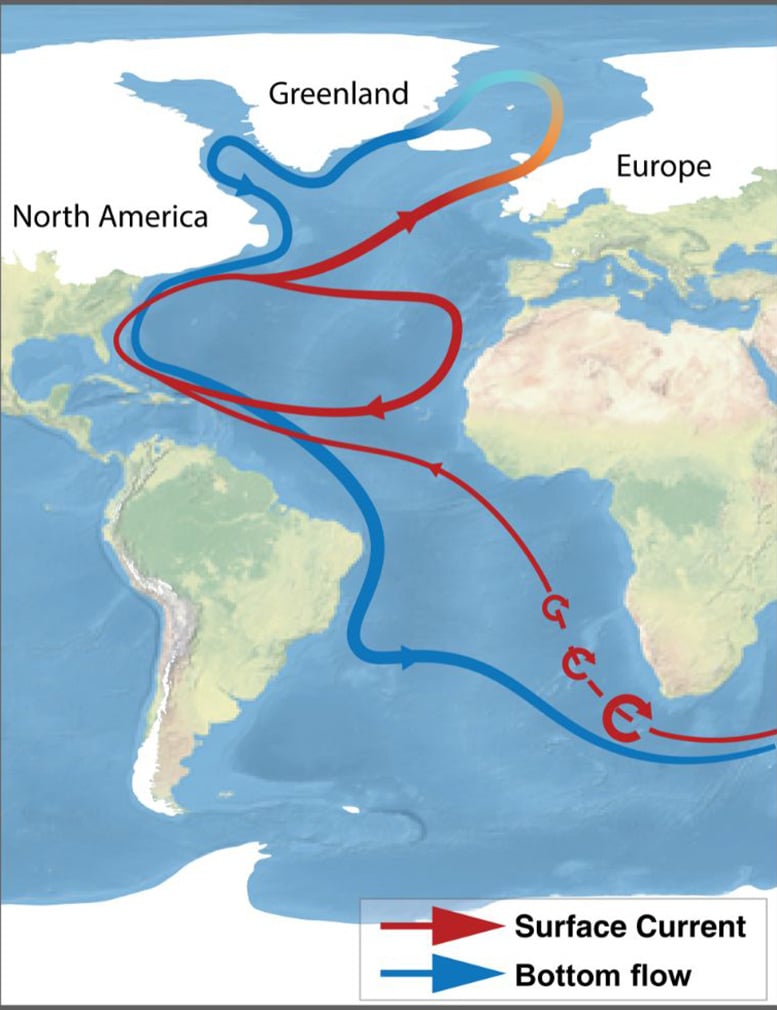
This scene describes a Heinrich Event, or a period of rapid iceberg discharge from the Laurentide Ice Sheet during the last glacial maximum. These episodes greatly weakened the system of ocean currents that circulate water within the Atlantic Ocean. The Atlantic Meridional Overturning Circulation, or AMOC for short, brings warm surface water north and cold deep water south. This oceanic conveyor belt is a major component of the global climate system, influencing marine ecosystems, weather patterns, and temperatures.
It’s also regarded as a potential tipping element of the Earth’s climate, meaning that a tiny perturbation could push the system to a point of no return. “That’s why a lot of people are worried about a potential collapse of the AMOC,” said Yuxin Zhou, a postdoctoral researcher in the University of California, Santa Barbara’s Department of Earth Science. A weakened AMOC would have a global impact, dropping temperatures in the northern hemisphere and raising them in the south. We’d see dramatic cooling in western Europe and eastern North America, and changes in the tropical rain belt that impact the Amazon and central Africa.
Zhou compared the rate of icebergs coming from the Greenland Ice Sheet to ice flux during Heinrich Events, the last time the AMOC collapsed. He found that as Greenland’s ice sheet retreats inland, its iceberg calving likely will not persist long enough to completely derail the Atlantic circulation. That said, increased freshwater runoff and continued global warming remain threats to the circulation’s stability. The results were published on May 30 in the journal Science.
“I think that sometimes people are in such despair about the future of the climate that they just give up,” Zhou said. “This study is saying that there is still hope, and we should act with that in mind.”
Modern Concerns and Historical Context
The North Atlantic is the lynchpin of the AMOC. This is where surface water chills and sinks to the deep ocean, driving this marine conveyor belt, which is a component of the global current system. Adding cold freshwater to the North Atlantic can disrupt this process, a frightening prospect for human society.
Scientists have a number of ways to predict how the AMOC will evolve in the future, including modern observations, statistical analyses, and computational models. But the ocean is vast and complex, making it difficult to capture many of its nuances in studies.
Zhou went back in history to study the most recent period when the AMOC was severely weakened — from 68,000 to 16,000 years ago, during the last glacial period. During cooler periods there is more water locked up in ice sheets, creating a reservoir for quickly flushing the ocean with freshwater in the form of icebergs or runoff. Scientists call these episodes Heinrich Events when they came from the Laurentide Ice Sheet. “Today it does not exist. But it used to cover northern North America and was kilometers thick in New York City,” Zhou said.

Comparing these Heinrich Events to the current melting in Greenland enabled Zhou to predict how current trends might change the AMOC in the future. Icebergs bring larger sediment out to sea than water or wind, a signature that geologist Hartmut Heinrich noticed in seafloor cores in the North Atlantic. To estimate how much ice each Heinrich Event released, Yuxin analyzed the amount of thorium-230 found in these sediments. This radioactive element is formed from the decay of naturally occurring uranium in seawater. Unlike uranium, thorium doesn’t dissolve well in water, so it precipitates out on particles in the water column. Because thorium-230 is produced at a steady rate, more sediment flux dilutes its concentration. Working in reverse: Less thorium means more sediment raining down, carried by more icebergs.
Future Projections and Hope
While this technique has been used before, Zhou is the first to compare the melting rate of icebergs during Heinrich Events to current trends and projections for Greenland’s ice sheet. Zhou discovered that Greenland’s predicted ice outflow is on par with a mid-range Heinrich Event. And what are the effects of a mid-range Heinrich Event?
“Dramatic,” Zhou replied. “It can be bad.”
“This is surprising, and people should be worried. But — and this is a big ‘but’ — during Heinrich Events, the AMOC was already moderately weakened before all the icebergs came in,” he said. “In contrast, the circulation is very vigorous right now.” This difference in initial state is cause for some relief.
Heinrich Events also lasted for tens to hundreds of years. In contrast, the Industrial Revolution only began around the late 18th century, with carbon emissions ramping up much later. “It is possible that we simply haven’t screwed up badly enough for long enough for it to really mess up the AMOC,” Zhou remarked.
There’s another nuance to the story. Not all melting has the same effect on the Atlantic circulation. Freshwater released as icebergs has a much larger impact on the AMOC than runoff, which is released after melting on land. Icebergs can cool the surrounding seawater, causing it to freeze into sea ice. Ironically, this ice layer acts as a blanket, keeping the ocean surface warm and preventing it from plunging down to the depths and driving the Atlantic circulation. What’s more, icebergs travel much farther out to sea than runoff, delivering freshwater to the regions where this deepwater formation occurs.
Scientists on the Intergovernmental Panel on Climate Change predict that the AMOC will weaken moderately over the 21st century, a trend similar to the effects of a Heinrich Event. However, Greenland’s ice discharge is projected to dwindle by that time as its ice sheet melts. This will cause its glaciers to recede inland, meaning they melt on land and release freshwater runoff rather than icebergs.
“This presents a tug-o-war between these two factors: the more disruptive but decreasing ice discharge and the less effective but accelerating runoff,” Zhou explained. “It’s going to be a competition, and the interplay between the two will determine the future of the AMOC.”
Zhou hopes to study the factors that caused Heinrich Events in the future. Some research suggests that each episode was preceded by ice discharge in the Pacific Ocean from the smaller Cordilleran Ice Sheet. Although this ice sheet hasn’t left any remnants, Zhou believes studying these Siku Events, as the latter are known, could provide more insight on global ocean circulation.
He’s also interested in the sediments around Antarctica. While Greenland’s location causes it to dominate the AMOC, the southern ice sheet is much larger, meaning it could have a greater influence on global sea level and salinity. Further, the West Antarctic Ice Sheet is marine-based, making it more susceptible to a feedback loop that could induce runaway melting. Zhou believes that applying the methodologies in this study to the Antarctic ice sheets could provide a better understanding of their future evolution and impacts.
“We have a lot of anxiety about how fast climate change is happening and how dramatic the changes could be,” Zhou said. “But this is a piece of good climate news that hopefully will dissuade people from climate doomism, and give people hope, because we do need hope to fight the climate crisis.”
Reference: “Heinrich event ice discharge and the fate of the Atlantic Meridional Overturning Circulation” by Yuxin Zhou and Jerry F. McManus, 30 May 2024, Science.
DOI: 10.1126/science.adh8369
Never miss a breakthrough: Join the SciTechDaily newsletter.
Follow us on Google and Google News.