
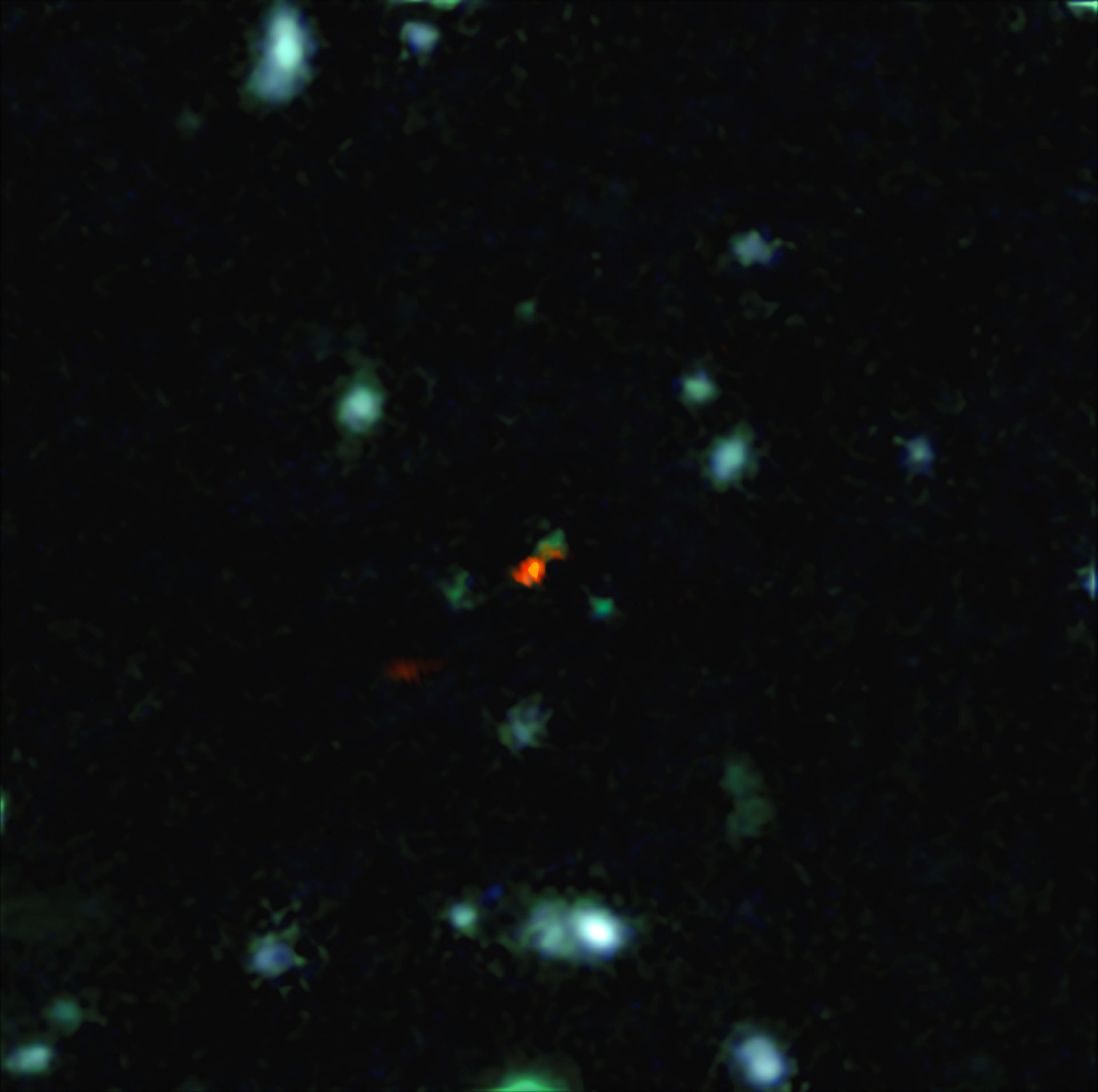
New observations from the Atacama Large Millimeter/submillimeter Array reveal the most distant clouds of star-forming gas yet found in normal galaxies in the early Universe.
The new images allow astronomers to start to see how the first galaxies were built up and how they cleared the cosmic fog during the era of reionization. This is the first time that such galaxies are seen as more than just faint blobs.
When the first galaxies started to form a few hundred million years after the Big Bang, the Universe was full of a fog of hydrogen gas. But as more and more brilliant sources — both stars and quasars powered by huge black holes — started to shine they cleared away the mist and made the Universe transparent to ultraviolet light. Astronomers call this the epoch of reionization, but little is known about these first galaxies, and up to now they have just been seen as very faint blobs. But now new observations using the power of ALMA are starting to change this.
A team of astronomers led by Roberto Maiolino (Cavendish Laboratory and Kavli Institute for Cosmology, University of Cambridge, United Kingdom) trained ALMA on galaxies that were known to be seen only about 800 million years after the Big Bang. The astronomers were not looking for the light from stars, but instead for the faint glow of ionized carbon coming from the clouds of gas from which the stars were forming. They wanted to study the interaction between a young generation of stars and the cold clumps that were assembling into these first galaxies.
They were also not looking for the extremely brilliant rare objects — such as quasars and galaxies with very high rates of star formation — that had been seen up to now. Instead, they concentrated on rather less dramatic, but much more common, galaxies that reionized the Universe and went on to turn into the bulk of the galaxies that we see around us now.
From one of the galaxies — given the label BDF 3299 — ALMA could pick up a faint but clear signal from the glowing carbon. However, this glow wasn’t coming from the center of the galaxy, but rather from one side.
Co-author Andrea Ferrara (Scuola Normale Superiore, Pisa, Italy) explains the significance of the new findings: “This is the most distant detection ever of this kind of emission from a ‘normal’ galaxy, seen less than one billion years after the Big Bang. It gives us the opportunity to watch the build-up of the first galaxies. For the first time, we are seeing early galaxies not merely as tiny blobs, but as objects with internal structure!”
The astronomers think that the off-center location of the glow is because the central clouds are being disrupted by the harsh environment created by the newly formed stars — both their intense radiation and the effects of supernova explosions — while the carbon glow is tracing fresh cold gas that is being accreted from the intergalactic medium.
By combining the new ALMA observations with computer simulations, it has been possible to understand in detail the key processes occurring within the first galaxies. The effects of the radiation from stars, the survival of molecular clouds, the escape of ionizing radiation, and the complex structure of the interstellar medium can now be calculated and compared with observation. BDF 3299 is likely to be a typical example of the galaxies responsible for reionization.
“We have been trying to understand the interstellar medium and the formation of the reionization sources for many years. Finally to be able to test predictions and hypotheses on real data from ALMA is an exciting moment and opens up a new set of questions. This type of observation will clarify many of the thorny problems we have with the formation of the first stars and galaxies in the Universe,” adds Andrea Ferrara.
Roberto Maiolino concludes: “This study would have simply been impossible without ALMA, as no other instrument could reach the sensitivity and spatial resolution required. Although this is one of the deepest ALMA observations so far it is still far from achieving its ultimate capabilities. In the future ALMA will image the fine structure of primordial galaxies and trace in detail the build-up of the very first galaxies.”
Reference: “The assembly of ‘normal’ galaxies at z ∼ 7 probed by ALMA” by R. Maiolino, S. Carniani, A. Fontana, L. Vallini, L. Pentericci, A. Ferrara, E. Vanzella, A. Grazian, S. Gallerani, M. Castellano, S. Cristiani, G. Brammer, P. Santini, J. Wagg and R. Williams, 30 June 2015, MNRAS.
DOI: 10.1093/mnras/stv1194
arXiv: 1502.06634
Never miss a breakthrough: Join the SciTechDaily newsletter.
Follow us on Google and Google News.