

Astronomers have identified the closest orbiting binary system of ultracool dwarfs, LP 413-53AB, with a record-breaking orbital period of 20.5 hours.
Astrophysicists from Northwestern University and the University of California San Diego have identified the tightest binary system ever observed among ultracool dwarfs.
The two stars are in such proximity that they complete a revolution around each other in less than one Earth day, meaning that each star’s “year” lasts a mere 20.5 hours.
The newly found system, LP 413-53AB, consists of a pair of ultracool dwarfs, which are very low-mass stars that emit light primarily in the infrared, thus making them invisible to the human eye. Despite this, they are one of the most abundant types of stars in the universe.
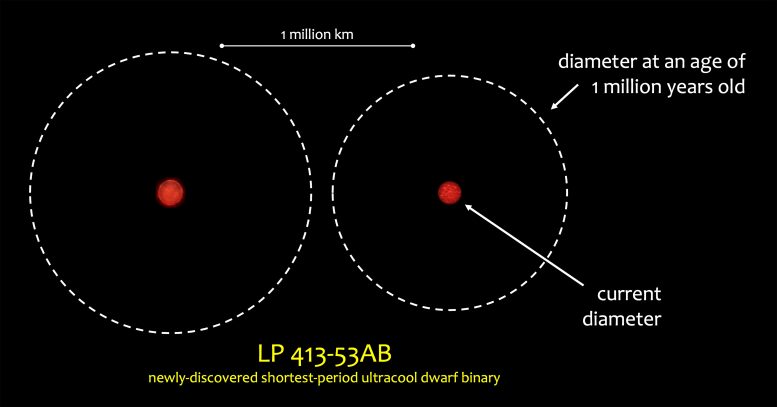
Previously, astronomers had only detected three short-period ultracool dwarf binary systems, all of which are relatively young — up to 40 million years old. LP 413-53AB is estimated to be billions of years old — similar age to our sun — but has an orbital period that is at least three times shorter than the all ultracool dwarf binaries discovered so far.
Breakthrough in Binary System Observation
“It’s exciting to discover such an extreme system,” said Chih-Chun “Dino” Hsu, a Northwestern astrophysicist who led the study. “In principle, we knew these systems should exist, but no such systems had been identified yet.”
Hsu recently presented the research during a press briefing at the 241st Meeting of the American Astronomical Society in Seattle as part of a session on “Stars and Their Activity.”
Hsu is a postdoctoral researcher in physics and astronomy at Northwestern’s Weinberg College of Arts and Sciences and a member of Northwestern’s Center for Interdisciplinary Exploration and Research in Astrophysics (CIERA). He began this study while a Ph.D. student at UC San Diego, where he was advised by Professor Adam Burgasser.
The team first discovered the strange binary system while exploring archival data. Hsu developed an algorithm that can model a star based on its spectral data. By analyzing the spectrum of light emitted from a star, astrophysicists can determine the star’s chemical composition, temperature, gravity and rotation. This analysis also shows the star’s motion as it moves toward and away from the observer, known as radial velocity.
When examining the spectral data of LP 413-53AB, Hsu noticed something strange. Early observations caught the system when the stars were roughly aligned and their spectral lines overlapped, leading Hsu to believe it was just one star. But as the stars moved in their orbit, the spectral lines shifted in opposite directions, splitting into pairs in later spectral data. Hsu realized there were actually two stars locked into an incredibly tight binary.
Using powerful telescopes at the W.M. Keck Observatory, Hsu decided to observe the phenomenon for himself. On March 13, 2022, the team turned the telescopes toward the constellation Taurus, where the binary system is located, and observed it for two hours. Then, they followed up with more observations in July, October and December.
“When we were making this measurement, we could see things changing over a couple of minutes of observation,” Burgasser said. “Most binaries we follow have orbit periods of years. So, you get a measurement every few months. Then, after a while, you can piece together the puzzle. With this system, we could see the spectral lines moving apart in real time. It’s amazing to see something happen in the universe on a human time scale.”
The observations confirmed what Hsu’s model predicted. The distance between the two stars is about 1% of the distance between the Earth and the sun. “This is remarkable, because when they were young, something like 1 million years old, these stars would have been on top of each other,” said Burgasser.
Formation Theories and Future Research
The team speculates that the stars either migrated toward each other as they evolved, or they could have come together after the ejection of a third — now lost — stellar member. More observations are needed to test these ideas.
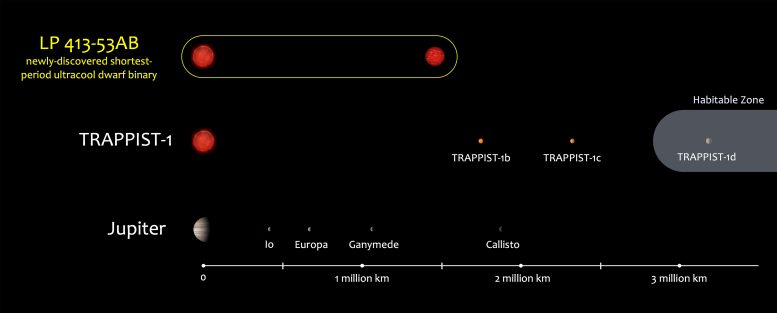
Hsu also said that by studying similar star systems researchers can learn more about potentially habitable planets beyond Earth. Ultracool dwarfs are much fainter and dimmer than the sun, so any worlds with liquid water on their surfaces — a crucial ingredient to form and sustain life — would need to be much closer to the star. However, for LP 413-53AB, the habitable zone distance happens to be the same as the stellar orbit, making it impossible to form habitable planets in this system.
“These ultracool dwarfs are neighbors of our sun,” Hsu said. “To identify potentially habitable hosts, it’s helpful to start with our nearby neighbors. But if close binaries are common among ultracool dwarfs, there may be few habitable worlds to be found.”
To fully explore these scenarios, Hsu, Burgasser and their collaborators hope to pinpoint more ultracool dwarf binary systems to create a full data sample. New observational data could help strengthen theoretical models for binary-star formation and evolution. Until now, however, finding ultracool binary stars has remained a rare feat.
“These systems are rare,” said Chris Theissen, study co-author and a Chancellor’s Postdoctoral Fellow at UC San Diego. “But we don’t know whether they are rare because they rarely exist or because we just don’t find them. That’s an open-ended question. Now we have one data point that we can start building on. This data had been sitting in the archive for a long time. Dino’s tool will enable us to look for more binaries like this.”
Meeting: 241st meeting of the American Astronomical Society
Never miss a breakthrough: Join the SciTechDaily newsletter.
Follow us on Google and Google News.