

Close Menu
    Facebook X (Twitter) Instagram
    SciTechDaily
    • Biology
    • Chemistry
    • Earth
    • Health
    • Physics
    • Science
    • Space
    • Technology
    Facebook X (Twitter) Pinterest YouTube RSS
    SciTechDaily
    Home»Technology»An Uncrackable Combination: Invisible Ink and Artificial Intelligence
    Technology

    An Uncrackable Combination: Invisible Ink and Artificial Intelligence

    By American Chemical SocietyMay 12, 2021No Comments3 Mins Read
    Facebook Twitter Pinterest Telegram LinkedIn WhatsApp Email Reddit
    Share
    Facebook Twitter LinkedIn Pinterest Telegram Email Reddit
    Coded Message Cybersecurity Concept
    The combination of invisible ink and artificial intelligence is presented as an uncrackable solution for security.

    Researchers created a new form of secure messaging by combining carbon nanoparticle-based invisible ink with AI-powered decryption. The messages only appear under UV light and can’t be cracked without the trained algorithm.

    Coded messages in invisible ink sound like something only found in espionage books, but in real life, they can have important security purposes. Yet, they can be cracked if their encryption is predictable. Now, researchers reporting in ACS Applied Materials & Interfaces have printed complexly encoded data with normal ink and a carbon nanoparticle-based invisible ink, requiring both UV light and a computer that has been taught the code to reveal the correct messages.

    Even as electronic records advance, paper is still a common way to preserve data. Invisible ink can hide classified economic, commercial, or military information from prying eyes, but many popular inks contain toxic compounds or can be seen with predictable methods, such as light, heat, or chemicals. Carbon nanoparticles, which have low toxicity, can be essentially invisible under ambient lighting but can create vibrant images when exposed to ultraviolet (UV) light — a modern take on invisible ink.

    In addition, advances in artificial intelligence (AI) models — made by networks of processing algorithms that learn how to handle complex information — can ensure that messages are only decipherable on properly trained computers. So, Weiwei Zhao, Kang Li, Jie Xu, and colleagues wanted to train an AI model to identify and decrypt symbols printed in a fluorescent carbon nanoparticle ink, revealing hidden messages when exposed to UV light.
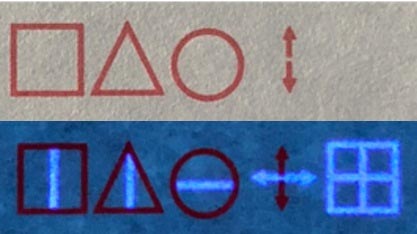
    Uncrackable Combination of Invisible Ink and Artificial Intelligence
    With regular ink, a computer trained with the codebook decodes “STOP” (top); when a UV light is shown on the paper, the invisible ink is exposed, and the real message is revealed as “BEGIN” (bottom). Credit: Adapted from ACS Applied Materials & Interfaces 2021, DOI: 10.1021/acsami.1c01179

    How the Invisible Ink and AI Codebook Work

    The researchers made carbon nanoparticles from citric acid and cysteine, which they diluted with water to create an invisible ink that appeared blue when exposed to UV light. The team loaded the solution into an ink cartridge and printed a series of simple symbols onto paper with an inkjet printer. Then, they taught an AI model, composed of multiple algorithms, to recognize symbols illuminated by UV light and decode them using a special codebook. Finally, they tested the AI model’s ability to decode messages printed using a combination of both regular red ink and the UV fluorescent ink.

    With 100% accuracy, the AI model read the regular ink symbols as “STOP,” but when a UV light was shown on the writing, the invisible ink illustrated the desired message “BEGIN.” Because these algorithms can notice minute modifications in symbols, this approach has the potential to encrypt messages securely using hundreds of different unpredictable symbols, the researchers say.

    Reference: “Paper Information Recording and Security Protection Using Invisible Ink and Artificial Intelligence” by Yunhuan Yuan, Jian Shao, Mao Zhong, Haoran Wang, Chen Zhang, Jun Wei, Kang Li, Jie Xu and Weiwei Zhao, 20 April 2021, ACS Applied Materials & Interfaces.
    DOI: 10.1021/acsami.1c01179

    The authors acknowledge funding from the Shenzhen Peacock Team Plan and the Bureau of Industry and Information Technology of Shenzhen through the Graphene Manufacturing Innovation Center (201901161514).

    Never miss a breakthrough: Join the SciTechDaily newsletter.
    Follow us on Google and Google News.

    American Chemical Society Artificial Intelligence Cybersecurity
    Share. Facebook Twitter Pinterest LinkedIn Email Reddit

    Related Articles

    New Research Warns: AI Needs To Be Better Understood and Managed

    Will Artificial Intelligence End Civilization?

    Hair Regeneration: AI Helps Design Baldness Treatment That Works Better Than Testosterone or Minoxidil

    AI-Driven Dynamic Face Mask Adapts To Exercise and Pollution Levels

    Cybersecurity Researchers Build a Better “Canary Trap” – Using AI to Generate Fake Documents

    A New Software Tool – Fawkes – Cloaks Your Images to Trick Facial Recognition Algorithms

    New “Cyborg” Technology Could Enable Merger of Humans and AI

    Princeton Has Developed a Technique for Tracking Online Foreign Misinformation Campaigns in Real Time

    Which Face is Real? Using Frequency Analysis to Identify “Deep-Fake” Images

    Leave A Reply Cancel Reply

    • Facebook
    • Twitter
    • Pinterest
    • YouTube

    Don't Miss a Discovery

    Subscribe for the Latest in Science & Tech!

    Trending News

    Enormous Prehistoric Insects Puzzle Scientists

    Scientists Develop Bioengineered Chewing Gum That Could Help Fight Oral Cancer

    After 37 Years, the World’s Longest-Running Soil Warming Experiment Uncovers a Startling Climate Secret

    NASA Satellite Captures First-Ever High-Res View of Massive Pacific Tsunami

    ADHD Isn’t Just a Deficit: Study Reveals Powerful Hidden Strengths

    Scientists Discover Stem Cells That Could Regrow Teeth and Bone

    Early Cannabis Use May Stall Key Brain Skills in Teens

    Popular Vitamin D Supplement Has “Previously Unknown” Negative Effect, Study Finds

    Follow SciTechDaily
    • Facebook
    • Twitter
    • YouTube
    • Pinterest
    • Newsletter
    • RSS
    SciTech News
    • Biology News
    • Chemistry News
    • Earth News
    • Health News
    • Physics News
    • Science News
    • Space News
    • Technology News
    Recent Posts
    • Scientists Identify Two Simple Treatments for Cancer-Related Cognitive Impairment
    • Omega-3 Supplements Linked to Cognitive Decline in Surprising New Study
    • One in Five at Risk: Scientists Identify a Hidden Blood Particle Linked to Higher Risk of Stroke and Death
    • Darwin’s Islands Still Evolving: Giant Daisies Rewrite the Rules of Evolution
    • Ancient Document Confirms “Legendary” African King Actually Existed
    Copyright © 1998 - 2026 SciTechDaily. All Rights Reserved.
    • Science News
    • About
    • Contact
    • Editorial Board
    • Privacy Policy
    • Terms of Use

    Type above and press Enter to search. Press Esc to cancel.