
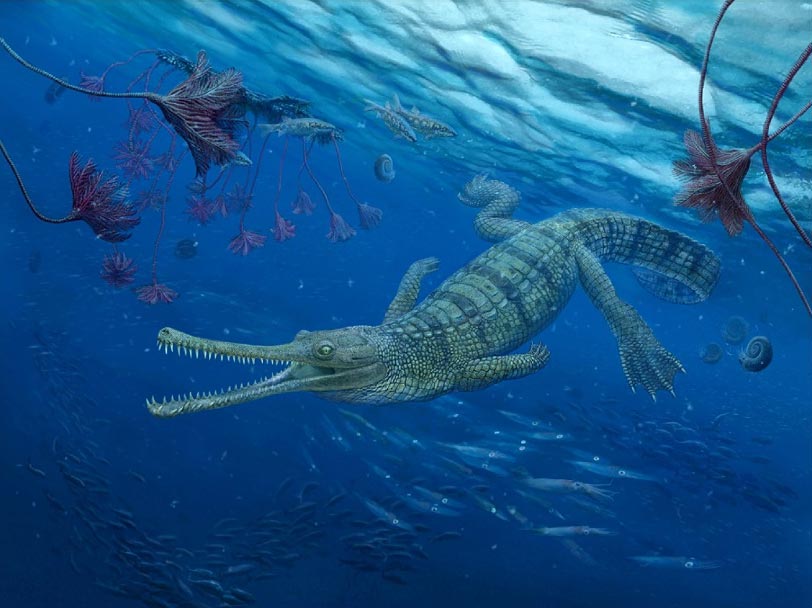
New fossil analysis reveals diverse behaviors and forms among Jurassic-era teleosauroids, including a new species from Thailand.
Scientists probing a prehistoric crocodile group’s shadowy past have discovered a timeless truth – pore over anyone’s family tree long enough, and something surprising will emerge.
Despite 300 years of research, and a recent renaissance in the study of their biological make-up, the mysterious, marauding teleosauroids have remained enduringly elusive.
Scientific understanding of this distant cousin of present-day long-snouted gharials has been hampered by a poor grasp of their evolutionary journey – until now.
Unknown Species
Researchers from the University of Edinburgh have identified one previously unknown species of teleosauroid and seven of its close relatives – part of a group that dominated Jurassic coastlines 190 to 120 million years ago.
Their analysis offers tantalizing glimpses of how teleosauroids adapted to the momentous changes that occurred during the Jurassic period, as the earth’s seas experienced many changes in temperature.
“Our study just scratches the surface of teleosauroid evolution but the findings are remarkable, raising interesting questions about their behaviour and adaptability. These creatures represented some of the most successful prehistoric crocodylomorphs during the Jurassic period and there is so much more to learn about them.”
Dr. Michela M. JohnsonStudy lead, School of GeoSciences, University of Edinburgh
The study reveals that not all teleosauroids were engaged in cut and thrust lifestyles, snapping at other reptiles and fish from the seas and swamps near the coast.
Instead, they were a complex, diverse group that were able to exploit different habitats and seek out a variety of food sources. Their physical make-up is also more diverse than was previously understood, the scientists say.
Previous research had provided insights into the origins and evolution of this fossilized croc’s whale-like relatives metriorhynchids, but less was known about teleosauroids.
500 Fossils
To address this, the expert team of paleontologists examined more than 500 fossils from more than 25 institutions around the world.
Cutting-edge computer software enabled the team to glean swathes of revealing data regarding their anatomical similarities and differences, by examining the entire skeleton, teeth, and bony armor, which indicated whether species were closely related or not.
This information enabled the team to create an up-to-date family tree of the teleosauroids group from which emerged two new large groups, whose anatomy, abundance, habitat, geography, and feeding styles differ from one another significantly.
The first group, teleosaurids, were more flexible in terms of their habitat and feeding. The second group known as machimosaurids – which included the fearsome turtle crushers, Lemmysuchus and Machimosaurus – were more abundant and widespread.
Curious Features
Names given by the team to seven newly described fossils, found in both teleosaurids and machimosaurids, reflect a curious range of anatomical features – among them Proexochokefalos, meaning ‘large head with big tuberosities’ and Plagiophthalmosuchus, the ‘side-eyed crocodile’.
There are even hints of their diverse behavioral characteristics and unique locations – Charitomenosuchus, meaning ‘graceful crocodile’ and Andrianavoay, the ‘noble crocodile’ from Madagascar.
Researchers have named the newly discovered species, Indosinosuchus kalasinensis, after the Kalasin Province in Thailand, where the fossil – now housed in Maha Sarakham University – was found.
The recognition of I. kalasinensis shows that at least two species were living in similar freshwater habitats during the Late Jurassic – an impressive feat as teleosauroids, with the exception of Machimosaurus, were becoming rare during this time.
“The same way family trees of our own ancestors and cousins tell us about our history, this huge new family tree of teleosauroids clarifies their evolution. They were some of the most diverse and important animals in the Jurassic oceans, and would have been familiar sights along the coastlines for tens of millions of years.”
Professor Steve Brusatte, School of GeoSciences, University of EdinburghSchool of GeoSciences, University of Edinburgh
Reference: “The phylogenetics of Teleosauroidea (Crocodylomorpha, Thalattosuchia) and implications for their ecology and evolution” by Michela M. Johnson, Mark T. Young and Stephen L. Brusatte, 8 October 2020, PeerJ.
DOI: 10.7717/peerj.9808
The study, published in the scientific journal PeerJ, was funded by the Natural Sciences and Engineering Council of Canada, SYNTHESYS Project and Leverhulme Trust Research. The Palaeontological Association and Paleontological Society provided travel grants.
Never miss a breakthrough: Join the SciTechDaily newsletter.
Follow us on Google and Google News.