
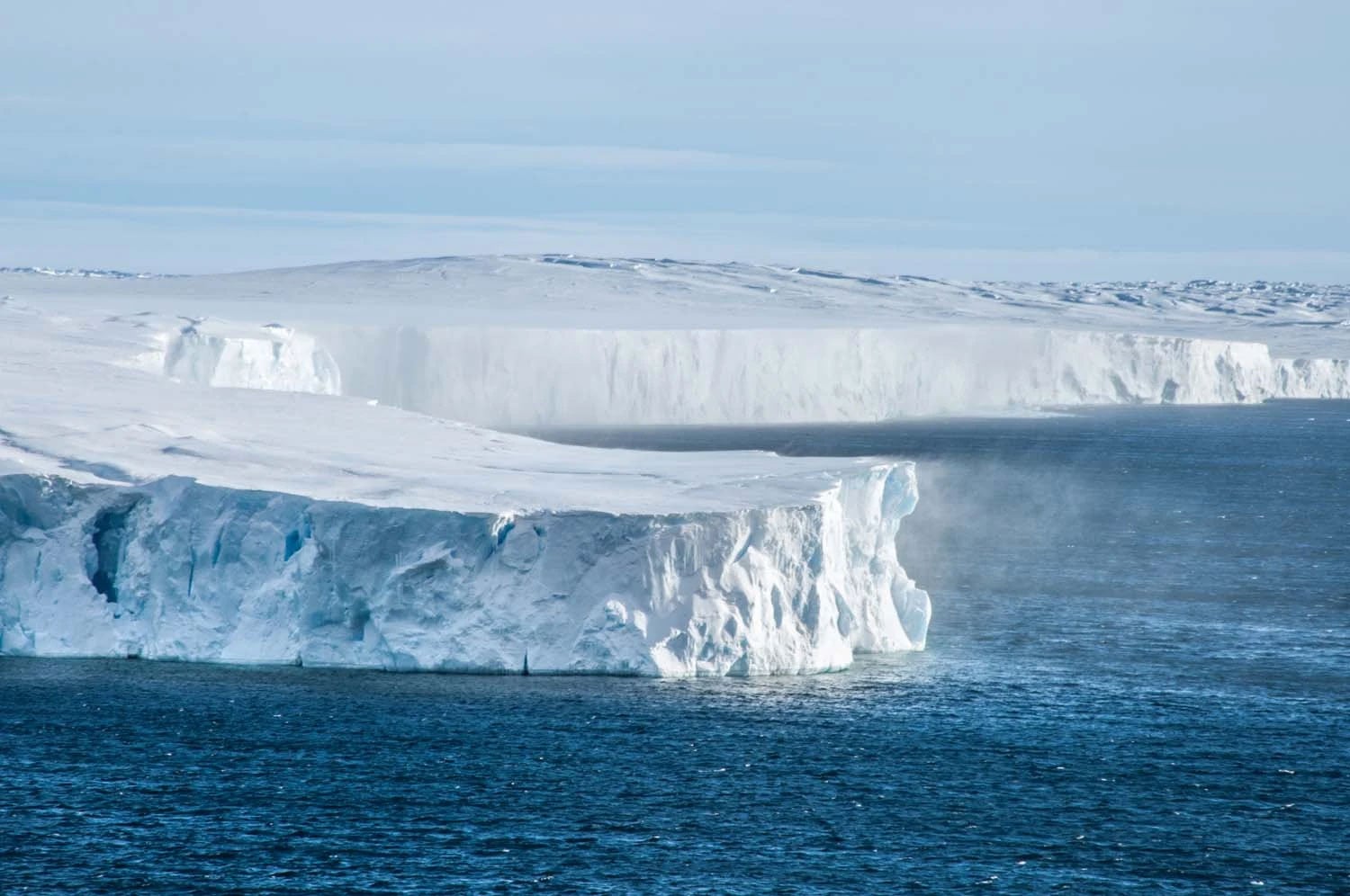
A new study suggests Antarctic ice loss may be reliably projected over the next several decades.
Scientists say the next 30 to 50 years could be a crucial period for understanding and preparing for Antarctic ice loss and its impact on rising sea levels.
A new study published in Nature and led by Monash University researcher Dr. Felicity McCormack of Securing Antarctica’s Environmental Future (SAEF) examined how reliably scientists can forecast Antarctic ice loss and what that means for future sea level rise.
According to reports from the Intergovernmental Panel on Climate Change (IPCC), global sea levels could rise by more than 2 meters (about 6.6 feet) by 2100 under high-emissions scenarios if the Antarctic Ice Sheet undergoes large-scale collapse.
Such an increase would have major consequences. It could expose one-quarter of Australian homes to flooding, make large areas of Pacific sovereign territory uninhabitable, and force hundreds of millions of people worldwide to relocate. The resulting humanitarian and economic impacts would be among the most severe in history.
Despite the risks, significant uncertainty remains about how sea levels will change between now and 2100. Much of that uncertainty stems from the challenge of forecasting Antarctic ice loss. In a worst-case scenario, the IPCC has projected that Antarctica’s contribution to sea level rise could nearly double over the next 30 years. Until now, however, researchers lacked a robust estimate of Antarctica’s likely contribution over the coming decades, which is the period most relevant for coastal planning and policymaking.
A Predictable Window Through Mid-Century
The study explored how much ice Antarctica may lose during the next 30 to 50 years and whether those losses can be predicted accurately enough to help governments prepare. Researchers evaluated the reliability of ice sheet models used to project future sea level rise during this near-term period.
The findings indicate that Antarctic ice loss remains relatively predictable through the middle of the century, allowing scientists to make more dependable estimates of future sea level rise.
“If ice sheet models accurately reproduce the rates of ice loss we observe today, we can have confidence in using those same models to reliably predict Antarctica’s contribution to sea level rise over the next 30 to 50 years. Accurately predicting how much and how fast global sea levels will rise offers vital information for future coastal planning and government policy,” said Dr. McCormack.
The study found that this predictability decreases later in the century as processes that can rapidly accelerate ice loss become more likely. One example involves ice resting on bedrock below sea level. Once retreat begins in these regions, it can be difficult to stop and may trigger much greater ice loss than near-term climate projections alone would indicate.
A Critical Opportunity for Climate Action
“The research findings provide a roadmap for future climate planning. By improving how ice sheet models represent critical physical processes that lead to rapid ice sheet retreat, we can narrow the deep uncertainty that hampers reliability of long-term sea level rise projections,” Dr. McCormack said.
Researchers concluded that a valuable opportunity for climate action still exists. They found that sea level rise pathways over the next three decades are comparatively well constrained, making this period especially important for adaptation planning.
Professor Steven Chown, Director of SAEF, said the findings highlight the need to act now and invest in stronger observation systems.
“The predictability identified in this research does not reduce long-term risk; instead, it provides a defined period in which to act with greater confidence. Improvements in observational systems and ice sheet model developments will directly translate into more reliable sea level projections for short-term planning horizons,” Professor Chown said.
Implications for the Indo-Pacific Region
Professor Chown said Australia is in a strong position to help regional partners apply these findings through practical adaptation strategies.
“Pacific Island governments require reliable near-term projections to make decisions about infrastructure, community relocation, and long-term land use. Engagement on sea level science and adaptation planning represents a foreign policy opportunity and a regional responsibility,” Professor Chown said.
Dr. McCormack added that developing a clear process for incorporating ice sheet model projections into sea level rise policies is essential.
“When models replicate present-day observations of Antarctic ice mass loss, their projected ice mass loss rates over the coming several decades provide a reliable foundation for planning and adaptation, while longer-term sea level rise uncertainties highlight the need for ongoing development,” Dr. McCormack said.
The researchers suggest that separating Antarctic projections into two distinct timeframes, one focused on relatively predictable near-term ice loss and another on longer-term changes driven by complex feedbacks, could provide policymakers with a stronger framework for future decisions.
Reference: “Emergent decadal predictability in Antarctic contribution to sea-level rise” by Felicity S. McCormack, Mathieu Morlighem, Frank Pattyn, Alexander A. Robel and Hélène Seroussi, 17 June 2026, Nature.
DOI: 10.1038/s41586-026-10614-4
Never miss a breakthrough: Join the SciTechDaily newsletter.
Follow us on Google and Google News.
8 Comments
I’m sorry folks. If you spend all your time whining about stopping people from living the lives to which they are accustomed AND never talk about mitigation measures you are overtly saying you do not believe the warming gospel you preach. And if you don’t people won’t take you seriously and try to reduce their carbon emissions. Certainly politicians get the message. They see it as a mechanism to control people. And they see no need to try to mitigate it. You are fighting the wrong fight. Fight to develop means to cope with the inevitable. You MAY get more success.
{^_^}
Agreed JDow. Didn’t we hear this all before from Al Gore? Sheesh
Just because the model can predict what happened in the past does not mean it can predict the future. The future of West Antarctica and other areas in East Antarctica such as the Aurora subglatial basin will be subject to the force of gravity in ways it has never been. The ice has accumulated so deep it cannot support its own weight without forming an arch to bedrock. Marine ice Cliff instability will break that Arch. The combination of top-down gravitational collapse and bottom up buoyancy forced calving will demolish the West Antarctic ice sheet much faster than the models predict because they don’t include this process.
When the sea rises it will do so rapidly making billions of people homeless and destitute. That’s a prescription for nuclear war.
Once again, an assertion without any supporting evidence. What makes you think it will happen rapidly? Can you provide a citation for your claim? Or even a logical explanation for why you may believe that? As to nuclear war, even that is pushing the envelope. Are you proposing that the homeless and destitute will use H-bombs that they have in their homes? Or that displaced people in big coastal cities think it would be wise to contaminate agricultural fields with radioactivity and reduce the available food supply? If you want to be taken seriously you need to provide some facts and logic to support your claims, not just spout off about fantastic claims.
“IF ice sheet models accurately reproduce the rates of ice loss we observe today, we can have confidence in using those same models to reliably predict Antarctica’s contribution to sea level rise over the next 30 to 50 years.”
That is true. However, what isn’t explicitly stated is the improbability that everything will stay the same for the “next 30 to 50 years.” The reason we aren’t all wealthy from betting on the outcome of future events is because of Murphy’s Law — “If something can go wrong, it will.” While the current trend is for warming, there is no guarantee that it WILL continue! There is no way, other than waiting for the future to unroll, that any alarmist can prove that what has not yet happened, will happen.
Also, the question that wasn’t answered, but should have been, is, “Do ice sheet models accurately reproduce the rates of ice loss we observe today?” How many readers are aware that almost all the Antarctic melting is restricted to the geothermally active West Antarctica? If that melting is driven by unpredictable, episodic subglacial or submarine volcanic activity, as is suggested by some, how can we actually predict the future of the glacial ice?
IPCC models do not include all the possible physical forces acting on the ice. They deliberately exclude Marine Ice Cliff Instability because they don’t have a good understanding of it. That process, driven by gravity, could destroy the West Antarctic Ice Sheet in less than a year. It destroyed Hektoria Glacier in 2 months.
“…, could destroy the West Antarctic Ice Sheet in less than a year.”
Can you provide a citation for that assertion? This website doesn’t ban URLs as long as they are on topic, unlike the mainstream news websites. So feel free to provide a URL for your otherwise unsupported claim.