
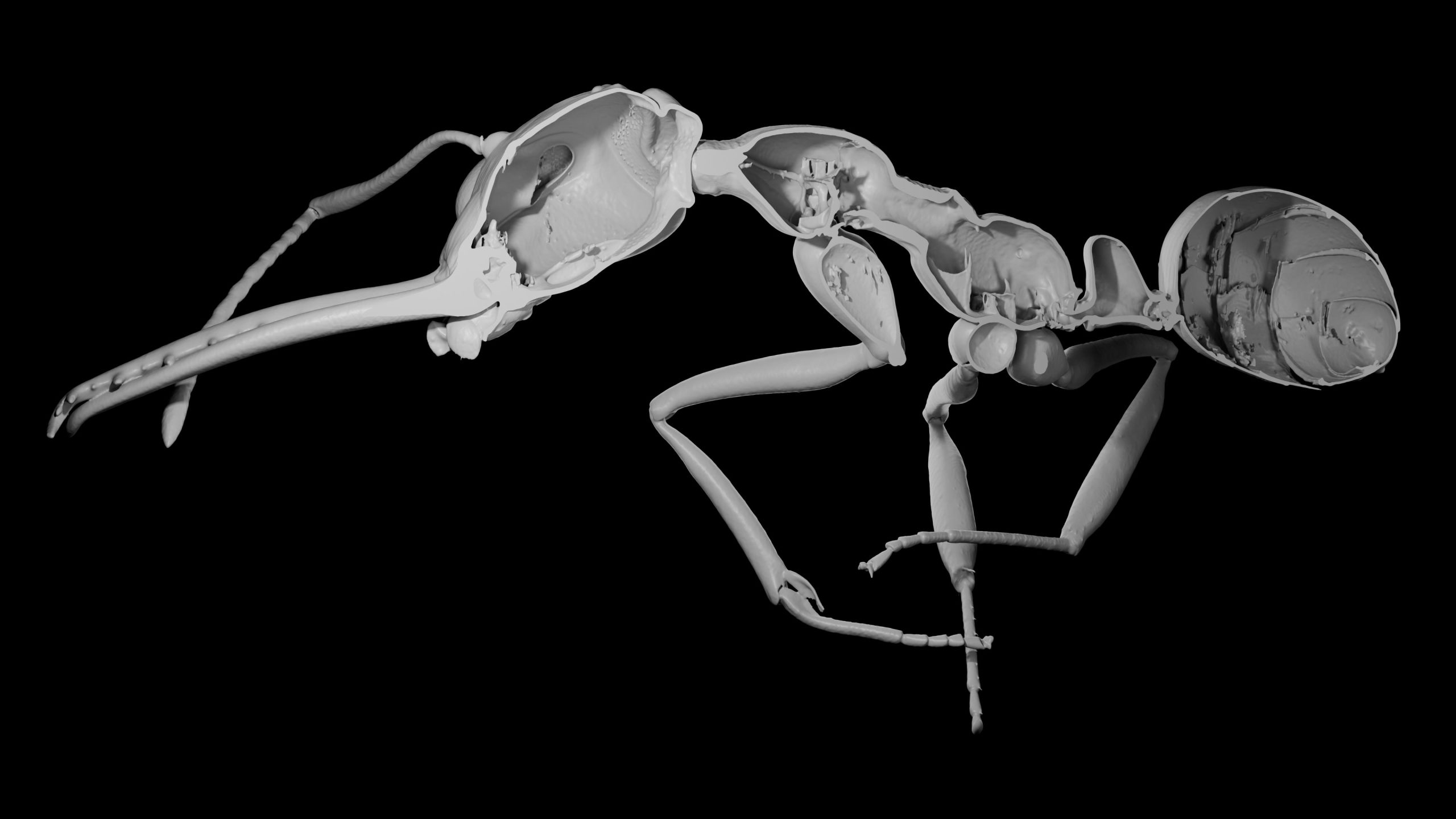
Would you rather fight a horse-sized duck or 100 duck-sized horses?
As silly as it sounds, the question captures a real dilemma: do you go for a few high-quality options, or many lower-quality ones? A new study suggests evolution has been running a version of this choice for millions of years, and ants offer one of the clearest examples.
Quantity vs quality in ant evolution
Research published today (December 19, 2025) in the journal Science Advances reports that some ant species build colonies by leaning into quantity over quality. Instead of heavily investing in each worker’s cuticle, the protective layer of the exoskeleton, these ants put fewer nutrients into individual protection. That frees up limited resources to produce more workers. According to the study, making workers less protected but more numerous turned out to be an evolutionarily successful strategy. The results also offer insight into what can happen to individuals as complex societies evolve, including in humans.
“There’s this question in biology of what happens to individuals as societies they are in get more complex. For example, the individuals may themselves become simpler because tasks that a solitary organism would need to complete can be handled by a collective,” said senior author Evan Economo, chair of the Department of Entomology at the University of Maryland.
One part of that shift is that individuals can become “cheaper,” meaning they take less to build and can be produced in larger numbers, even if each one is less sturdy.
“That idea hasn’t been explicitly tested with large-scale analyses of social insects until now,” said Economo, who also holds the James B. Gahan and Margaret H. Gahan Professorship at UMD.
Ants are a powerful test case because colony sizes vary enormously, from just a few dozen individuals to millions.
“Ants are everywhere,” said the study’s lead author Arthur Matte, a Ph.D. student in zoology at the University of Cambridge. “Yet the fundamental biological strategies which enabled their massive colonies and extraordinary diversification remain unclear.”
Why the cuticle matters
The researchers suspected there might be a tradeoff between how large a colony becomes and how much each ant invests in its cuticle. The cuticle helps protect ants from predators, drying out, and disease. It also provides the structural support their muscles rely on. But it is costly to construct, because it requires limited nutrients including nitrogen and various minerals. Building a thicker cuticle uses more of those resources, which could reduce how many individuals a colony can sustain.
To test this idea, the team used a large dataset of 3D X-ray scans to measure cuticle volume and overall body volume in more than 500 ant species. They found big differences across species, with cuticle investment ranging from 6% to 35% of total body volume. When those measurements were combined with evolutionary models, a clear pattern emerged: species that invested less in cuticle tended to have larger colonies.
How weaker individuals can support stronger colonies
A thinner cuticle leaves an ant less protected, but the authors suggest it may have opened the door to bigger colonies. They argue that reduced individual armor may be linked with other helpful social traits that evolve alongside large colony size, such as collective foraging, shared nest defense, and division of labor.
“Ants reduce per-worker investment in one of the most nutritionally expensive tissues for the good of the collective,” Matte explained. “They’re shifting from self-investment toward a distributed workforce, resulting in more complex societies. It’s a pattern that echoes the evolution of multicellularity, where cooperative units can be individually simpler than a solitary cell, yet collectively capable of far greater complexity.”
The study also found that lower cuticle investment was associated with higher diversification rates, a measure of speciation events that biologists often use as a sign of evolutionary success. Economo noted that relatively few traits have been tied to diversification in ants, which makes the link especially noteworthy.
Why this strategy might boost speciation
Researchers still do not know exactly why reduced cuticle investment would lead to more speciation. One possibility is that it helps ants spread into environments where key nutrients are limited.
“Requiring less nitrogen could make them more versatile and able to conquer new environments,” said Matte, who began this work during his master’s program while interning in Economo’s lab at the Okinawa Institute of Science and Technology in Japan.
The authors also propose that as ant societies became more advanced, group-level defenses like collective nest protection and disease control reduced the need for each worker to be heavily armored. That could create a reinforcing cycle: lower cuticle investment enables bigger colonies, and bigger colonies can rely more on collective protection, which further reduces the pressure to build formidable individual armor.
“I think of this as the evolution of squishability,” laughed Economo. “Many kids have discovered that insects aren’t all equally robust.”
Other social organisms, including termites, might have followed similar evolutionary routes, although that idea still needs testing.
What it could mean for humans
The findings also invite comparisons to human systems. The researchers point to military history, where heavily armored knights were eventually outcompeted by specialized fighters like archers and crossbowmen. Economo also mentioned Lanchester’s Laws—a set of mathematical equations devised during World War I that examine when large numbers of weaker units can outperform a smaller force of stronger units.
“The tradeoff between quantity and quality is all around. It’s in the food you eat, the books you read, the offspring you want to raise,” Matte said. “It was fascinating to retrace how ants handled it through their long evolution. We could see lineages taking different directions, being shaped by different constraints and environments, and ultimately giving rise to the extraordinary diversity we observe today.”
Reference: “The evolution of cheaper workers facilitated larger societies and accelerated diversification in ants” by Arthur Matte, Benoit Guénard, Shubham Gautam, Fumika Azuma, Julian Katzke, Francisco Hita Garcia, Thomas van de Kamp and Evan P. Economo, 19 December 2025, Science Advances.
DOI: 10.1126/sciadv.adx8068
This research was supported by the Okinawa Institute of Science and Technology, the Japan Society for the Promotion of Science KAKENHI (24K01785), the University of Cambridge and the General Research Fund 2022/2023 (17121922) from the Research Grant Council of Hong Kong. This article does not necessarily reflect the views of these organizations.
Never miss a breakthrough: Join the SciTechDaily newsletter.
Follow us on Google and Google News.
1 Comment
Fascinating read, thank you, researchers. Can this phenomenon be applied to why socialism is better than capitalism?!!! 🙂