
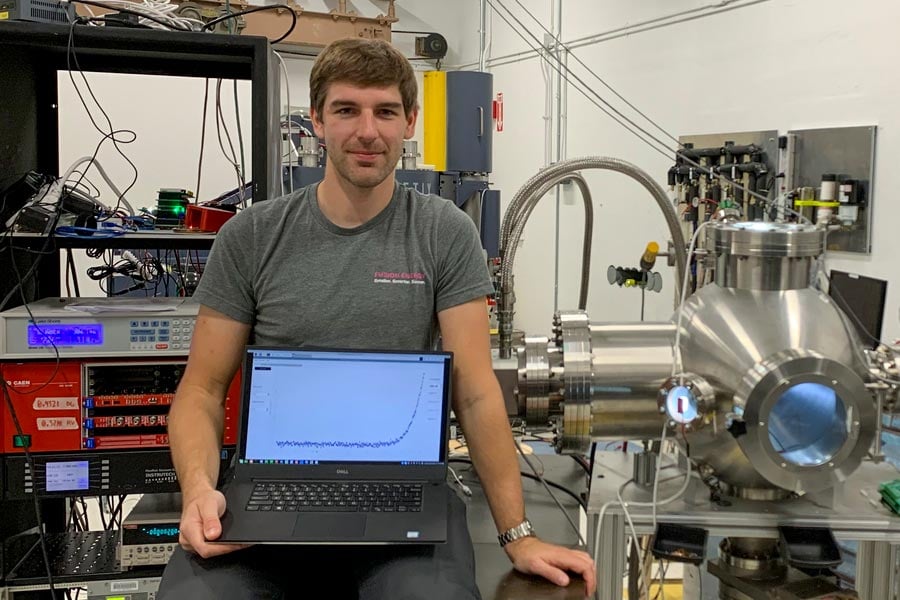
MIT Energy Fellow David Fischer irradiates high-temperature superconducting tape to test its resilience and prepare for the first pilot fusion plant.
“At the age of between 12 and 15 I was drawing; I was making plans of fusion devices.”
David Fischer remembers growing up in Vienna, Austria, imagining how best to cool the furnace used to contain the hot soup of ions known as plasma in a fusion device called a tokamak. With plasma hotter than the core of the sun being generated in a donut-shaped vacuum chamber just a meter away from these magnets, what temperature ranges might be possible with different coolants, he wondered.
“I was drawing these plans and showing them to my father,” he recalls. “Then somehow I forgot about this fusion idea.”
Now starting his second year at the MIT Plasma Science and Fusion Center (PSFC) as a postdoc and a new Eni-sponsored MIT Energy Fellow, Fischer has clearly reconnected with the “fusion idea.” And his research revolves around the concepts that so engaged him as a youth.
Fischer’s early designs explored a popular approach to generating carbon-free, sustainable fusion energy known as “magnetic confinement.” Since plasma responds to magnetic fields, the tokamak is designed with magnets to keep the fusing atoms inside the vessel and away from the metal walls, where they would cause damage. The more effective the magnetic confinement the more stable the plasma can become, and the longer it can be sustained within the device.
Fischer is working on ARC, a fusion pilot plant concept that employs thin high-temperature superconductor (HTS) tapes in the fusion magnets. HTS allows much higher magnetic fields than would be possible from conventional superconductors, enabling a more compact tokamak design. HTS also allows the fusion magnets to operate at higher temperatures, greatly reducing the required cooling.
Fischer is particularly interested in how to keep the HTS tapes from degrading. Fusion reactions create neutrons, which can damage many parts of a fusion device, with the strongest effect on components closest to the plasma. Although the superconducting tapes may be as much as a meter away from the first wall of the tokamak, neutrons can still reach them. Even in reduced numbers and after losing most of their energy, the neutrons damage the microstructure of the HTS tape and over time change the properties of the superconducting magnets.
Much of Fischer’s focus is devoted to the effect of irradiation damage on the critical currents, the maximum electrical current that can pass through a superconductor without dissipating energy. If irradiation causes the critical currents to degrade too much, the fusion magnets can no longer produce the high magnetic fields necessary to confine and compress the plasma.
Fischer notes that it is possible to reduce damage to the magnets almost completely by adding more shielding between the magnets and the fusion plasma. However, this would require more space, which comes at a premium in a compact fusion power plant.
“You can’t just put infinite shielding in between. You have to learn first how much damage can this superconductor tolerate, and then determine how long you want the fusion magnets to last. And then design around these parameters.”
Fischer’s expertise with HTS tapes stems from studies at Technische Universität Wien (Vienna University of Technology), Austria. Working on his master’s degree in the low-temperature physics group, he was told that a PhD position was available researching radiation damage on coated conductors, materials that could be used for fusion magnets.
Recalling the drawings he shared with his father, he thought, “Oh, that’s interesting. I was attracted to fusion more than 10 years ago. Yeah, let’s do that.”
The resulting research on the effects of neutron irradiation on high-temperature superconductors for fusion magnets, presented at a workshop in Japan, got the attention of PSFC nuclear science and engineering Professor Zach Hartwig and Commonwealth Fusion Systems Chief Science Officer Brandon Sorbom.
“They lured me in,” he laughs.
Like Fischer, Sorbom had explored in his own dissertation the effect of radiation damage on the critical current of HTS tapes. What neither researcher had the opportunity to examine was how the tapes behave when irradiated at 20 kelvins, the temperature at which the HTS fusion magnets will operate.
Fischer now finds himself overseeing a proton irradiation laboratory for PSFC Director Dennis Whyte. He is building a device that will not only allow him to irradiate the superconductors at 20 K (-253 C), but also immediately measure changes in the critical currents.
He is glad to be back in the NW13 lab, fondly known as “The Vault,” working safely with graduate and Undergraduate Research Opportunities Program student assistants. During his COVID-19 lockdown, he was able to work from home on programming a measurement software, but he missed the daily connection with his peers.
“The atmosphere is very inspiring,” he says, noting some of the questions his work has recently stimulated. “What is the effect of the irradiation temperature? What are the mechanisms for the degradation of the critical currents? Could we design HTS tapes that are more radiation resistant? Is there a way to heal radiation damage?”
Fischer may have the chance to explore some of his questions as he prepares to coordinate the planning and design of a new neutron irradiation facility at MIT.
“It’s a great opportunity for me,” he says. “It’s great to be responsible for a project now, and see that people trust that you can make it work.”
Never miss a breakthrough: Join the SciTechDaily newsletter.
Follow us on Google and Google News.
3 Comments
high temp. confinement,vortec light used on military ships,during vietnam war. Temp as hot as the sun TAK
Are the elements to make these fusion can tolorate the heat of the sun temperture or will it melt??
More fusion BS. More engineering, same worthless results.