
Can super-Earth interior dynamics set the table for habitability?
New research led by Carnegie’s Yingwei Fei provides a framework for understanding the interiors of super-Earths — rocky exoplanets between 1.5 and 2 times the size of our home planet — which is a prerequisite to assess their potential for habitability. Planets of this size are among the most abundant in exoplanetary systems. The paper is published in Nature Communications.
“Although observations of an exoplanet’s atmospheric composition will be the first way to search for signatures of life beyond Earth, many aspects of a planet’s surface habitability are influenced by what’s happening beneath the planet’s surface, and that’s where Carnegie researcher’s longstanding expertise in the properties of rocky materials under extreme temperatures and pressures comes in,” explained Earth and Planets Laboratory Director Richard Carlson.
On Earth, the interior dynamics and structure of the silicate mantle and metallic core drive plate tectonics, and generate the geodynamo that powers our magnetic field and shields us from dangerous ionizing particles and cosmic rays. Life as we know it would be impossible without this protection. Similarly, the interior dynamics and structure of super-Earths will shape the surface conditions of the planet.
The Challenge of Extreme Planetary Conditions
With exciting discoveries of a diversity of rocky exoplanets in recent decades, are much more massive super-Earths capable of creating conditions that are hospitable for life to arise and thrive?
Knowledge of what’s occurring beneath a super-Earth’s surface is crucial for determining whether or not a distant world is capable of hosting life. But the extreme conditions of super-Earth-mass planetary interiors challenge researchers’ ability to probe the material properties of the minerals likely to exist there.
That’s where lab-based mimicry comes in.

For decades, Carnegie researchers have been leaders at recreating the conditions of planetary interiors by putting small samples of material under immense pressures and high temperatures. But sometimes even these techniques reach their limitations.
“In order to build models that allow us to understand the interior dynamics and structure of super-Earths, we need to be able to take data from samples that approximate the conditions that would be found there, which could exceed 14 million times atmospheric pressure,” Fei explained. “However, we kept running up against limitations when it came to creating these conditions in the lab. ”
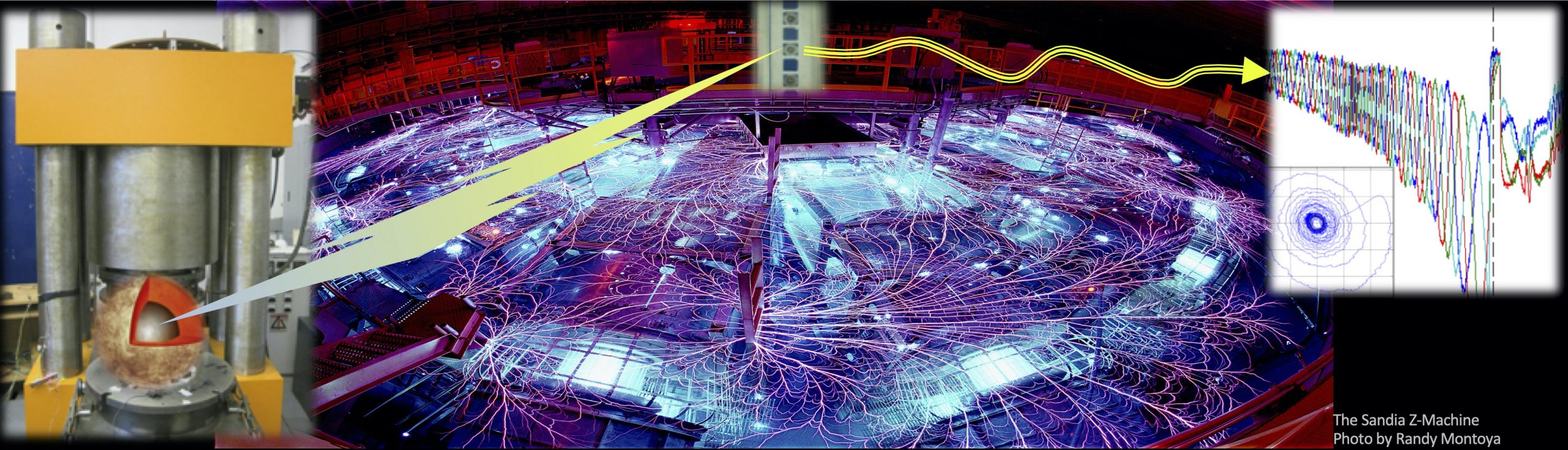
A breakthrough occurred when the team — including Carnegie’s Asmaa Boujibar and Peter Driscoll, along with Christopher Seagle, Joshua Townsend, Chad McCoy, Luke Shulenburger, and Michael Furnish of Sandia National Laboratories — was granted access to the world’s most powerful, magnetically-driven pulsed power machine (Sandia’s Z Pulsed Power Facility) to directly shock a high-density sample of bridgmanite — a high-pressure magnesium silicate that is believed to be predominant in the mantles of rocky planets — in order to expose it to the extreme conditions relevant to the interior of super-Earths.
Key Discoveries on Bridgmanite Properties
A series of hypervelocity shockwave experiments on representative super-Earth mantle material provided density and melting temperature measurements that will be fundamental for interpreting the observed masses and radii of super-Earths.
The researchers found that under pressures representative of super-Earth interiors, bridgmanite has a very high melting point, which would have important implications for interior dynamics. Under certain thermal evolutionary scenarios, they say, massive rocky planets might have a thermally driven geodynamo early in their evolution, then lose it for billions of years when cooling slows down. A sustained geodynamo could eventually be restarted by the movement of lighter elements through inner core crystallization.
“The ability to make these measurements is crucial to developing reliable models of the internal structure of super-Earths up to eight times our planet’s mass,” Fei added. “These results will make a profound impact on our ability to interpret observational data.”
Reference: “Melting and density of MgSiO3 determined by shock compression of bridgmanite to 1254GPa” by Yingwei Fei, Christopher T. Seagle, Joshua P. Townsend, Chad A. McCoy, Asmaa Boujibar, Peter Driscoll, Luke Shulenburger and Michael D. Furnish, 9 February 2021, Nature Communications.
DOI: 10.1038/s41467-021-21170-y
The project is partially supported by a Carnegie Venture Grant and the U.S. National Science Foundation.
The project is made possible by the Z Fundamental Science Program.
Never miss a breakthrough: Join the SciTechDaily newsletter.
Follow us on Google and Google News.