
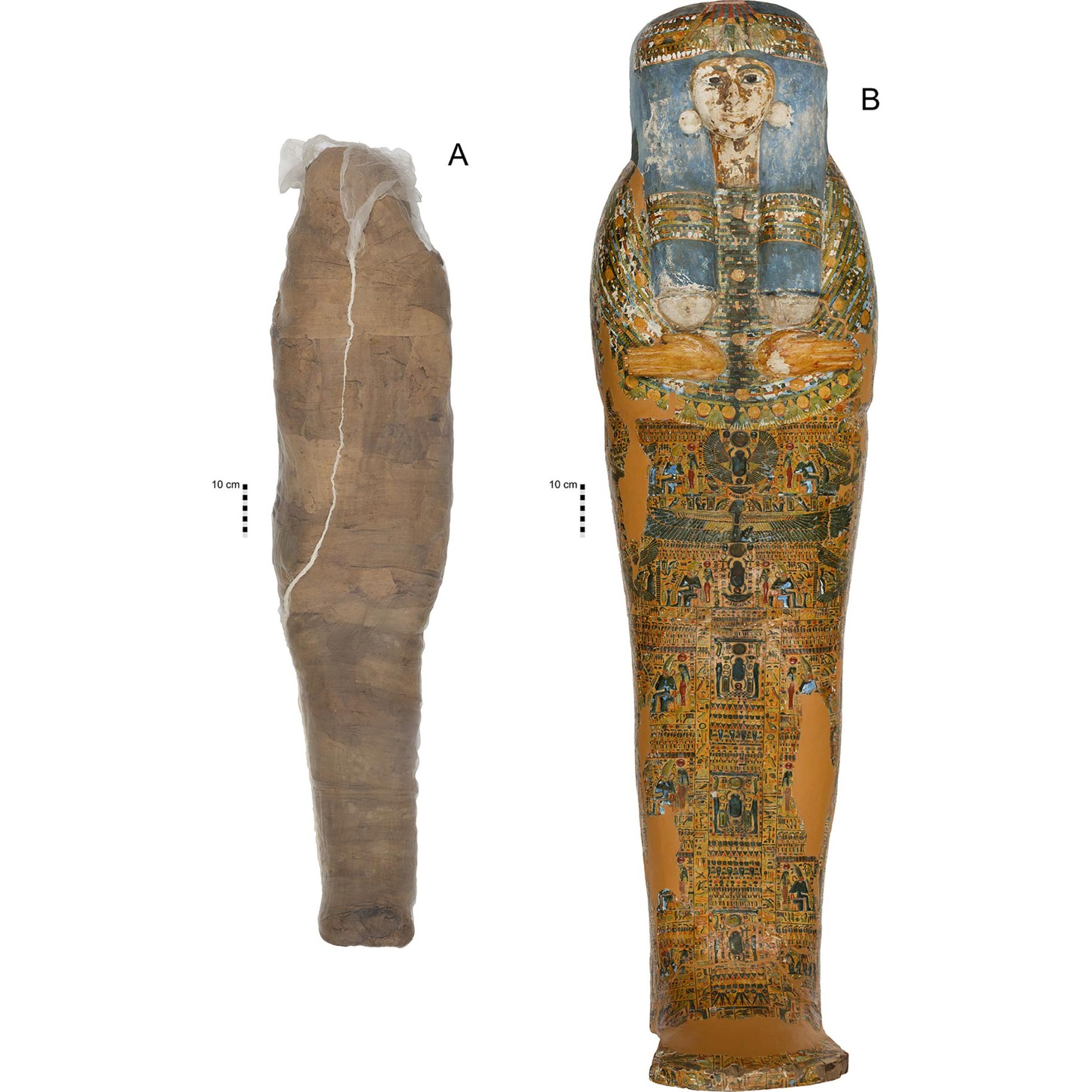
A unique mud shell on a mummified woman offers rare insight into non-elite burial practices in ancient Egypt. The body predates the coffin, likely mismatched in the 19th century.
New analysis of a 20th Dynasty mummified individual reveals her rare mud carapace, according to a study published February 3, 2021 in the open-access journal PLOS ONE by Karin Sowada from Macquarie University, Sydney, Australia, and colleagues.
Studies of mummified bodies from the late New Kingdom to the 21st Dynasty (c. 1294-945 BC) have occasionally reported a hard resinous shell protecting the body within its wrappings, especially for royal mummies of the period. Here, Sowada and colleagues describe their discovery of a rare painted mud carapace enclosing an adult mummy in Sydney’s Chau Chak Wing Museum.
Sir Charles Nicholson bought the mummified body, lidded coffin, and mummy board as a set during a trip to Egypt in 1856-7, donating it to the University of Sydney in 1860. The coffin inscription identifies the owner as a titled woman named Meruah, and the iconography dates it to approximately 1000 BC. Though the mummified individual underwent a full computed tomography (CT) scan in 1999, the authors rescanned the body for the current study using updated technology.
Using this new visualization of the dentition and skeleton, the authors determined the mummified individual was a young middle adult (26-35 years). Though the body scans did not reveal external genitalia, and internal reproductive organs had been removed during the mummification process, osseous secondary sexual characteristics (hip bones, jaw, and cranium) strongly suggest the mummified individual was female.
The current analysis of the mummification technique and radiocarbon dating of textile samples from the linen wrappings placed the mummified individual in the late New Kingdom (c. 1200-1113 BC). This means the body is older than the coffin, suggesting local 19th-century dealers placed an unrelated body in the coffin to sell as a complete set.
Cultural Significance of the Mud Carapace
The new scans also revealed the extent and nature of the mud carapace, showing the mud shell fully sheaths the body and is layered within the linen wrappings. Images of the inmost layers indicate the body was damaged relatively shortly after initial mummification, and the mud carapace and additional wrappings applied to reunify and restore the body. In addition to its practical restorative purpose, the authors suggest the mud carapace gave those who cared for the deceased the chance to emulate elite funerary practices of coating the body in an expensive imported resin shell with cheaper, locally available materials.
Though this mud carapace treatment has not been previously documented in the literature, the authors note it’s not yet possible to determine how frequent this treatment may have been for non-elite mummies in the late New Kingdom of ancient Egypt — and suggest further radiological studies on other non-royal mummies may reveal more about this practice.
The authors add: “The mud shell encasing the body of a mummified woman within the textile wrappings is a new addition to our understanding of ancient Egyptian mummification.”
Reference: “Multidisciplinary discovery of ancient restoration using a rare mud carapace on a mummified individual from late New Kingdom Egypt” by Karin Sowada, Ronika K. Power, Geraldine Jacobsen, Timothy Murphy, Alice McClymont, Fiona Bertuch, Andrew Jenkinson, Jacinta Carruthers and John Magnussen, 3 February 2021, PLoS ONE.
DOI: 10.1371/journal.pone.0245247
Funding: (1) Australian Institute of Nuclear Science and Engineering Grant # AINGRA07/136P. The competitive grant covered the cost of radiocarbon dating but did not play any role in the study design, data collection, analysis, decision to publish, or preparation of the manuscript (2) Rundle Foundation for Egyptian Archaeology. The competitive grant assisted with preparation of the manuscript, but otherwise did not play any role in the study design, data collection and analysis, or decision to publish.
Never miss a breakthrough: Join the SciTechDaily newsletter.
Follow us on Google and Google News.