
Close Menu
    Facebook X (Twitter) Instagram
    SciTechDaily
    • Biology
    • Chemistry
    • Earth
    • Health
    • Physics
    • Science
    • Space
    • Technology
    Facebook X (Twitter) Pinterest YouTube RSS
    SciTechDaily
    Home»Space»Bacteria-Sized Microscopic Deformation of a Neutron Star Inferred From 4500 Light-Years Away
    Space

    Bacteria-Sized Microscopic Deformation of a Neutron Star Inferred From 4500 Light-Years Away

    By Tata Institute of Fundamental ResearchAugust 20, 2020No Comments3 Mins Read
    Facebook Twitter Pinterest Telegram LinkedIn WhatsApp Email Reddit
    Share
    Facebook Twitter LinkedIn Pinterest Telegram Email Reddit
    Traveling Through Space
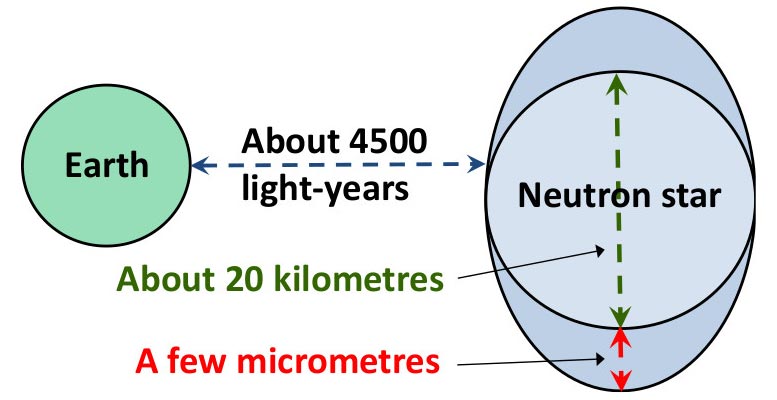
    A bacterium-sized deformation, causing a few micrometers of extra height in one direction, has been observed in a neutron star located approximately 4500 light-years away.

    Imagine that the size of a bacterium is measured from a distance of about 4500 light-years. This would be an incredible measurement, considering that a bacterium is so small that a microscope is required to see it, and what an enormous distance light can travel in 4500 years, given that it can round the Earth more than seven times in just one second. But a small deformation of the size of a bacterium, that is an extra height of a few micrometers in one direction, has now been inferred for a neutron star at a distance of about 4500 light-years, from a research by Prof. Sudip Bhattacharyya of the Tata Institute of Fundamental Research (TIFR), India. This research is published in a new paper in Monthly Notices of the Royal Astronomical Society.
    Microscopic Deformation Neutron Star
    A microscopic deformation of the neutron star in the binary stellar system PSR J1023+0038 is inferred. Here, the spin-axis of the star is perpendicular to the plane of the figure. The extra height of the neutron star in one direction is only a few micrometers (that is of the size of a bacterium), which is estimated from a distance of about 4500 light-years. Credit: Sudip Bhattacharyya

    Neutron stars are incredibly dense cosmic objects. They are about the size of a city, but contain more material than in the Sun, and a handful of stellar stuff would outweigh a mountain on the Earth. Some of them are observed to spin several hundred times in a second, and we call them millisecond pulsars. A slight asymmetry or deformation around the spin axis of such a star would cause the emission of gravitational waves continuously.

    Gravitational waves, which are ripples in spacetime, have recently provided a new window to the universe. But so far they have been found as transient phenomena of mergers of black holes and neutron stars. Continuous gravitational waves, for example from a slightly deformed and spinning neutron star, have so far not been detected. The current instruments may not have the capability to detect these waves, if the deformation is too small.

    However, a way to indirectly infer such waves and to measure this deformation is to estimate the contribution of the waves to the spin-down rate of the pulsar, which was not possible till now. PSR J1023+0038 is a unique cosmic source for this purpose, because it is the only millisecond pulsar for which two spin-down rates, in the phase of mass transfer from the companion star and in the phase when there is no mass transfer, were measured. Using these values, and primarily a fundamental principle of physics, that is the conservation of angular momentum, Bhattacharyya has inferred continuous gravitational waves and has estimated the neutron star’s microscopic deformation.

    Reference: “The permanent ellipticity of the neutron star in PSR J1023+0038” by Sudip Bhattacharyya, 18 August 2020, Monthly Notices of the Royal Astronomical Society.
    DOI: 10.1093/mnras/staa2304

    Never miss a breakthrough: Join the SciTechDaily newsletter.
    Follow us on Google and Google News.

    Astronomy Astrophysics Neutron Star Popular Tata Institute of Fundamental Research
    Share. Facebook Twitter Pinterest LinkedIn Email Reddit

    Related Articles

    A New Type of Cataclysmic Event in the Cosmos: Astrophysicists Detect First Black Hole-Neutron Star Mergers

    Reclusive Neutron Star May Have Been Found in Famous Supernova SN 1987A

    Chandra Studies Extraordinary Magnetar: Fastest Spinning and Possibly the Youngest Magnetar Known

    Mysterious, Repeating Radio Burst Identified in Our Own Galaxy for the First Time

    Ultrabright Radio Flashes Detected Coming From Inside Our Own Galaxy

    Galactic “Mystery Source” of Gamma Rays Identified: Record-Setting “Black Widow” Pulsar

    Mass of Hydrogen in Distant Galaxies Measured by Upgraded Giant Metrewave Radio Telescope

    Astronomers Surprised by Lingering X-rays Years After Landmark Neutron Star Collision

    Cosmic X-Rays Reveal a Distinctive Signature of Black Hole Event Horizons

    Leave A Reply Cancel Reply

    • Facebook
    • Twitter
    • Pinterest
    • YouTube

    Don't Miss a Discovery

    Subscribe for the Latest in Science & Tech!

    Trending News

    Popular Sugar-Free Sweetener Linked to Liver Disease, Study Warns

    What Is Hantavirus? The Deadly Disease Raising Alarm Worldwide

    Scientists Just Discovered How the Universe Builds Monster Black Holes

    Scientists Unveil New Treatment Strategy That Could Outsmart Cancer

    A Simple Vitamin May Hold the Key to Treating Rare Genetic Diseases

    Scientists Think the Real Fountain of Youth May Be Hiding in Your Gut

    Ravens Don’t Follow Wolves, They Predict Them

    This Common Knee Surgery May Be Doing More Harm Than Good

    Follow SciTechDaily
    • Facebook
    • Twitter
    • YouTube
    • Pinterest
    • Newsletter
    • RSS
    SciTech News
    • Biology News
    • Chemistry News
    • Earth News
    • Health News
    • Physics News
    • Science News
    • Space News
    • Technology News
    Recent Posts
    • Scientists Uncover the Surprising Source of Strange Clouds Near the Milky Way’s Supermassive Black Hole
    • This Dazzling Green Snake Was Hiding in Plain Sight for Decades
    • Scientists Discover That a Single Dose of Psilocybin Changes the Human Brain
    • “Totally Unexpected” – Scientists Discover Pancreatic Cancer’s Fatal Addiction
    • A Strange Quantum Effect May Explain One of Biology’s Greatest Mysteries
    Copyright © 1998 - 2026 SciTechDaily. All Rights Reserved.
    • Science News
    • About
    • Contact
    • Editorial Board
    • Privacy Policy
    • Terms of Use

    Type above and press Enter to search. Press Esc to cancel.