
Close Menu
    Facebook X (Twitter) Instagram
    SciTechDaily
    • Biology
    • Chemistry
    • Earth
    • Health
    • Physics
    • Science
    • Space
    • Technology
    Facebook X (Twitter) Pinterest YouTube RSS
    SciTechDaily
    Home»Space»Innovative New Method Developed to Detect Colliding Supermassive Black Holes
    Space

    Innovative New Method Developed to Detect Colliding Supermassive Black Holes

    By OzGravSeptember 18, 2020No Comments3 Mins Read
    Facebook Twitter Pinterest Telegram LinkedIn WhatsApp Email Reddit
    Share
    Facebook Twitter LinkedIn Pinterest Telegram Email Reddit
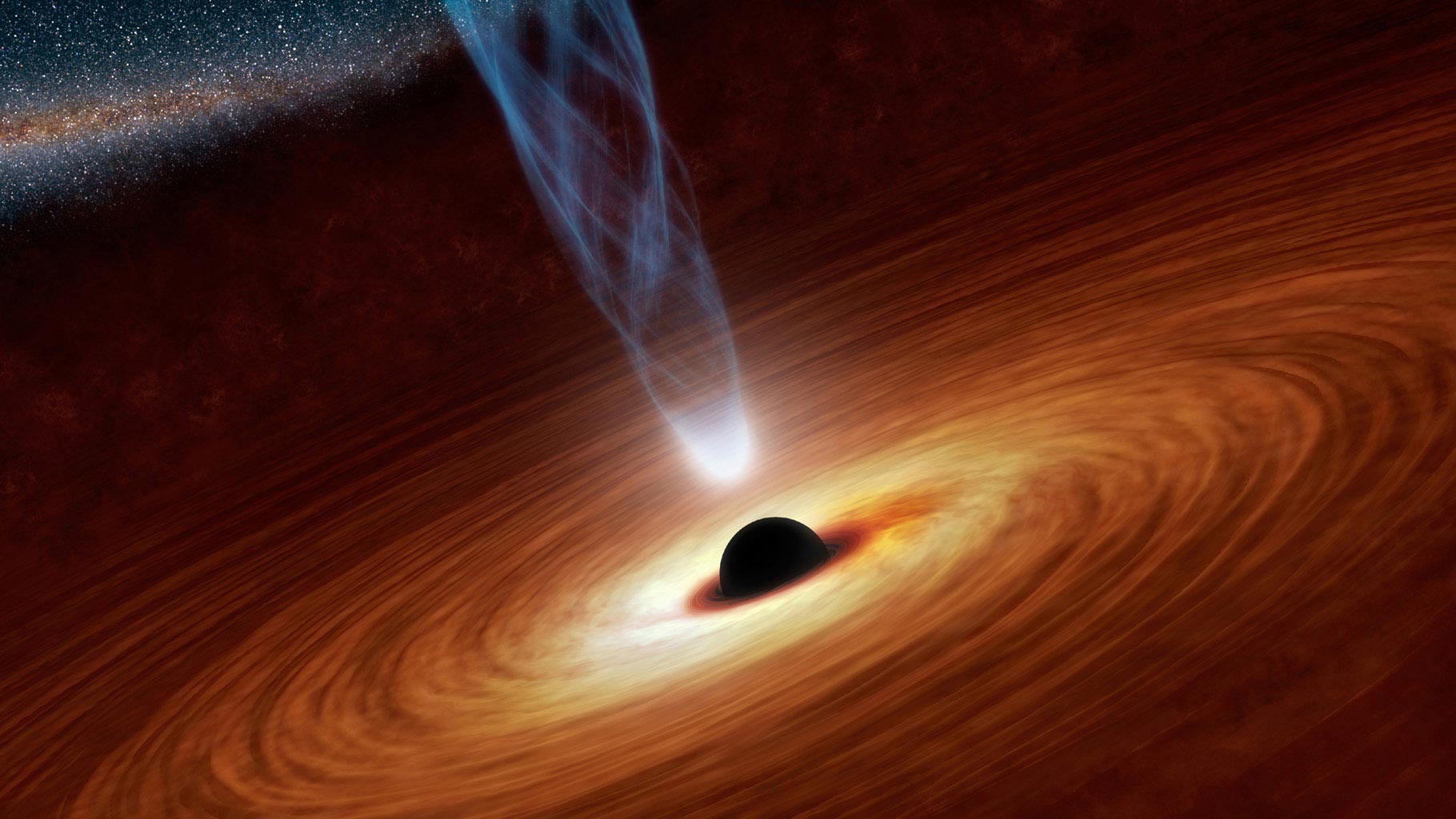
    Supermassive Black Hole Artists Concept
    An artist’s concept illustrates a supermassive black hole. Credit: NASA/JPL-Caltech

    A new study has developed an innovative method to detect colliding supermassive black holes in our Universe. The study has just been published in the Astrophysical Journal and was led by postdoctoral researcher Xingjiang Zhu from the ARC Centre of Excellence for Gravitational Wave Discovery (OzGrav), at Monash University.

    At the center of every galaxy in our Universe lives a supermassive black hole—a black hole that’s millions to billions times the mass of our Sun. Big galaxies are assembled from smaller galaxies merging together, so collisions of supermassive black holes are expected to be common in the cosmos. But merging supermassive black holes remain elusive: no conclusive evidence of their existence has been found so far.

    One way to look for these mergers is through their emission of gravitational waves—ripples in the fabric of space and time. A distant merging pair of supermassive black holes emit gravitational waves as they spiral in around each other. Since the black holes are so large, each wave takes many years to pass by Earth. Astronomers use a technique known as pulsar timing array to catch gravitational waves from supermassive binary black holes—so far to no avail.

    In parallel, astronomers have been looking for the collision of supermassive black holes with light. A number of candidate sources have been identified by looking for regular fluctuations in the brightness of distant galaxies called “quasars.” Quasars are extremely bright, believed to be powered by the accumulation of gas clouds onto supermassive black holes.

    If the center of a quasar contains two black holes orbiting around each other (instead of a single black hole), the orbital motion might change the gas cloud accumulation and lead to periodic variation in its brightness. Hundreds of candidates have been identified through such searches, but astronomers are yet to find the smoking-gun signal.

    ‘If we can find a pair of merging supermassive black holes, it will not only tell us how galaxies evolved, but also reveal the expected gravitational-wave signal strength for pulsar watchers,’ says Zhu.

    The OzGrav study seeks to settle the debate, determining if any of the identified quasars are likely to be powered by colliding black holes. The verdict? Probably not.

    “We’ve developed a new method allowing us to search for a periodic signal and measure quasar noise properties at the same time,” says Zhu. “Therefore, it should produce a reliable estimate of the detected signal’s statistical significance.”

    Applying this method to one of the most prominent candidate sources, called PG1302-102, the researchers found strong evidence for periodic variability; however, they argued that the signal is likely to be more complicated than current models.

    “The commonly assumed model for quasar noise is wrong,” adds Zhu. “The data reveal additional features in the random fluctuations of gas accumulation onto supermassive black holes.”

    “Our results are showing that quasars are complicated,” says collaborator and OzGrav Chief Investigator Eric Thrane. “We’ll need to improve our models if we are going to use them to identify supermassive binary black holes.”

    Reference: “Toward the Unambiguous Identification of Supermassive Binary Black Holes through Bayesian Inference” by Xing-Jiang Zhu and Eric Thrane, 8 September 2020, The Astrophysical Journal.
    DOI: 10.3847/1538-4357/abac5a

    Never miss a breakthrough: Join the SciTechDaily newsletter.
    Follow us on Google and Google News.

    Astronomy Astrophysics Black Hole OzGrav Quasars
    Share. Facebook Twitter Pinterest LinkedIn Email Reddit

    Related Articles

    Pulsar Timing Array Explores Mystery Gravitational Waves From Supermassive Black Holes

    Black Hole Pairs Found in Distant Merging Galaxies Provide Crucial Insight Into the Early Universe

    Testing Einstein’s Theory of General Relativity From the Shadows and Collisions of Black Holes

    Record-Breaking Jet of Particles Spied From a Supermassive Black Hole in the Early Universe

    Massive X-ray Jet – Extending for 160,000 Light-Years – Spied From Supermassive Black Hole in Early Universe

    A Most Distant Signal: Earliest Supermassive Black Hole and Quasar in the Universe Discovered

    Massive Stellar Triples Leading to Sequential Binary Black-Hole Mergers

    Astronomers Discover Earliest Supermassive Black Hole and Quasar in the Universe – 1000x More Luminous Than the Milky Way

    Most Distant Quasar Discovered Sheds Light on How Supermassive Black Holes Grow

    Leave A Reply Cancel Reply

    • Facebook
    • Twitter
    • Pinterest
    • YouTube

    Don't Miss a Discovery

    Subscribe for the Latest in Science & Tech!

    Trending News

    Massive Study Warns Marijuana Use in Teens Is Linked to Serious Mental Illness

    Scientists Discover a Completely Unexpected Way T Cells Kill Cancer

    Scientists Just Found the Solar System’s Original “Planet Factory”

    Study Warns Widely Used Food Preservatives Linked to High Blood Pressure and Heart Disease

    New Treatment Could Reverse Osteoarthritis Within Weeks

    Physicists Have Measured “Negative Time” in Bizarre Quantum Experiment

    The Deadly Tapeworm Spreading Across America Has Reached the Pacific Northwest

    Could Low Vitamin D Be Making Your Pain Worse?

    Follow SciTechDaily
    • Facebook
    • Twitter
    • YouTube
    • Pinterest
    • Newsletter
    • RSS
    SciTech News
    • Biology News
    • Chemistry News
    • Earth News
    • Health News
    • Physics News
    • Science News
    • Space News
    • Technology News
    Recent Posts
    • Scientists Discover Mysterious Creature Living in the Great Salt Lake – and It Exists Nowhere Else on Earth
    • It’s Alive? Surprising Discovery Changes What We Know About Fog
    • Simple Family Routines May Be the Secret to a Smoother Start at School
    • Brain Study Overturns Long-Held Beliefs About How Humans Learn Speech
    • Ancient Goose Fossil Challenges Long-Held Theories About New Zealand Birds
    Copyright © 1998 - 2026 SciTechDaily. All Rights Reserved.
    • Science News
    • About
    • Contact
    • Editorial Board
    • Privacy Policy
    • Terms of Use

    Type above and press Enter to search. Press Esc to cancel.