
Close Menu
    Facebook X (Twitter) Instagram
    SciTechDaily
    • Biology
    • Chemistry
    • Earth
    • Health
    • Physics
    • Science
    • Space
    • Technology
    Facebook X (Twitter) Pinterest YouTube RSS
    SciTechDaily
    Home»Earth»Astronaut Captures Stunning Nighttime Image of the World’s Deepest Lake
    Earth

    Astronaut Captures Stunning Nighttime Image of the World’s Deepest Lake

    By Justin Wilkinson, NASA Earth ObservatoryJuly 31, 2024No Comments3 Mins Read
    Facebook Twitter Pinterest Telegram LinkedIn WhatsApp Email Reddit
    Share
    Facebook Twitter LinkedIn Pinterest Telegram Email Reddit
    Lake Baikal From Space Station Annotated
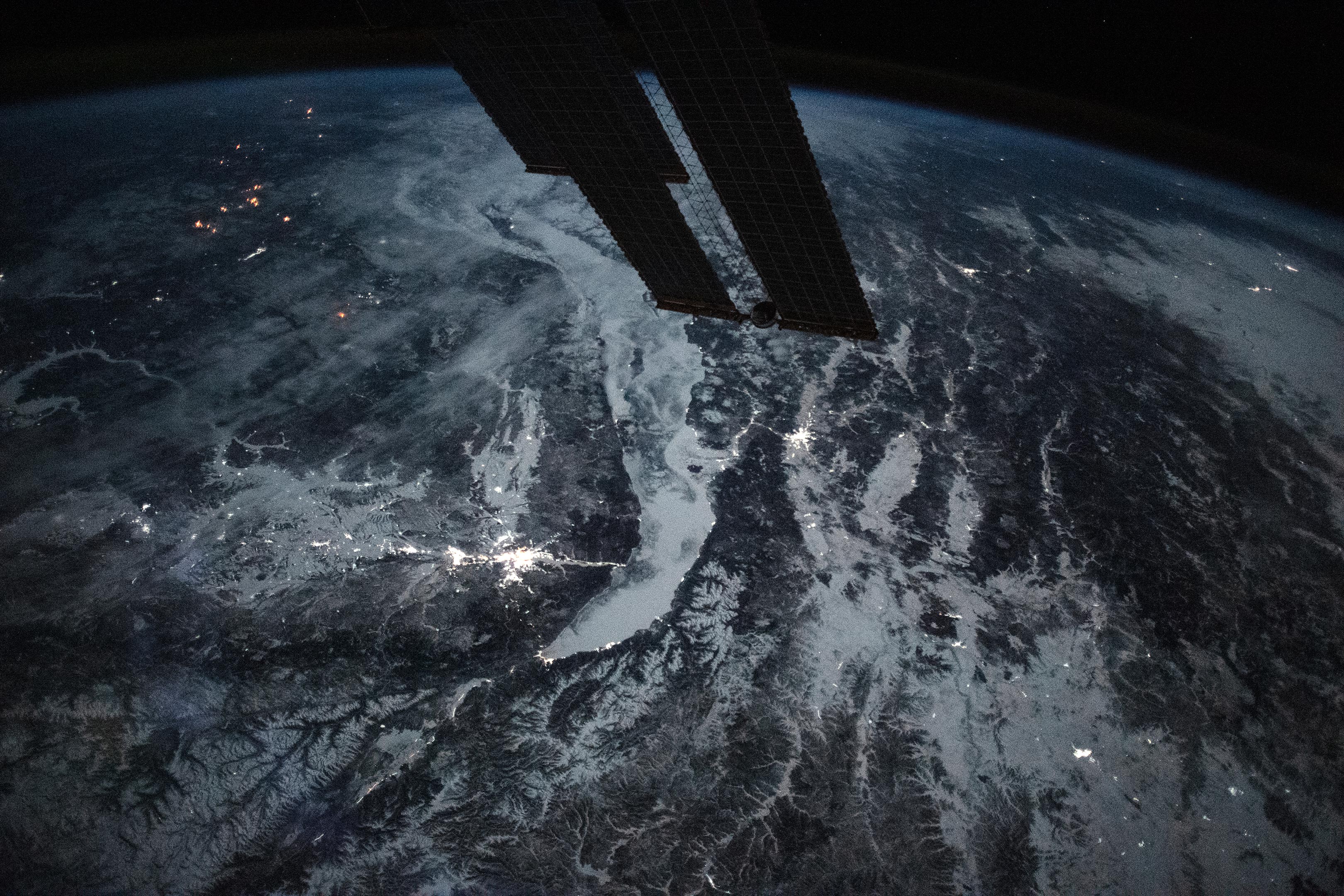
    Nighttime photo of Siberia captured on January 24, 2024, by an astronaut aboard the International Space Station.

    An astronaut’s photo from the International Space Station showcases Siberia and Lake Baikal at night, with snow and ice brightening the landscape.

    Lake Baikal is the largest and deepest freshwater lake, known for its significant age and biodiversity. The image also highlights bright city lights, oil fields, and parts of the Trans-Siberian Railway. UNESCO has designated Lake Baikal a World Heritage site due to its unique fauna.

    Siberia and Lake Baikal at Night

    An astronaut aboard the International Space Station (ISS) took this nighttime photo of Siberia and the ice-covered Lake Baikal in January 2024. Snow and ice brighten sparsely vegetated land, whereas forested areas appear darker. Several of the station’s solar arrays are visible as the dark angular objects at the top of the image.

    Lake Baikal is the world’s largest freshwater lake, measuring 640 kilometers (395 miles) long, and the deepest lake, with a depth of up to 1,700 meters (1 mile). Scientists also consider Baikal to be among the planet’s oldest lakes, having formed about 25 million years ago, according to UNESCO.

    Bright City Lights and Industrial Centers

    The brightest spots in the image are cities, including the large industrial city of Irkutsk and its neighboring industrial towns. Irkutsk is located along the Angara River, which flows from Lake Baikal and feeds several reservoirs, including the ice-covered Bratsk Reservoir. Scattered orange-red spots at the top left of the image are lights associated with oil fields. The urban lights in the lower-right corner of the image are towns in northern Mongolia.

    Trans-Siberian Railway Route

    The image encompasses a significant portion of the Trans-Siberian Railway. The railroad passes through the city of Zima and follows a straight line through a series of towns to Irkutsk. From there, it curves around the southern tip of Lake Baikal before heading east through the major towns of Ulan-Ude and Chita. The railroad ultimately reaches the Pacific coast.

    UNESCO World Heritage Site

    UNESCO declared the lake a World Heritage site, stating: “Its age and isolation have produced one of the world’s richest and most unusual freshwater fauna, which is of exceptional value to evolutionary science.” The Baikal seal is the only known freshwater species of seal, and biologists continue to investigate how it came to be isolated in Lake Baikal.

    Other astronaut photographs show the area in daylight, including this image of Irkutsk and the Angara River. Detailed photos of Lake Baikal’s ice cover can be seen here and here.

    Astronaut photograph ISS070-E-80639 was acquired on January 24, 2024, with a Nikon D5 digital camera using a focal length of 24 millimeters. It is provided by the ISS Crew Earth Observations Facility and the Earth Science and Remote Sensing Unit, Johnson Space Center. The image was taken by a member of the Expedition 70 crew. The image has been cropped and enhanced to improve contrast, and lens artifacts have been removed. The International Space Station Program supports the laboratory as part of the ISS National Lab to help astronauts take pictures of Earth that will be of the greatest value to scientists and the public, and to make those images freely available on the Internet.

    Never miss a breakthrough: Join the SciTechDaily newsletter.
    Follow us on Google and Google News.

    Geography NASA NASA Earth Observatory
    Share. Facebook Twitter Pinterest LinkedIn Email Reddit

    Related Articles

    NASA Picturing Earth: Astronaut Photography In Focus [Video]

    Coloring the Great Salt Lake – Astronaut Takes Beautiful Photograph From Space Station

    Sea Ice in Denmark Strait – Drifted More Than 1,000 Km (600 Miles) From the Arctic Ocean

    NASA Scientists Map Beirut Blast Damage – Devastating Explosion Rocked Port Area

    NASA Advanced Rapid Imaging Satellite Maps Blast Damage: Beirut Explosion Aftermath

    NASA/NOAA Satellites Observe Surprisingly Rapid Increase in Scale and Intensity of Fires in Siberia

    Mars Terraforming: Cultivating Ideas for Mars on Earth

    Meandering Mississippi River: Photo Taken by Astronaut on Space Station Shows Divergence From State Boundaries

    Incredible Rare Peek at Patagonia in Winter

    Leave A Reply Cancel Reply

    • Facebook
    • Twitter
    • Pinterest
    • YouTube

    Don't Miss a Discovery

    Subscribe for the Latest in Science & Tech!

    Trending News

    Enormous Prehistoric Insects Puzzle Scientists

    Scientists Develop Bioengineered Chewing Gum That Could Help Fight Oral Cancer

    After 37 Years, the World’s Longest-Running Soil Warming Experiment Uncovers a Startling Climate Secret

    NASA Satellite Captures First-Ever High-Res View of Massive Pacific Tsunami

    ADHD Isn’t Just a Deficit: Study Reveals Powerful Hidden Strengths

    Scientists Discover Stem Cells That Could Regrow Teeth and Bone

    Early Cannabis Use May Stall Key Brain Skills in Teens

    Popular Vitamin D Supplement Has “Previously Unknown” Negative Effect, Study Finds

    Follow SciTechDaily
    • Facebook
    • Twitter
    • YouTube
    • Pinterest
    • Newsletter
    • RSS
    SciTech News
    • Biology News
    • Chemistry News
    • Earth News
    • Health News
    • Physics News
    • Science News
    • Space News
    • Technology News
    Recent Posts
    • Rewriting Dinosaur Evolution: Scientists Unearth Remarkable 150-Million-Year-Old Stegosaur Skull
    • Scientists Identify Two Simple Treatments for Cancer-Related Cognitive Impairment
    • Omega-3 Supplements Linked to Cognitive Decline in Surprising New Study
    • One in Five at Risk: Scientists Identify a Hidden Blood Particle Linked to Higher Risk of Stroke and Death
    • Darwin’s Islands Still Evolving: Giant Daisies Rewrite the Rules of Evolution
    Copyright © 1998 - 2026 SciTechDaily. All Rights Reserved.
    • Science News
    • About
    • Contact
    • Editorial Board
    • Privacy Policy
    • Terms of Use

    Type above and press Enter to search. Press Esc to cancel.