
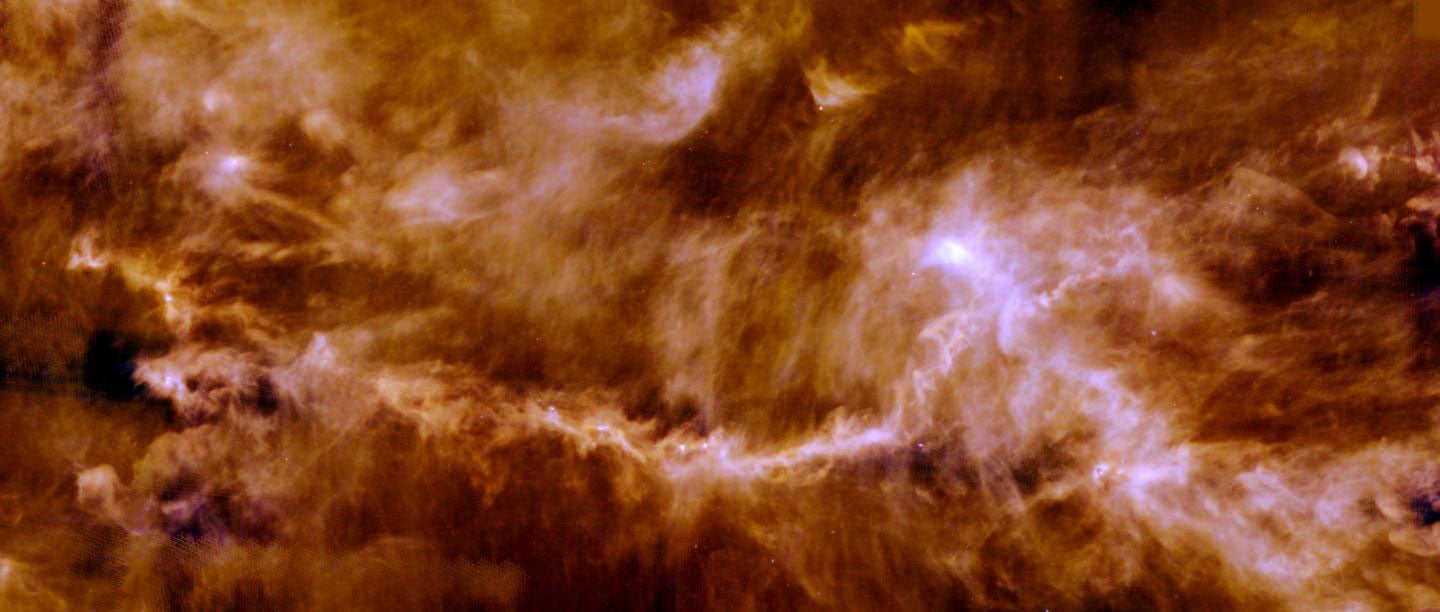
The first unbiased survey of protoplanetary disks surrounding young stars in the Taurus star-forming region turned up a higher-than-expected number of disks with features suggesting nascent planets.
“Super-Earths” and Neptune-sized planets could be forming around young stars in much greater numbers than scientists thought, new research by an international team of astronomers suggests.
Observing a sampling of young stars in a star-forming region in the constellation Taurus, researchers found many of them to be surrounded by structures that can best be explained as traces created by invisible, young planets in the making. The research, published in the Astrophysical Journal, helps scientists better understand how our own solar system came to be.
Some 4.6 billion years ago, our solar system was a roiling, billowing swirl of gas and dust surrounding our newborn sun. At the early stages, this so-called protoplanetary disk had no discernable features, but soon, parts of it began to coalesce into clumps of matter – the future planets. As they picked up new material along their trip around the sun, they grew and started to plow patterns of gaps and rings into the disk from which they formed. Over time, the dusty disk gave way to the relatively orderly arrangement we know today, consisting of planets, moons, asteroids, and the occasional comet.
Scientists base this scenario of how our solar system came to be on observations of protoplanetary disks around other stars that are young enough to currently be in the process of birthing planets. Using the Atacama Large Millimeter Array, or ALMA, comprising 45 radio antennas in Chile’s Atacama Desert, the team performed a survey of young stars in the Taurus star-forming region, a vast cloud of gas and dust located a modest 450 light-years from Earth. When the researchers imaged 32 stars surrounded by protoplanetary disks, they found that 12 of them – 40 percent – have rings and gaps, structures that according to the team’s measurements and calculations can be best explained by the presence of nascent planets.
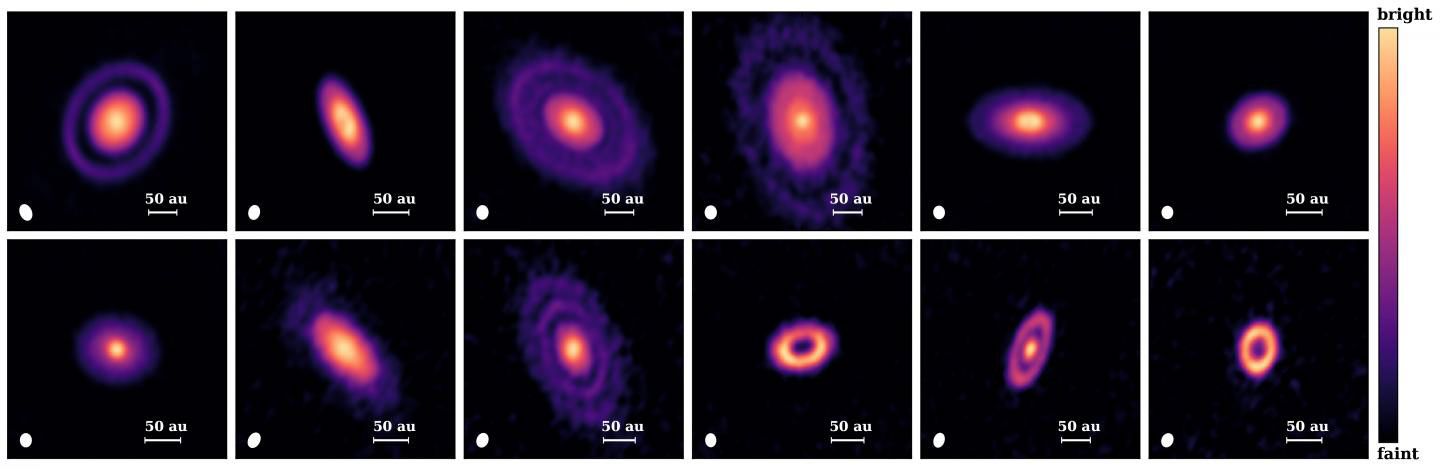
“This is fascinating because it is the first time that exoplanet statistics, which suggest that super-Earths and Neptunes are the most common type of planets, coincide with observations of protoplanetary disks,” said the paper’s lead author, Feng Long, a doctoral student at the Kavli Institute for Astronomy and Astrophysics at Peking University in Beijing, China.
While some protoplanetary disks appear as uniform, pancake-like objects lacking any features or patterns, concentric bright rings separated by gaps have been observed, but since previous surveys have focused on the brightest of these objects because they are easier to find, it was unclear how common disks with ring and gap structures really are in the universe. This study presents the results of the first unbiased survey in that the target disks were selected independently of their brightness – in other words, the researchers did not know whether any of their targets had ring structures when they selected them for the survey.
“Most previous observations had been targeted to detect the presence of very massive planets, which we know are rare, that had carved out large inner holes or gaps in bright disks,” said the paper’s second author Paola Pinilla, a NASA Hubble Fellow at the University of Arizona’s Steward Observatory. “While massive planets had been inferred in some of these bright disks, little had been known about the fainter disks.”
The team, which also includes Nathan Hendler and Ilaria Pascucci at the UA’s Lunar and Planetary Laboratory, measured the properties of rings and gaps observed with ALMA and analyzed the data to evaluate possible mechanisms that could cause the observed rings and gaps. While these structures may be carved by planets, previous research has suggested that they may also be created by other effects. In one commonly suggested scenario, so-called ice lines caused by changes in the chemistry of the dust particles across the disc in response to the distance to the host star and its magnetic field create pressure variations across the disk. These effects can create variations in the disk, manifesting as rings and gaps.
The researchers performed analyses to test these alternative explanations and could not establish any correlations between stellar properties and the patterns of gaps and rings they observed.
“We can therefore rule out the commonly proposed idea of ice lines causing the rings and gaps,” Pinilla said. “Our findings leave nascent planets as the most likely cause of the patterns we observed, although some other processes may also be at work.”
Since detecting the individual planets directly is impossible because of the overwhelming brightness of the host star, the team performed calculations to get an idea of the kinds of planets that might be forming in the Taurus star-forming region. According to the findings, Neptune-sized gas planets or so-called super-Earths – terrestrial planets of up to 20 Earth masses – should be the most common. Only two of the observed disks could potentially harbor behemoths rivaling Jupiter, the largest planet in the solar system.
“Since most of the current exoplanet surveys can’t penetrate the thick dust of protoplanetary disks, all exoplanets, with one exception, have been detected in more evolved systems where a disk is no longer present,” Pinilla said.
Going forward, the research group plans to move ALMA’s antennas farther apart, which should increase the array’s resolution to around five astronomical units (one AU equals the average distance between the Earth and the sun), and to make the antennas sensitive to other frequencies that are sensitive to other types of dust.
“Our results are an exciting step in understanding this key phase of planet formation,” Long said, “and by making these adjustments, we are hoping to better understand the origins of the rings and gaps.”
This work was made possible through an international collaboration, including astronomers at UA’s Steward Observatory and LPL. For a complete list of authors and funding information, please see the paper, “Gaps and Rings in an ALMA Survey of Disks in the Taurus Star-forming Region.” A preprint of the article is available at https://arxiv.org/abs/1810.06044. Funding for this project was provided by Peking University, National Science Foundation of China, the Hubble Fellowship Program, the National Science Foundation, and the Earths in Other Solar Systems Nexus for Exoplanetary System Science program.
Reference: “Gaps and Rings in an ALMA Survey of Disks in the Taurus Star-forming Region” by Feng Long, Paola Pinilla, Gregory J. Herczeg, Daniel Harsono, Giovanni Dipierro, Ilaria Pascucci, Nathan Hendler, Marco Tazzari, Enrico Ragusa, Colette Salyk, Suzan Edwards, Giuseppe Lodato, Gerrit van de Plas, Doug Johnstone, Yao Liu, Yann Boehler, Sylvie Cabrit, Carlo F. Manara, Francois Menard, Gijs D. Mulders, Brunella Nisini, William J. Fischer, Elisabetta Rigliaco, Andrea Banzatti, Henning Avenhaus and Michael Gully-Santiago, 6 December 2018, The Astrophysical Journal.
DOI: 10.3847/1538-4357/aae8e1
Never miss a breakthrough: Join the SciTechDaily newsletter.
Follow us on Google and Google News.
1 Comment
aint no body go t time for dat