
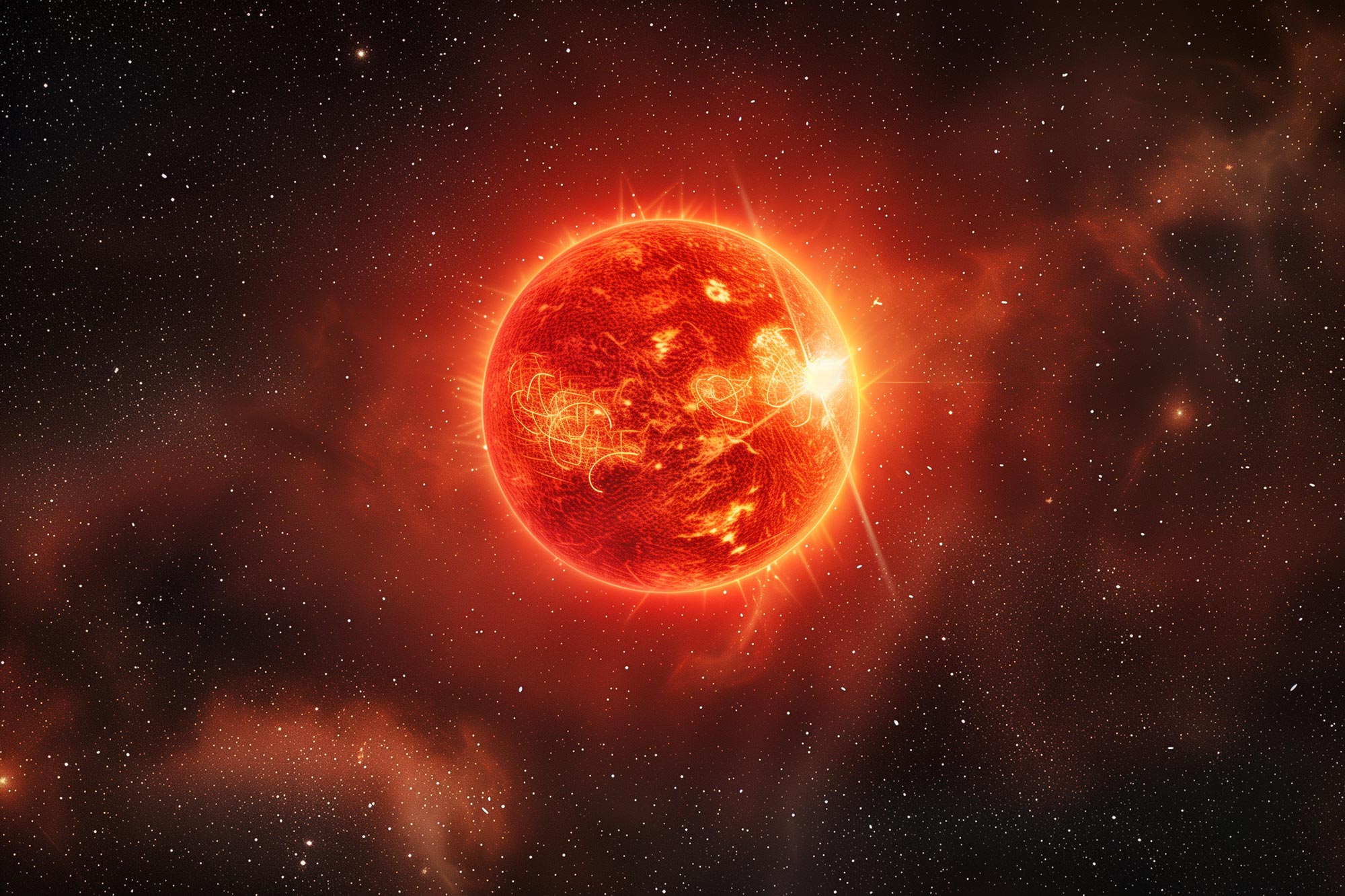
New observations of a nearby red giant star suggest that a long-standing explanation for how giant stars spread life’s essential elements through the galaxy may be incomplete.
Starlight pushing on grains of stardust may not be strong enough to launch the intense winds that flow from giant stars and carry life forming elements across the Milky Way.
That is the takeaway from a new study by researchers at Chalmers University of Technology in Sweden, based on observations of the red giant star R Doradus. The findings call into question a decades-old explanation for how the atoms needed for life become widely distributed in space.
“We thought we had a good idea of how the process worked. It turns out we were wrong. For us as scientists, that’s the most exciting result,” says Theo Khouri, astronomer at Chalmers and joint leader of the study.
Understanding how these winds are launched matters because red giant stars help supply the galaxy with key chemical elements. For many years, scientists have proposed that the winds begin when the star’s light presses outward on freshly formed dust grains.
This idea has been used to explain how red giants release carbon, oxygen, nitrogen, and other ingredients tied to future planets and life. The new measurements of R Doradus suggest that this mechanism may not be enough on its own.
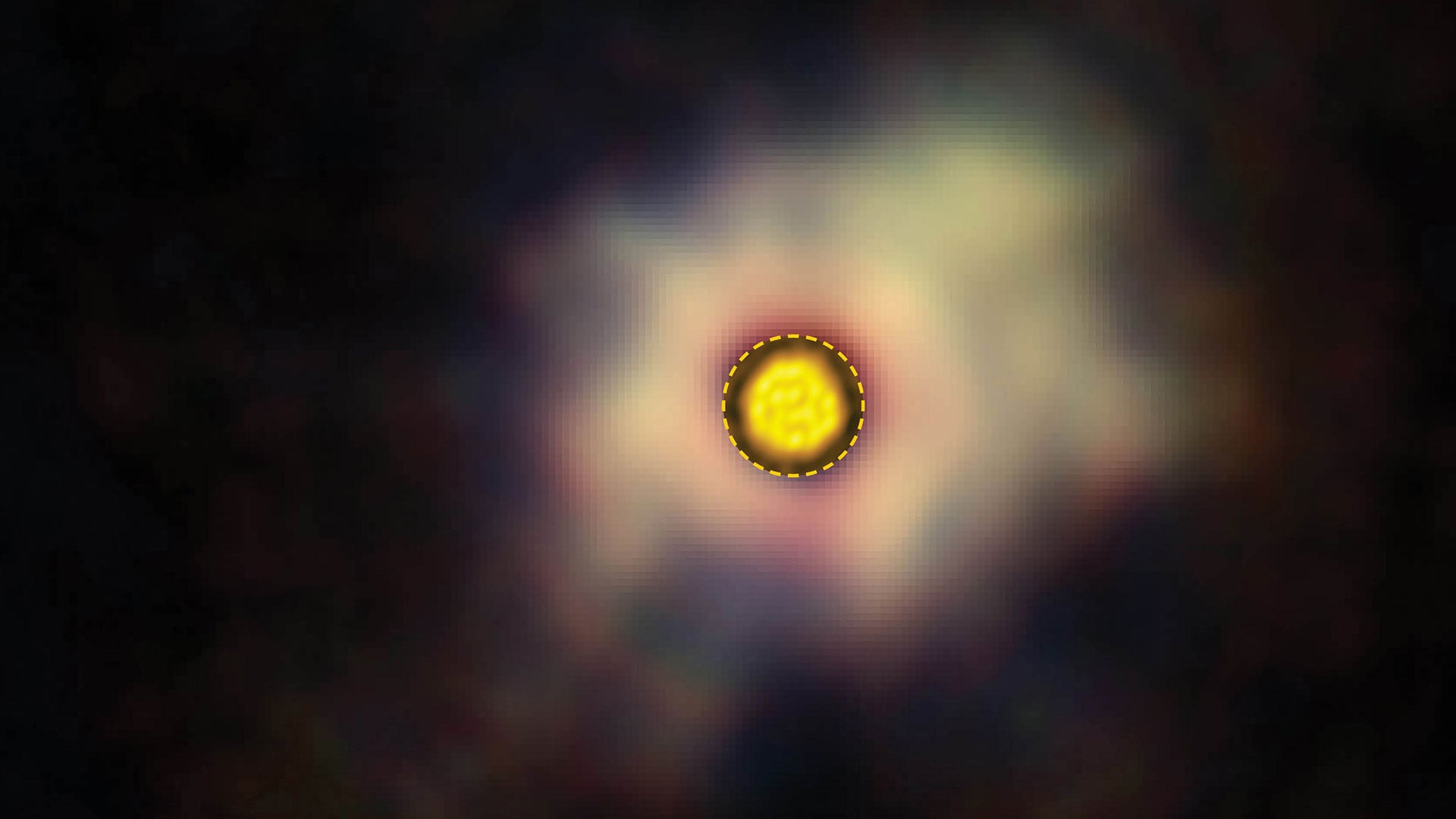
Red giant stars represent a late stage in the life of stars similar to the Sun, marked by cooler surface temperatures and greatly expanded sizes.
During this phase, they shed vast amounts of gas and dust through steady stellar winds, supplying the space between stars with the basic materials needed to form new planets and, eventually, life. Even with their central role in cosmic recycling, scientists have not yet reached a clear understanding of what actually powers these outflows.
A Closer Look at R Doradus
Astronomers studying the nearby red giant star R Doradus have discovered that the dust grains surrounding the star are extremely small. Their analysis shows that these particles cannot be pushed outward by the star’s light with enough force to break free into interstellar space.
The study, led by researchers at Chalmers University of Technology, is published in the scientific journal Astronomy & Astrophysics.
“Using the world’s best telescopes, we can now make detailed observations of the closest giant stars. R Doradus is a favourite target of ours – it’s bright, nearby, and typical of the most common type of red giant”, says Theo Khouri. “
The team observed R Doradus using the Sphere instrument on ESO’s Very Large Telescope, measuring light reflected by dust grains in a region roughly the size of our Solar System. By analysing polarised light at different wavelengths, the researchers determined the size and composition of the grains, finding them consistent with common forms of stardust such as silicates and alumina.
The observations were then combined with advanced computer simulations that model how starlight interacts with dust.
“For the first time, we were able to carry out stringent tests of whether these dust grains can feel a strong enough push from the star’s light”, says Thiébaut Schirmer.
When Starlight Falls Short
The push of starlight is not enough, the team was surprised to find. The grains surrounding R Doradus are typically only about one ten-thousandth of a millimetre across — far too small for starlight alone to drive the star’s wind into space.
“Dust is definitely present, and it is illuminated by the star,” says Thiébaut Schirmer. “But it simply doesn’t provide enough force to explain what we see.”
The findings point to other, more complex processes playing a major role. The team has previously used the ALMA telescope to capture images of enormous bubbles rising and falling on the surface of R Doradus.
“Even though the simplest explanation doesn’t work, there are exciting alternatives to explore,” says Wouter Vlemmings, professor at Chalmers and co-author of the study. “Giant convective bubbles, stellar pulsations, or dramatic episodes of dust formation could all help explain how these winds are launched.”
More about the star
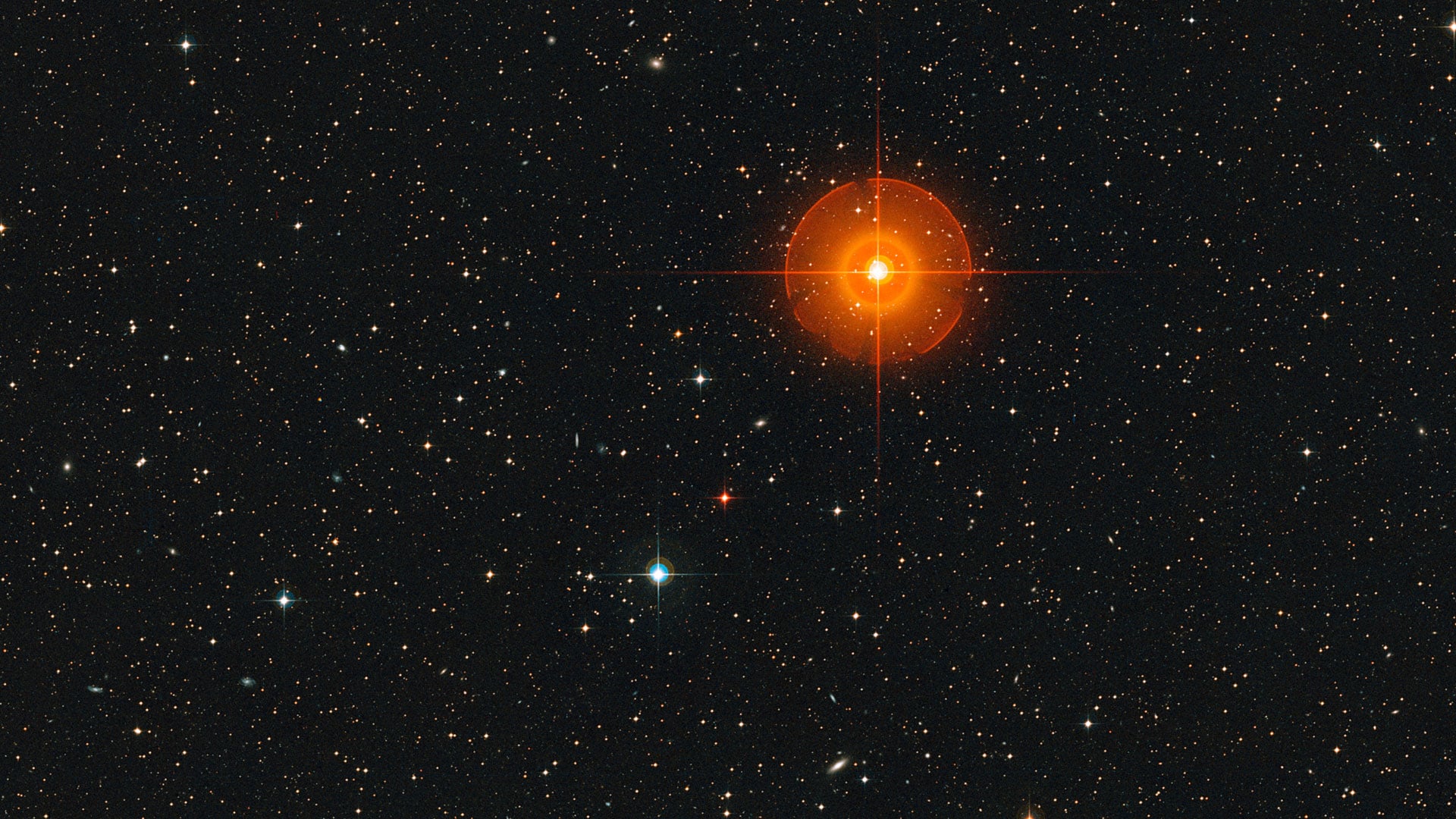
R Doradus is a red giant star located only 180 light years from Earth in the southern hemisphere constellation of Dorado, the Swordfish. Born with a mass similar to the Sun’s, it is now nearing the end of its life. It’s an example of an AGB star (AGB = asymptotic giant branch).
Such stars lose their outer layers to interstellar space in the form of dense stellar winds made of gas and dust. R Doradus loses the equivalent of a third of the Earth’s mass every decade. Other similar stars can lose mass hundreds or thousands of times faster. In the distant future, several billion years from now, the Sun is expected to become a star just like R Doradus.
Reference: “An empirical view of the extended atmosphere and inner envelope of the asymptotic giant branch star R Doradus – II. Constraining the dust properties with radiative transfer modelling” by Thiebaut Schirmer, Theo Khouri, Wouter Vlemmings, Gunnar Nyman, Matthias Maercker, Ramlal Unnikrishnan, Behzad Bojnordi Arbab, Kirsten K. Knudsen and Susanne Aalto, 27 November 2025, Astronomy & Astrophysics.
DOI: 10.1051/0004-6361/202556884
The research was carried out as part of the cross-disciplinary project “The origin and fate of dust in our Universe” funded by the Knut and Alice Wallenberg Foundation as a collaboration between researchers at Chalmers University of Technology and the University of Gothenburg.
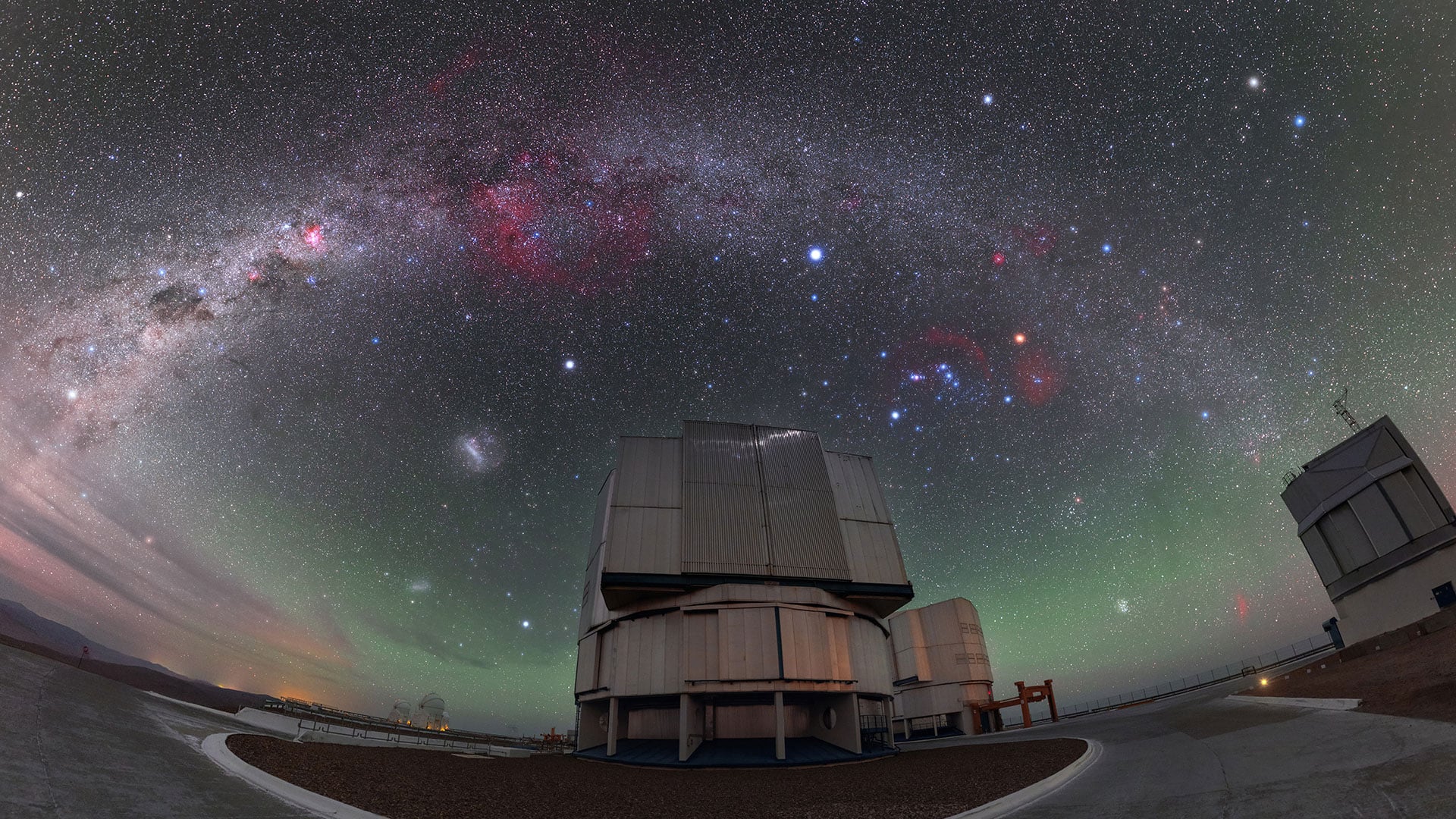
The team used the instrument Sphere (Spectro-Polarimetric High-contrast Exoplanet REsearch) on the Very Large Telescope (VLT), located at the Paranal Observatory in Chile. The VLT is operated by ESO, the European Southern Observatory. Sweden is one of ESO’s 16 member states.
Never miss a breakthrough: Join the SciTechDaily newsletter.
Follow us on Google and Google News.
2 Comments
” life forming elements”
This is certainly incorrect.
Memo 2512319637_Source 1. Reinterpretation []
Source 1.
https://scitechdaily.com/astronomers-overturn-decades-old-theory-about-how-stars-spread-lifes-ingredients/
1.
_Astronomers have overturned a decades-old theory about how stars spread the building blocks of life.
ㅡ [The stellar winds of red giants, which spread the building blocks of life throughout the universe, originate from system-scale mass loss (banc.mass_loss).
>>>For some reason, the stellar wind nk_wind(dust_system.sum) does not replace the galactic system unit qpeoms.unit. Hmm.
0655> 0714]
_Close observations of a nearby red giant have revealed that starlight alone may not be enough to generate the powerful stellar winds that spread the building blocks of life throughout the galaxy.
Red giants are old stars that have exhausted their cores of hydrogen and expanded to several times their original size. Observations of nearby red giants suggest that a long-standing explanation for how these massive stars disperse the elements essential for life throughout the galaxy may be incomplete.
1-1.
The force of starlight pushing against interstellar dust particles alone may not be enough to create the powerful winds that emanate from massive stars and transport life-forming elements throughout the Milky Way.
This is the central finding of a new study published by researchers at Chalmers University of Technology in Sweden, based on observations of the red giant star R Doradus. The results challenge decades-old explanations for how the atoms essential for life are dispersed throughout space.
1-2.
“We thought we knew how the process works, but it turns out we were wrong. As scientists, that’s the most exciting result,” said Theo Kuri, an astronomer at Chalmers University of Technology and co-lead author of the study.
Understanding how these stellar winds occur is crucial because red giants play a crucial role in supplying the galaxy with essential chemical elements. Scientists have long believed that stellar winds begin when starlight pushes newly formed dust particles outward.
2.
This idea has been used to explain how red giants expel carbon, oxygen, nitrogen, and other elements associated with future planets and life. However, new measurements of R Doradus suggest that this mechanism alone may not be sufficient.
Red giant stars represent the later stages of the life cycle of Sun-like stars, characterized by cooler surface temperatures and greatly expanded size.
During this stage, stars expel vast quantities of gas and dust through persistent stellar winds, supplying the interstellar space with the building blocks needed for the formation of new planets and, ultimately, life. Despite the crucial role these materials play in cosmic recycling, scientists still do not clearly understand the actual driving force behind this material release.
2-1. Let’s take a closer look at R Doradus.
Astronomers studying the nearby red giant R Doradus have discovered that the dust particles surrounding it are extremely small. Analysis revealed that these particles are not pushed by starlight with enough force to escape into interstellar space.
“Using the world’s best telescopes, we can now observe the closest giants in detail. R Doradus is a particularly exciting target for us because it is bright, close, and represents the most common type of red giant,” says Theo Kuri.
The team observed R Doradus using the Sphere instrument on the European Southern Observatory’s (ESO) Very Large Telescope and measured the light reflected by the dust particles over an area roughly the size of our solar system. By analyzing the polarization of light at various wavelengths, they determined the size and composition of the dust particles, finding that they match common forms of interstellar dust, such as silicates and alumina.
2-2. When Starlight Isn’t Enough
The team was surprised to discover that starlight alone wasn’t enough. The particles surrounding R Doradus are typically only one-ten-thousandth of a millimeter in diameter, too small for starlight alone to propel the star’s stellar wind into space.
“Clearly, dust is present, and it’s glowing brightly in the starlight,” says Thiébault Schirmer. “But dust alone doesn’t provide enough power to explain what we’re observing.”
3.
These results suggest that other, more complex processes are also playing a role. The team previously used the Atacama Large Millimeter/submillimeter Array (ALMA) to image a massive bubble rising and falling on the surface of R Doradus.
– [The stellar wind is caused by a mass loss event, qpeome(n).banc.mass_loss, which is the same size as the entire msbase(n) system.
>> This idea is explained by the way red giants expel massive amounts of mass from their systems, releasing carbon, oxygen, nitrogen, and other elements relevant for future planets and life. Hmm
>>>_”Giant convective bubbles, stellar pulsations, or dramatic dust production events could help explain how these winds arise.”
0647.49>>>50]
3-1. More about the star
_R Doradus is a red giant star located in the southern constellation Dorado (the Dorado), just 180 light-years from Earth. Born with a mass similar to that of the Sun, this star is now nearing the end of its lifespan. R Doradus is an example of an asymptotic giant branch (AGB) star.
_These stars expel their outer layers into interstellar space in the form of a dense stellar wind of gas and dust. R Doradus is losing mass equivalent to one-third of the mass of Earth every decade. Other similar stars can lose mass hundreds or thousands of times faster. It is predicted that in the distant future, billions of years from now, our Sun will become a star like R Doradus.
ㅡ [The process by which msbase gradually loses mass through banc sheds the outer layers of mass, much like a star shedding its outer shell. This process provides clues to how these winds are generated, including giant convective bubbles, stellar pulsations, and dramatic dust production events.
>>>These stars expel their outer layers into interstellar space in the form of dense stellar winds of gas and dust.
>>>Of course, since the reverse sequence reverse.banc_qpeoms.dark_energy created msbase.stars.galaxy, it seems only natural that the vast night sky outside, through the open door above the ascending stairs in the msbase stratum, would encounter dark matter and dark energy.
>>> It is clear that the mechanism by which a dying red giant generates a stellar wind is due to msbase/ shedding, shedding.banc_qpeoms.
>>The stellar wind disperses elements throughout the universe. >>Can AI make these kinds of inferences? I have thoughts on a cosmic scale, every second. Hehe.
>>>Other similar stars can also lose mass instantaneously at the speed of light due to stellar winds, or conversely, create stars. Of course, it could be even faster in the case of entanglement transfer, but that’s the case for dark matter and energy systems. Hehe.
2512310550>0551>0 619>26>28>0710 ]