
Close Menu
    Facebook X (Twitter) Instagram
    SciTechDaily
    • Biology
    • Chemistry
    • Earth
    • Health
    • Physics
    • Science
    • Space
    • Technology
    Facebook X (Twitter) Pinterest YouTube RSS
    SciTechDaily
    Home»Space»Astronomers Reveal Suppressed Star Formation in the Early Universe
    Space

    Astronomers Reveal Suppressed Star Formation in the Early Universe

    By Harvard-Smithsonian Center For AstrophysicsMay 12, 20192 Comments3 Mins Read
    Facebook Twitter Pinterest Telegram LinkedIn WhatsApp Email Reddit
    Share
    Facebook Twitter LinkedIn Pinterest Telegram Email Reddit
    Suppressed Star Formation in Early Universe
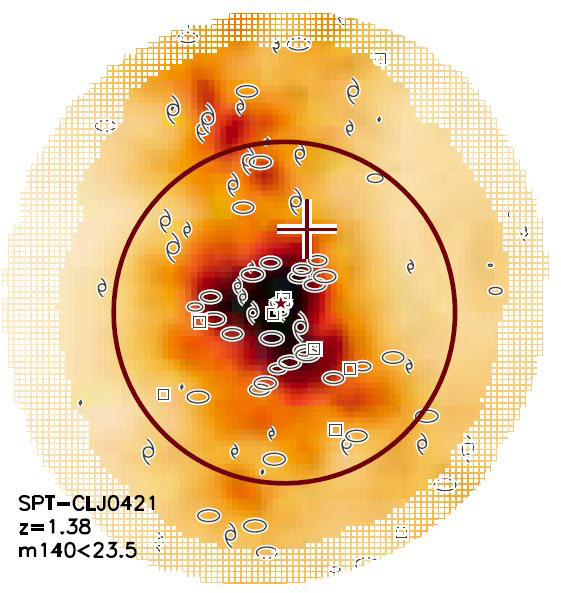
    A galaxy cluster map portraying the density of galaxies members in the massive cluster SPT-CLJ0421. Astronomers studying five such clusters in the epoch about 4.5 billion years after the big bang conclude that their star formation is quenched. Symbols show the positions of individual galaxies and the cross marks the position of the SPT detection. Credit: Strazzullo et al. 2019

    Massive clusters of galaxies, some with more mass than a hundred Milky Way galaxies, have been detected from cosmic epochs as early as about three billion years after the big bang. Their ongoing star formation makes them bright enough to be detected at these distances. These kinds of clusters were predicted by simulations of cosmological evolution but their properties are very uncertain. Astronomers piecing together the evolution of stars in the universe are particularly interested in these clusters because of their abundance of stars and activity.

    Star formation in galaxies is by no means a steady process. Not only can there be bursts of activity, prompted perhaps by a collision with a neighboring galaxy, but the opposite can occur. Star formation can be self- limiting because its massive young stars produce winds and supernovae that can blow apart the natal molecular clouds and disable future star formation. Combined with the disruption induced by jets from an active nuclear supermassive black hole, this disruptive process is called quenching and is thought to be able to bring star formation to a halt. Whether or not this occurs in the early universe, and when and how it proceeds, is a key area of comic research.

    CfA astronomers Matt Ashby and Esra Bulbul are members of the South Pole Telescope (SPT) team that discovered and studies massive galaxy clusters in the early universe. They recently completed a follow-up study of star formation and the stellar populations in most distant clusters found in the SPT surveys. Using the IRAC camera on the Spitzer Space Telescope along with the Hubble Space Telescope Wide Field camera, they probed five clusters located in the epoch about 4.5 billion years after the big bang, a time when galaxies in general were particularly active in producing new stars. Clusters of this size are exceedingly rare at these distances, and this is the first such study ever done of them. Using the infrared colors of the galaxies in the selected SPT clusters, the scientists were able to characterize the stars and the star formation activity. The scientists found that, curiously, during this epoch the massive clusters tend to host a mixture of galaxy types with quiescent galaxies being quite common. Apparently in these quiescent cluster members the quenching of star formation has already occurred. The astronomers conclude that star formation can be efficiently suppressed in the central regions of the most massive clusters even in these early cosmic epochs when the most intense star formation is occurring.

    Publication: “Galaxy Populations in the Most Distant SPT-SZ Clusters: I. Environmental quenching in massive clusters at 1.4. – z -.1.7,” by V. Strazzullo, M. Pannella, J. J. Mohr, A. Saro, M. L. N. Ashby, M. B. Bayliss, S. Bocquet, E. Bulbul, G. Khullar, A. B. Mantz, S. A. Stanford, B. A. Benson, L. E. Bleem, M. Brodwin, R. E. A. Canning, R. Capasso, I. Chiu, A. H. Gonzalez, N. Gupta1, J. Hlavacek-Larrondo, M. Klein, M. McDonald, E. Noordeh, D. Rapetti, C. L. Reichardt, T. Schrabback, K. Sharon, and B. Stalder, 7 February 2019, Astronomy & Astrophysics.
    DOI: 10.1051/0004-6361/201833944

    Never miss a breakthrough: Join the SciTechDaily newsletter.
    Follow us on Google and Google News.

    Astronomy Cosmology Harvard-Smithsonian Center for Astrophysics
    Share. Facebook Twitter Pinterest LinkedIn Email Reddit

    Related Articles

    Astronomers Just Reconstructed a Galaxy’s 12-Billion-Year History

    Webb’s Mysterious “Little Red Dots” May Be the Cradle of the First Black Holes

    Mysterious Radio Signals Reveal What’s Hiding Between Galaxies

    Cosmic Mystery Solved: Astronomers Have Discovered the Universe’s “Missing” Matter

    Invisible Storm Lights Up Galaxy Cluster With Record-Breaking Radio Glow

    Herschel Observations Help Identify the Physical Processes Underway in Cold, Dense Clouds

    CfA Scientists Measure the Rate of Expansion of the Universe

    New Study Challenges Planck Results

    Calculations Show the Ideal Time to Study the Cosmos

    2 Comments

    1. Peter Millican on May 12, 2019 10:13 am

      “key area of comic research…”

      Reply
    2. leo vuyk on May 13, 2019 5:31 am

      quote: “supernovae that can blow apart the natal molecular clouds and disable future star formation.”
      So should we look out for natal molecular cloud populations ?

      Reply
    Leave A Reply Cancel Reply

    • Facebook
    • Twitter
    • Pinterest
    • YouTube

    Don't Miss a Discovery

    Subscribe for the Latest in Science & Tech!

    Trending News

    Popular Sugar-Free Sweetener Linked to Liver Disease, Study Warns

    What Is Hantavirus? The Deadly Disease Raising Alarm Worldwide

    Scientists Just Discovered How the Universe Builds Monster Black Holes

    Scientists Unveil New Treatment Strategy That Could Outsmart Cancer

    A Simple Vitamin May Hold the Key to Treating Rare Genetic Diseases

    Scientists Think the Real Fountain of Youth May Be Hiding in Your Gut

    Ravens Don’t Follow Wolves, They Predict Them

    This Common Knee Surgery May Be Doing More Harm Than Good

    Follow SciTechDaily
    • Facebook
    • Twitter
    • YouTube
    • Pinterest
    • Newsletter
    • RSS
    SciTech News
    • Biology News
    • Chemistry News
    • Earth News
    • Health News
    • Physics News
    • Science News
    • Space News
    • Technology News
    Recent Posts
    • Why Are So Many New Fathers Dying? Scientists Say the U.S. Has a Dangerous Blind Spot
    • Scientists Identify Simple Supplement That Greatly Reduces Alzheimer’s Damage
    • You May Have a Dangerous Type of Cholesterol Even if Your Tests Look Normal
    • Study Reveals Dangerous Flaw in AI Symptom Checkers
    • New MRI Breakthrough Captures Stunningly Clear Images of the Eye and Brain
    Copyright © 1998 - 2026 SciTechDaily. All Rights Reserved.
    • Science News
    • About
    • Contact
    • Editorial Board
    • Privacy Policy
    • Terms of Use

    Type above and press Enter to search. Press Esc to cancel.