
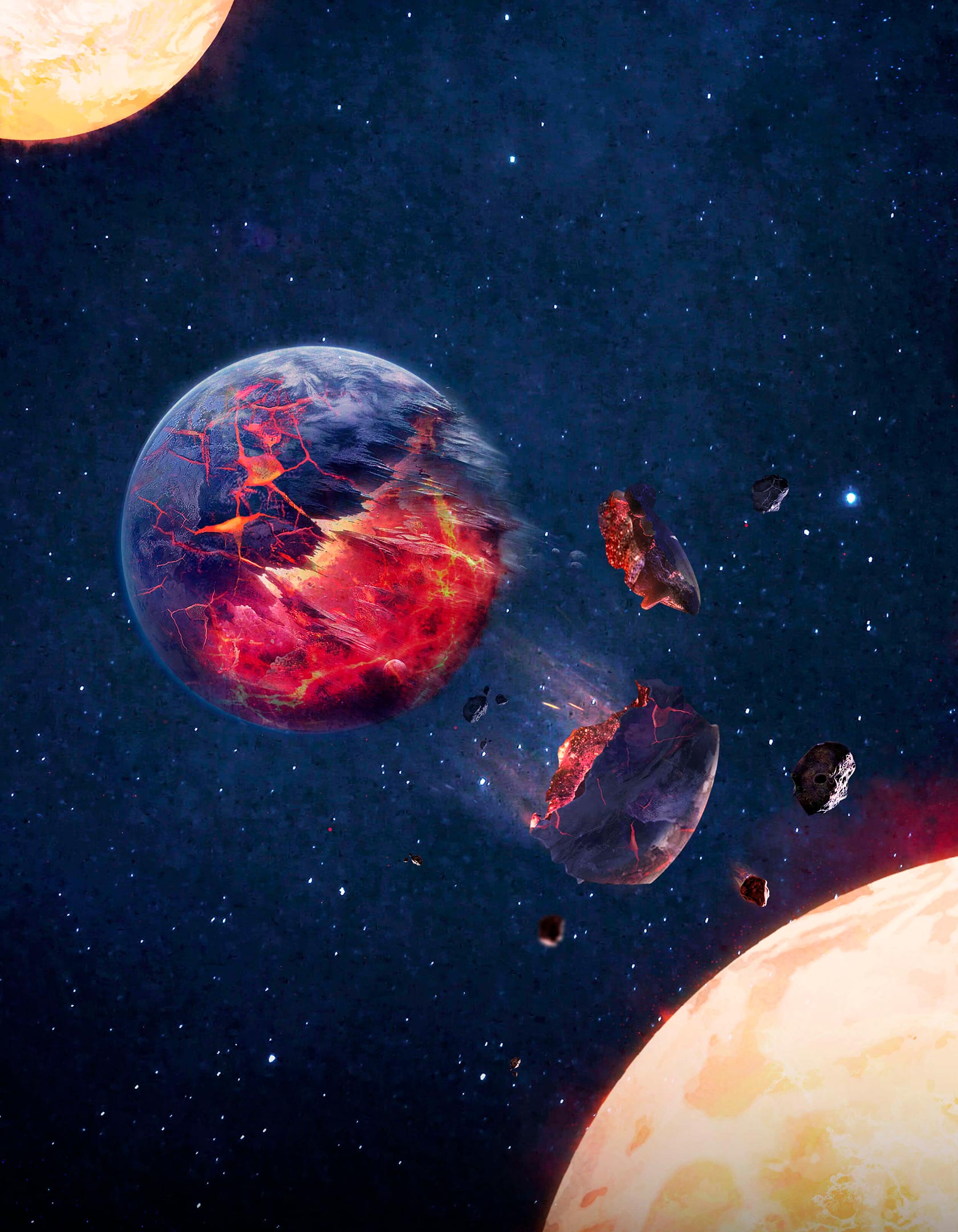
At least one in a dozen stars show evidence of planetary ingestion.
At least one in a dozen stars show evidence of planetary ingestion according to a paper published on March 20 in the journal Nature.
The international research team studied twin stars that should have identical composition. But, in about eight percent of cases, they differ, perplexing astronomers.
The team, led by ASTRO 3D researchers has found that the difference is due to one of the twins devouring planets or planetary material.
Advanced Astronomical Techniques
The findings have been made possible thanks to a large dataset collected with the 6.5-meter Magellan Telescope and the European Southern Observatory’s Very Large Telescope, both in Chile, and the 10-meter Keck Telescope in Hawaii, United States.
“We looked at twin stars traveling together. They are born of the same molecular clouds and so should be identical,” says ASTRO 3D Researcher Dr. Fan Liu, from Monash University, and lead author of the paper.
“Thanks to this very high precision analysis, we can see chemical differences between the twins. This provides very strong evidence that one of the stars has swallowed planets or planetary material and changed its composition.”
Stellar Evolution Insights
The phenomenon appeared in about eight percent of the 91 pairs of twin stars that the team looked at. What makes this study compelling is that the stars were in their prime of life – so-called main sequence stars, rather than stars in their final phases such as red giants.
“This is different from previous studies where late-stage stars can engulf nearby planets when the star becomes a very giant ball,” Dr. Liu says.
There is some room for doubt as to whether the stars are swallowing planets whole or engulfing protoplanetary material but Dr. Liu suspects both are possible.
“It’s complicated. The ingestion of the whole planet is our favored scenario but of course, we can also not rule out that these stars have ingested a lot of material from a protoplanetary disk,” he says.
The findings have wide-ranging implications for the study of the long-term evolution of planetary systems.
Astronomical Research Impact
“Astronomers used to believe that these kinds of events were not possible. But from the observations in our study, we can see that, while the occurrence is not high, it is actually possible. This opens a new window for planet evolution theorists to study,” says Associate Professor Yuan-Sen Ting, a co-author and an ASTRO 3D researcher from the Australian National University (ANU).
The study forms part of a larger collaboration, the Complete Census of Co-moving Pairs of Objects (C3PO) initiative to spectroscopically observe a complete sample of all bright co-moving stars identified by the Gaia astrometric satellite, which is jointly led by Liu, Ting, and Associate Professor David Yong (also with ASTRO 3D at ANU).
“The findings presented here contribute to the big picture of a key ASTRO 3D research theme: the Chemical Evolution of the Universe. Specifically, they shed light on the distribution of chemical elements and their subsequent journey, which includes being consumed by stars,” said Professor Emma Ryan-Weber, Director of ASTRO 3D.
Note: the researchers worked with twin stars known as co-natal – borne in the same molecular clouds and traveling together. They are not necessarily binary stars, though some of the pairs were.
Reference: “At least one in a dozen stars shows evidence of planetary ingestion” by Fan Liu, Yuan-Sen Ting, David Yong, Bertram Bitsch, Amanda Karakas, Michael T. Murphy, Meridith Joyce, Aaron Dotter and Fei Dai, 20 March 2024, Nature.
DOI: 10.1038/s41586-024-07091-y
Scientists from Australia’s Swinburne University of Technology, University College Cork in Ireland, Carnegie Observatories, Ohio State University, Dartmouth College in United States, Konkoly Observatory in Hungry, and the Max Planck Institute for Astronomy took part in the research.
Never miss a breakthrough: Join the SciTechDaily newsletter.
Follow us on Google and Google News.