
Close Menu
    Facebook X (Twitter) Instagram
    SciTechDaily
    • Biology
    • Chemistry
    • Earth
    • Health
    • Physics
    • Science
    • Space
    • Technology
    Facebook X (Twitter) Pinterest YouTube RSS
    SciTechDaily
    Home»Chemistry»Unlocking TNA: Researchers Develop Artificial Building Blocks of Life
    Chemistry

    Unlocking TNA: Researchers Develop Artificial Building Blocks of Life

    By University of CologneMarch 25, 2024No Comments3 Mins Read
    Facebook Twitter Pinterest Telegram LinkedIn WhatsApp Email Reddit
    Share
    Facebook Twitter LinkedIn Pinterest Telegram Email Reddit
    Abstract Chemistry Art Concept
    Groundbreaking research has led to the creation of threofuranosyl nucleic acid (TNA), offering enhanced stability and therapeutic potential, with applications in drug delivery and diagnostics. Credit: SciTechDaily.com

    Groundbreaking research has led to the creation of threofuranosyl nucleic acid (TNA), offering enhanced stability and therapeutic potential, with applications in drug delivery and diagnostics.

    The DNA carries the genetic information of all living organisms and consists of only four different building blocks, the nucleotides. Nucleotides are composed of three distinctive parts: a sugar molecule, a phosphate group, and one of the four nucleobases adenine, thymine, guanine, and cytosine. The nucleotides are lined up millions of times and form the DNA double helix, similar to a spiral staircase.

    Breakthrough in Nucleic Acid Research

    Scientists from the Breakthrough in Nucleic Acid Research’s Department of Chemistry have now shown that the structure of nucleotides can be modified to a great extent in the laboratory. The researchers developed so-called threofuranosyl nucleic acid (TNA) with a new, additional base pair. These are the first steps on the way to fully artificial nucleic acids with enhanced chemical functionalities. The study ‘Expanding the Horizon of the Xeno Nucleic Acid Space: Threose Nucleic Acids with Increased Information Storage’ was published in the Journal of the American Chemical Society.
    Artificial Nukleotides
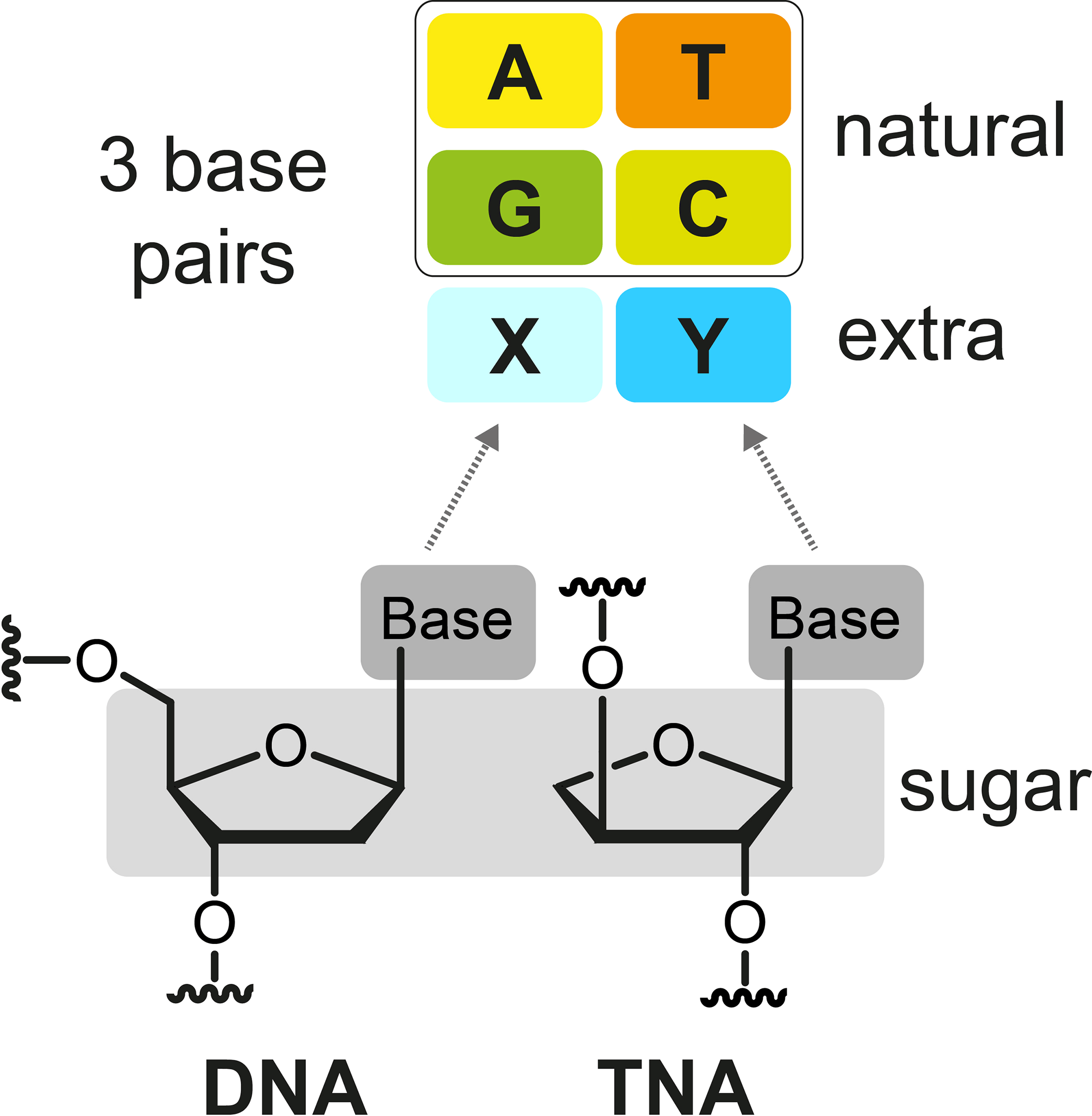
    Structural comparison of DNA and the artificial TNA, a Xeno nucleic acid with the natural base pairs AT and GC and an additional base pair (XY). Credit: Stephanie Kath-Schorr

    Potential of Artificial Nucleic Acids

    Artificial nucleic acids differ in structure from their originals. These changes affect their stability and function.

    “Our threofuranosyl nucleic acid is more stable than the naturally occurring nucleic acids DNA and RNA, which brings many advantages for future therapeutic use,” said Professor Dr Stephanie Kath-Schorr.

    For the study, the 5-carbon sugar deoxyribose, which forms the backbone in DNA, was replaced by a 4-carbon sugar. In addition, the number of nucleobases was increased from four to six. By exchanging the sugar, the TNA is not recognized by the cell’s own degradation enzymes. This has been a problem with nucleic acid-based therapeutics, as synthetically produced RNA that is introduced into a cell is rapidly degraded and loses its effect. The introduction of TNAs into cells that remain undetected could now maintain the effect for longer.

    “In addition, the built-in unnatural base pair enables alternative binding options to target molecules in the cell,” added Hannah Depmeier, lead author of the study.

    Kath-Schorr is certain that such a function can be used in particular in the development of new aptamers, short DNA or RNA sequences, which can be used for the targeted control of cellular mechanisms. TNAs could also be used for the targeted transport of drugs to specific organs in the body (targeted drug delivery) as well as in diagnostics; they could also be useful for the recognition of viral proteins or biomarkers.

    Reference: “Expanding the Horizon of the Xeno Nucleic Acid Space: Threose Nucleic Acids with Increased Information Storage” by Hannah Depmeier and Stephanie Kath-Schorr, 5 March 2024, Journal of the American Chemical Society.
    DOI: 10.1021/jacs.3c14626

    Never miss a breakthrough: Join the SciTechDaily newsletter.
    Follow us on Google and Google News.

    Biochemistry Genetics University of Cologne
    Share. Facebook Twitter Pinterest LinkedIn Email Reddit

    Related Articles

    How Three Mutations Work Together To Spur New COVID-19 Variants

    Innovative Chemical “Nose” Sniffs Critical Differences in DNA Structures

    Highly-Selective New Tool to Dissect the “Undruggable”

    New Forensic DNA Technology to Combat Terrorism – Dust on Boots, Baggage Can Track Down Suspects

    Small Molecule Identified That Targets Genes of COVID-19 Virus for Destruction

    Hidden Symmetry Discovered in Chemical Kinetic Equations – Significant for Drug Design, Genetics & More

    Life’s Frankenstein Beginnings: Surprising Discoveries About First Building Blocks of Life on Earth

    Human Cells Made Magnetic With Engineered Protein Crystals

    Quantum Chemistry Solves Amino Acid Mystery

    Leave A Reply Cancel Reply

    • Facebook
    • Twitter
    • Pinterest
    • YouTube

    Don't Miss a Discovery

    Subscribe for the Latest in Science & Tech!

    Trending News

    Don’t Miss: A Brilliant Venus and Glowing Harvest Moon Light Up the Sky

    New Twist on the Einstein Problem Reveals Unexpected Physics

    JWST Captures Stunning Evidence of How Supermassive Black Holes Feed

    Early Exercise May Permanently Change How Much Energy the Body Uses To Move

    New Molecule Wipes Out Aggressive Lymphoma Tumors in Mice in Just 11 Days

    The Human Family Tree May Need a Major Rewrite

    Scientists Find a Surprising Cancer-Fighting Effect in Dark Sweet Cherries

    New AI Detects Hidden Warning Signs of Solar Eruptions Hours Before They Emerge

    Follow SciTechDaily
    • Facebook
    • Twitter
    • YouTube
    • Pinterest
    • Newsletter
    • RSS
    SciTech News
    • Biology News
    • Chemistry News
    • Earth News
    • Health News
    • Physics News
    • Science News
    • Space News
    • Technology News
    Recent Posts
    • Scientists May Have Finally Explained Why Astronauts Get Constipated in Space
    • Pomegranates Could Unlock a New Treatment for Heart Failure
    • Africa’s Giant Herbivores Were Disappearing Millions of Years Before Humans Could Hunt Them
    • This Utah Mountain Is Hiding Enough Ice To Fill 600 Olympic Pools
    • Vagus Nerve Stimulation Could Unlock the Brain’s Hidden Learning Potential
    Copyright © 1998 - 2026 SciTechDaily. All Rights Reserved.
    • Science News
    • About
    • Contact
    • Editorial Board
    • Privacy Policy
    • Terms of Use

    Type above and press Enter to search. Press Esc to cancel.