
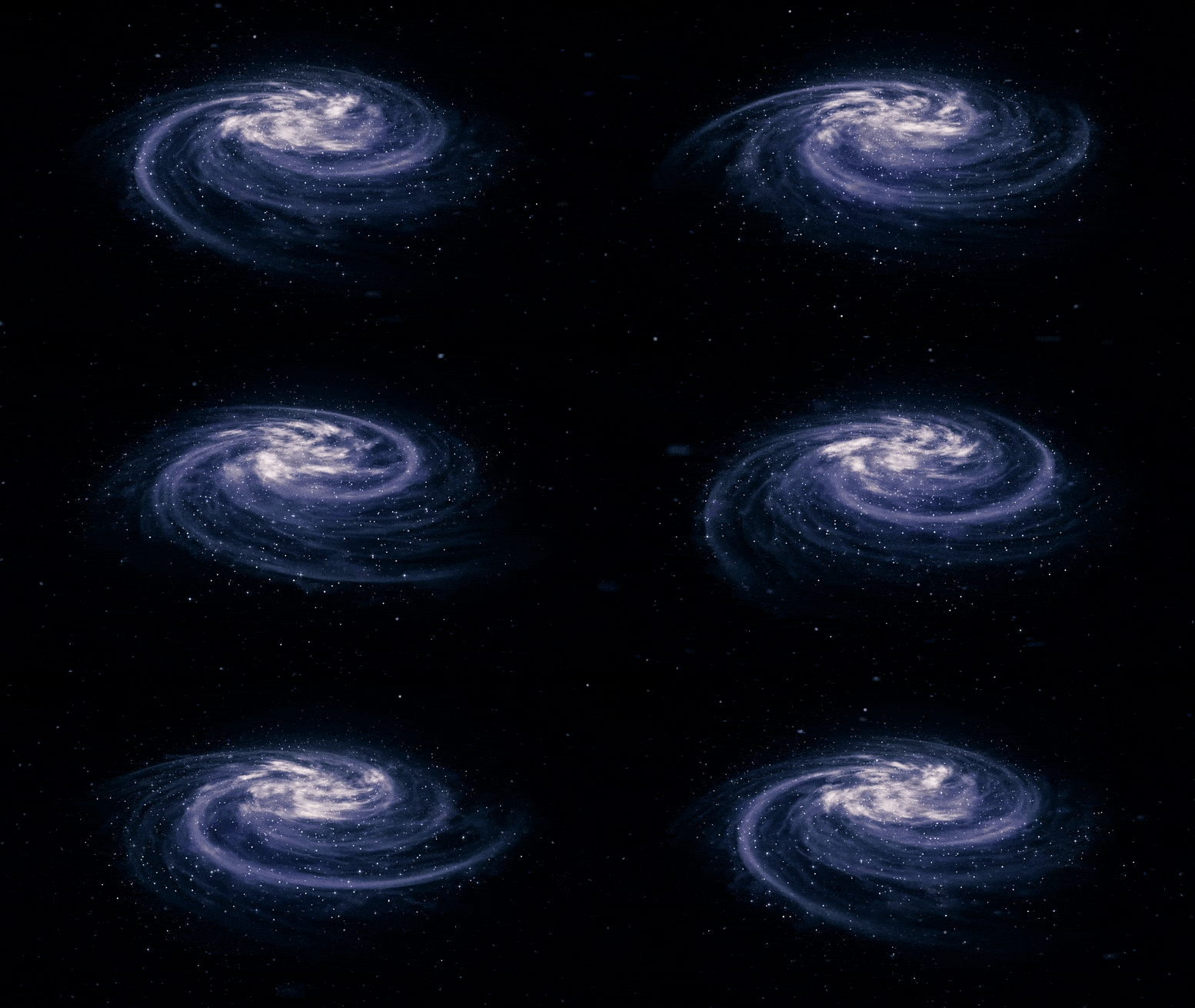
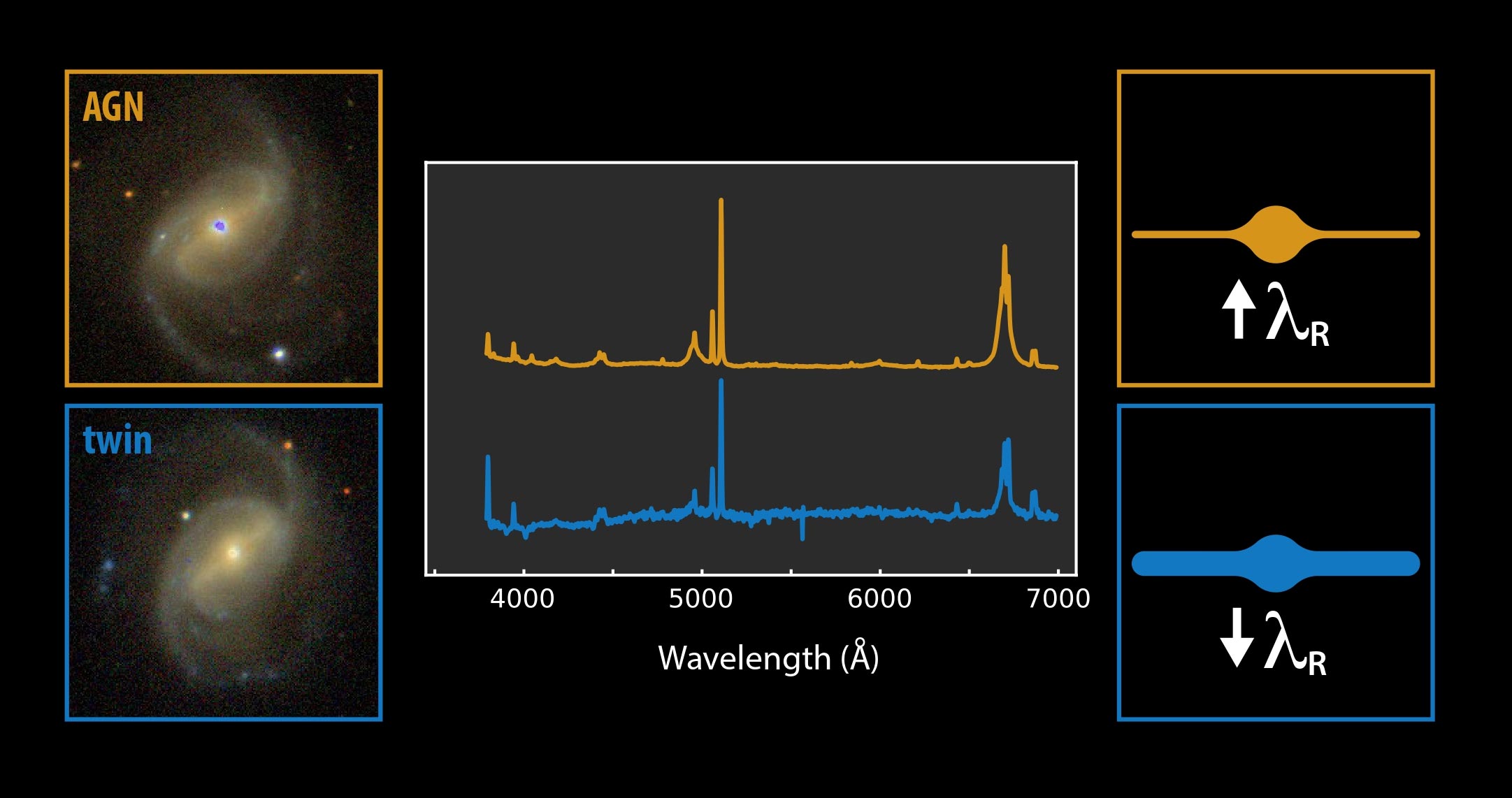
A study led by researchers at the Instituto de Astrofísica de Canarias (IAC), making comparison between the discs of several pairs of spiral galaxies, active and non-active, concludes that in the discs of the former, the rotational motion of the stars is of greater importance. This study, just accepted for publication in Astronomy & Astrophysics Letters, is the first evidence for large scale dynamical differences between active and non-active galaxies in the local universe. The astronomers participating are from the Instituto de Astrofísica de Canarias (IAC) and the University of La Laguna (ULL); as well as the NatiAstronomical First: Differences Detected Between Discs of Active and Non-active Galaxiesonal Autonomous University of Mexico (UNAM), the Complutense University of Madrid (UCM) and the Instituto de Astrofísica de Andalucia (IAA).
There is now evidence that the supermassive black holes at the centers of the majority of galaxies have a basic influence on their evolution. In some of them, the black hole is ingesting the material surrounding it at a very high rate, emitting a large quantity of energy. In those cases we say that the galaxy has an active nucleus (AGN). The material which feeds the AGN must initially be quite distant from the nucleus, in the disc of the galaxy, rotating around its center. This gas must, one way or another, have been “braked” in order to fall into the central zone, a process known as loss of angular momentum.
“Studying the mechanisms which control the relation between the active nucleus and the rest of the galaxy -explains Ignacio del Moral Castro, a doctoral student in the IAC and the University of La Laguna (ULL) and first author of the article- is necessary to understand how these objects form and evolve, and to be able to throw light on this question we need to compare active and non-active galaxies. With this purpose, the main idea of my doctoral thesis is centred on the study and comparison of galaxies which are almost twin, but with the difference being nuclear activity.”
The work has consisted of comparing the dynamics of the galactic discs of various active/non-active pairs. The researchers used data from the CALIFA survey (Calar Alto Legacy Integral Field Area). This contains spectroscopic data over complete 2D fields for more than 600 galaxies, taken at the Calar Alto Observatory in Almería, which allow observations of virtually the whole of each galaxy, so that its global characteristics can be studied.
Novel methodology
Previously, in the majority of studies the procedure used was the identification of a sample of active galaxies within a large survey, which were then compared to the rest of the galaxies in the survey having similar properties that do not show nuclear activity. However, this time, the researchers used a novel method: they performed one-to-one comparisons. Firstly, they identified active spiral galaxies in the CALIFA sample, and for each of them they looked for a non-active galaxy which had equivalent global properties, i.e. with the same mass, brightness, orientation, and so on, and very similar in appearance.
Using this method the team put forward two scenarios to explain the dynamical differences between active and non-active galaxies. In the first, the explanation would be that it is the trace of the angular momentum transfer between the gas which has fallen into the center and the material which remains in the disc. The second attributes the difference to the infall of gas from outside, via the capture of small nearby satellite galaxies, in which case, this capture should occur more frequently in the active galaxies. Both scenarios are compatible with this result and they are not mutually exclusive.
“The result surprised us; we really didn’t expect to find this type of differences on a large scale, given that the duration of the active phase is very short in comparison with the lifetime of a galaxy, and with the time needed to produce morphological and dynamical changes,” says Begoña García Lorenzo, and IAC researcher, and a coauthor of the article.
“Up to now we thought that all galaxies go through active phases during their lifetimes, but this result could mean that this is not the case, which would imply a major change to current models,” adds Cristina Ramos Almeida, also an IAC researcher and coauthor of the article.
Reference: “Larger λR in the disc of isolated active spiral galaxies than in their non-active twins” by I. del Moral-Castro, B. García-Lorenzo, C. Ramos Almeida, T. Ruiz-Lara, J. Falcón-Barroso, S.F. Sánchez, P. Sánchez-Blázquez, I. Márquez and J. Masegosa, 14 July 2020, Astronomy & Astrophysics Letters.
DOI: 10.1051/0004-6361/202038091
arXiv: 2006.12654
Never miss a breakthrough: Join the SciTechDaily newsletter.
Follow us on Google and Google News.
1 Comment
bla bla bla