
Close Menu
    Facebook X (Twitter) Instagram
    SciTechDaily
    • Biology
    • Chemistry
    • Earth
    • Health
    • Physics
    • Science
    • Space
    • Technology
    Facebook X (Twitter) Pinterest YouTube RSS
    SciTechDaily
    Home»Biology»Asymmetrical Dinosaur Skull Discovery Turns Paleontology Assumptions on Their Head
    Biology

    Asymmetrical Dinosaur Skull Discovery Turns Paleontology Assumptions on Their Head

    By University of AlbertaNovember 25, 2019No Comments3 Mins Read
    Facebook Twitter Pinterest Telegram LinkedIn WhatsApp Email Reddit
    Share
    Facebook Twitter LinkedIn Pinterest Telegram Email Reddit
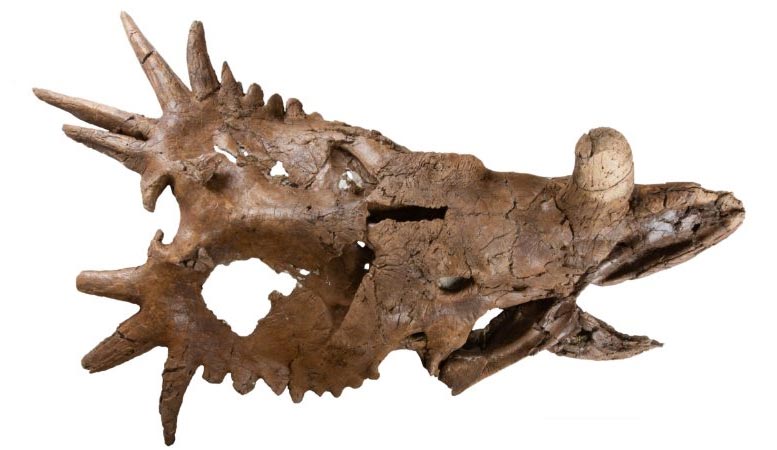
    Hannah's Skull
    Hannah’s skull. Credit: Scott Persons.

    University of Alberta paleontologists uncover spiky skull—and overturn long-standing assumptions in identifying horned dinosaurs.

    A team of researchers at the University of Alberta has unearthed a well-preserved Styracosaurus skull—and its facial imperfections have implications for how paleontologists identify new species of dinosaurs.

    The skull was discovered by Scott Persons in 2015, then a graduate student in the Department of Biological Sciences, during an expedition in the badlands northwest of Dinosaur Provincial Park.

    Nicknamed Hannah, the dinosaur was a Styracosaurus—a horned dinosaur over five meters in length with a fan of long horns. UAlberta paleontologists led by Robert Holmes, professor in the Department of Biological Sciences, have learned much from those horns—because they aren’t symmetrical.
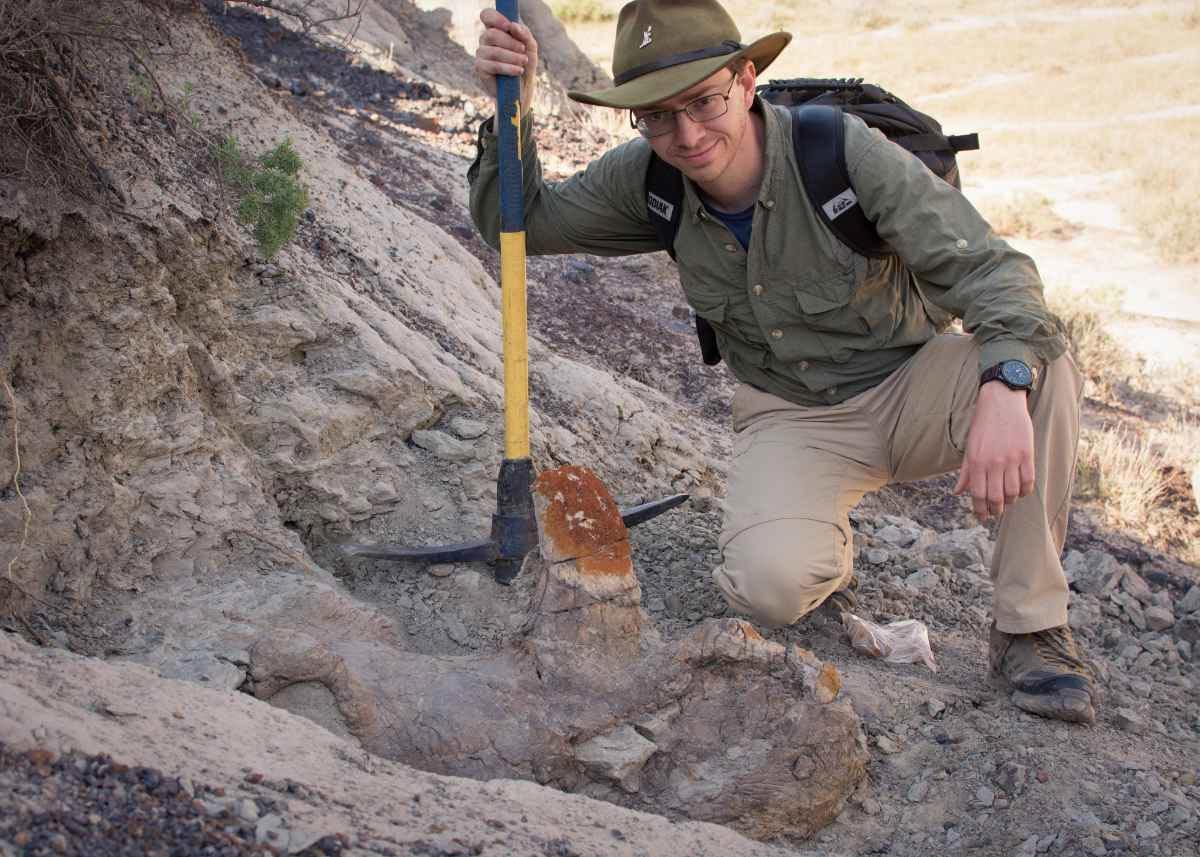
    Paleontologist Scott Persons
    Paleontologist Scott Persons, pictured alongside the partially-uncovered skull. The Styracosaurus skull has implications for how horned dinosaurs are identified. Credit: Scott Persons.

    “When parts of one side of the skull were missing, paleontologists have assumed that the missing side was symmetrical to the one that was preserved,” explained Persons. “Turns out, it isn’t necessarily. Today, deer often have left and right antlers that are different in terms of their branching patterns. Hannah shows dramatically that dinosaurs could be the same way.”
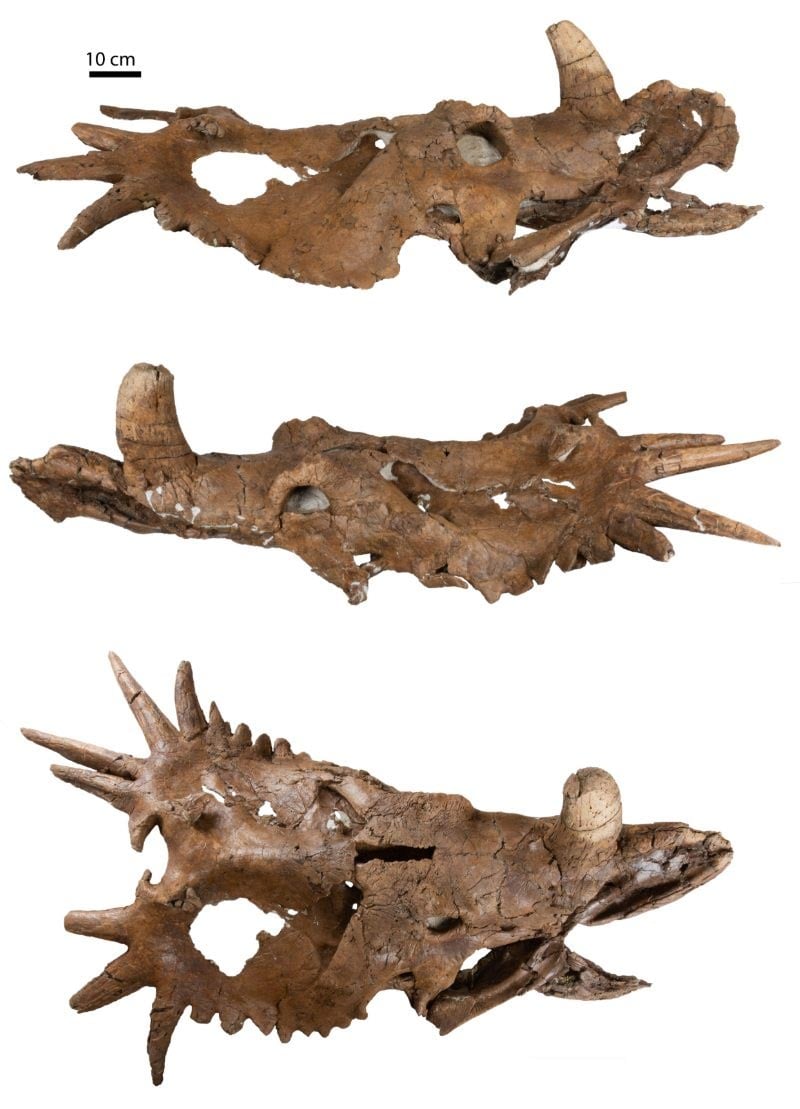
    Hannah's Skull All Sides
    Hannah’s skull, seen from all sides. The jacket used to recover Hannah’s skull weighed 2500 kilograms—requiring a helicopter to retrieve from the field! Credit: Scott Persons.

    The differences in the skull’s left and right halves are so extreme that had the paleontologists found only isolated halves, they might have concluded that they belong to two different species

     “The skull shows how much morphological variability there was in the genus,” said Holmes. Like the antlers of modern deer and moose, Hannah shows that the pattern of dinosaur horns could vary significantly—meaning some fossils that were once assumed to be unique species will have to be reevaluated.

    Stumbling upon a skull

    Tradition dictates that the person who finds an important dinosaur specimen gets to give it a nickname. “Hannah the dinosaur is named after my dog,” explained Persons, now a professor and museum curator at the College of Charleston. “She’s a good dog, and I knew she was home missing me while I was away on the expedition.”

    Despite the nickname, paleontologists have no way of knowing if the dinosaur was female. But they have learned other details from the skull—from a partnership with researchers in the Faculty of Engineering.

    “Ahmed Qureshi and graduate student Baltej Rupal in the Faculty of Engineering assisted us in performing a 3D laser scan of the skull,” said Persons. “That let our publication to include a digital reconstruction, allowing scientists all over the world to download the 3D model and inspect it in detail.”

    “This is the future of paleontological collections: digital dinosaurs.”

    Reference: “Morphological variation and asymmetrical development in the skull of Styracosaurus albertensis” by Robert B. Holmes, Walter Scott Persons, Baltej Singh Rupal, Ahmed Jawad Qureshi and Philip J. Currie, 8 November 2019, Cretaceous Research.
    DOI: 10.1016/j.cretres.2019.104308

    Never miss a breakthrough: Join the SciTechDaily newsletter.
    Follow us on Google and Google News.

    Dinosaurs Fossils Paleontology University of Alberta
    Share. Facebook Twitter Pinterest LinkedIn Email Reddit

    Related Articles

    Paleontologists Discover First North American Co-occurrence of Hadrosaur and Therizinosaur Tracks

    ‘Bloat-and-Float’ Explains Dinosaur Fossil Mystery

    Newly Discovered Dinosaur (Mansourasaurus shahinae) Links Africa and Europe

    Tiny Jurassic Dinosaur Featured Rainbow Ruff and a Bony Crest

    New Species of Horned Dinosaur – Regaliceratops Peterhewsi

    Paleontologists Announce the Discovery of Bird-Like Dinosaur Anzu Wyliei

    Discovery of ‘Bird-Dinosaur’ Eosinopteryx Challenges Bird Evolution Theory

    Nyasasaurus, Oldest Dinosaur Believed to Be 243 Million Years Old

    Pegomastax Africanus, A Miniature Dinosaur That Thrived in Southern Africa

    Leave A Reply Cancel Reply

    • Facebook
    • Twitter
    • Pinterest
    • YouTube

    Don't Miss a Discovery

    Subscribe for the Latest in Science & Tech!

    Trending News

    The Strange “Spacetime Crystal” That Can Suddenly Turn Into a Black Hole

    The Surprising Way Asteroids May Have Helped Life Begin on Earth

    Vast Hidden Structure Discovered Under Miles of Ice in East Antarctica

    A Surprising Discovery Suggests Autism Is Not One Condition

    New Alzheimer’s Discovery Could Change How Scientists Fight the Disease

    Yale Discovery Overturns Long-Held “Evolutionary Dead End” Theory

    UCLA Scientists Uncover a “Hidden Weakness” in Some of the World’s Deadliest Cancers

    Humpback Whale Stuns Scientists With 15,000 Kilometer Journey Across Oceans

    Follow SciTechDaily
    • Facebook
    • Twitter
    • YouTube
    • Pinterest
    • Newsletter
    • RSS
    SciTech News
    • Biology News
    • Chemistry News
    • Earth News
    • Health News
    • Physics News
    • Science News
    • Space News
    • Technology News
    Recent Posts
    • Food Waste Becomes a Powerful Carbon Trap in Climate Breakthrough
    • Battery-Free Artificial Photosynthesis Turns Sunlight, Water, and CO2 Into Fuel
    • How Ancient People Moved a 6-Ton Stone 700 Kilometers to Stonehenge
    • Scientists Finally See How Antibodies Really Attack Viruses
    • The Unexpected Gut Health Risk of Cutting Out Sugar
    Copyright © 1998 - 2026 SciTechDaily. All Rights Reserved.
    • Science News
    • About
    • Contact
    • Editorial Board
    • Privacy Policy
    • Terms of Use

    Type above and press Enter to search. Press Esc to cancel.