
Close Menu
    Facebook X (Twitter) Instagram
    SciTechDaily
    • Biology
    • Chemistry
    • Earth
    • Health
    • Physics
    • Science
    • Space
    • Technology
    Facebook X (Twitter) Pinterest YouTube RSS
    SciTechDaily
    Home»Biology»Nyasasaurus, Oldest Dinosaur Believed to Be 243 Million Years Old
    Biology

    Nyasasaurus, Oldest Dinosaur Believed to Be 243 Million Years Old

    By SciTechDailyDecember 5, 20122 Comments3 Mins Read
    Facebook Twitter Pinterest Telegram LinkedIn WhatsApp Email Reddit
    Share
    Facebook Twitter LinkedIn Pinterest Telegram Email Reddit
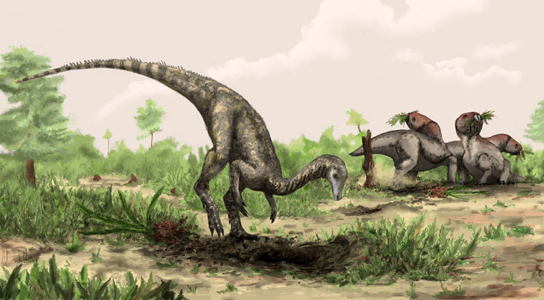
    Nyasasaurus
    An artist’s reconstruction of Nyasasaurus, which is either the earliest known dinosaur or a close relative. Credit: Copyright Natural History Museum, London/Mark Witton

    Paleontologists think that they may have identified the earliest known dinosaur, which was no bigger than a Labrador retriever and lived 243 million years ago, during the Triassic Period. This is 10 million years earlier than the previously oldest known dinosaurs, and could change researchers’ views of how they evolved.

    The scientists published their findings in the journal Biology Letters. Some scientists, including the authors, caution that the fossils could also represent a close relative to dinosaurs.

    The earliest dinosaurs were probably Eoraptor and Eodromaeus, which were true dinosaurs, and lived in what was Argentina 230 million years ago.  In 2010, Sterling Nesbitt, a paleontologist at the University of Washington, Seattle, discovered a close relative to dinosaurs in Tanzania’s Manda Beds, a geological formation dated between 242 million and 245 million years ago. Asilisaurus isn’t a dinosaur, but a sister taxon, the closest that it could be without actually being a dinosaur.

    Nyasasaurus was discovered in the 1930s by the paleontologist Alan Charig from London’s Natural History Museum. The fossils include an arm bone and several vertebrae, and were also discovered in the Manda Beds. Nesbitt and his colleagues took a closer look at them.

    The scientists carried out a systematic comparison between the bones of dinosaurs and their closest relative species. The findings indicate that Nyasasaurus has a number of features characteristic of true dinosaurs. It had a broad crest of bone along the edge of its upper arm, which would have been attached to its chest muscles. The crest extends to more than 30% of the bone’s length, which is indicative of dinosaurs. Nyasasaurus had three vertebrae in its sacrum, whereas proto-dinosaur species had only two. A microscopic study of the arm bone showed that it had grown rapidly during the animal’s development, typical of dinosaurs, as well as mammals and birds.

    This combination of features has led the scientists to think that Nyasasaurus was either a true dinosaur or the closest relative that has been discovered. By the time that Eoraptor and Eodromaeus appeared in Argentina, 10 million years later, they represented a diverse group that must have been evolving for millions of years. This could mean that dinosaur evolution must have begun a considerable time before that.

    At that time, Africa was part of the supercontinent Pangaea, which included modern-day South America, Antarctica, and Australia. The scientists state that Nyasasaurus is probably, but not definitely a dinosaur, because the arm bone isn’t complete.

    Reference: “The oldest dinosaur? A Middle Triassic dinosauriform from Tanzania” by Sterling J. Nesbitt, Paul M. Barrett, Sarah Werning, Christian A. Sidor and Alan J. Charig, 23 February 2013, Biology Letters.
    DOI: 10.1098/rsbl.2012.0949

    Never miss a breakthrough: Join the SciTechDaily newsletter.
    Follow us on Google and Google News.

    Dinosaurs Fossils Paleontology
    Share. Facebook Twitter Pinterest LinkedIn Email Reddit

    Related Articles

    Burnt Toast and Dinosaur Bones Have a Common Trait

    Paleontologists Discover First North American Co-occurrence of Hadrosaur and Therizinosaur Tracks

    ‘Bloat-and-Float’ Explains Dinosaur Fossil Mystery

    Newly Discovered Dinosaur (Mansourasaurus shahinae) Links Africa and Europe

    Tiny Jurassic Dinosaur Featured Rainbow Ruff and a Bony Crest

    New Species of Horned Dinosaur – Regaliceratops Peterhewsi

    Paleontologists Announce the Discovery of Bird-Like Dinosaur Anzu Wyliei

    Discovery of ‘Bird-Dinosaur’ Eosinopteryx Challenges Bird Evolution Theory

    Pegomastax Africanus, A Miniature Dinosaur That Thrived in Southern Africa

    2 Comments

    1. Gradivus on December 5, 2012 10:53 am

      Oldest dinosaur? 243 million years and he’s not dead yet? What’s his secret?

      Reply
    2. Dr. A. Kwekason on September 11, 2013 11:42 pm

      It is long time since the fossils taken out of the country (Tanzania) and no sign of returning them back to the country of origin.
      Are they going to end like Tendaguru dinosaurs in German?

      What a shame?

      Reply
    Leave A Reply Cancel Reply

    • Facebook
    • Twitter
    • Pinterest
    • YouTube

    Don't Miss a Discovery

    Subscribe for the Latest in Science & Tech!

    Trending News

    Millions Take These IBS Drugs, But a New Study Finds Serious Risks

    Scientists Unlock Hidden Secrets of 2,300-Year-Old Mummies Using Cutting-Edge CT Scanner

    Bread Might Be Making You Gain Weight Even Without Eating More Calories

    Scientists Discover Massive Magma Reservoir Beneath Tuscany

    Europe’s Most Active Volcano Just Got Stranger – Here’s Why Scientists Are Rethinking It

    Alzheimer’s Symptoms May Start Outside the Brain, Study Finds

    Millions Take This Popular Supplement – Scientists Discover a Concerning Link to Heart Failure

    The Universe Is Expanding Too Fast and Scientists Can’t Explain Why

    Follow SciTechDaily
    • Facebook
    • Twitter
    • YouTube
    • Pinterest
    • Newsletter
    • RSS
    SciTech News
    • Biology News
    • Chemistry News
    • Earth News
    • Health News
    • Physics News
    • Science News
    • Space News
    • Technology News
    Recent Posts
    • Doctors Surprised by the Power of a Simple Drug Against Colon Cancer
    • Why Popular Diabetes Drugs Like Ozempic Don’t Work for Everyone: The “Genetic Glitch”
    • Scientists Create Improved Insulin Cells That Reverse Diabetes in Mice
    • Scientists Stunned After Finding Plant Thought Extinct for 60 Years
    • A Common Diabetes Drug May Hold the Key to Stopping HIV From Coming Back
    Copyright © 1998 - 2026 SciTechDaily. All Rights Reserved.
    • Science News
    • About
    • Contact
    • Editorial Board
    • Privacy Policy
    • Terms of Use

    Type above and press Enter to search. Press Esc to cancel.