
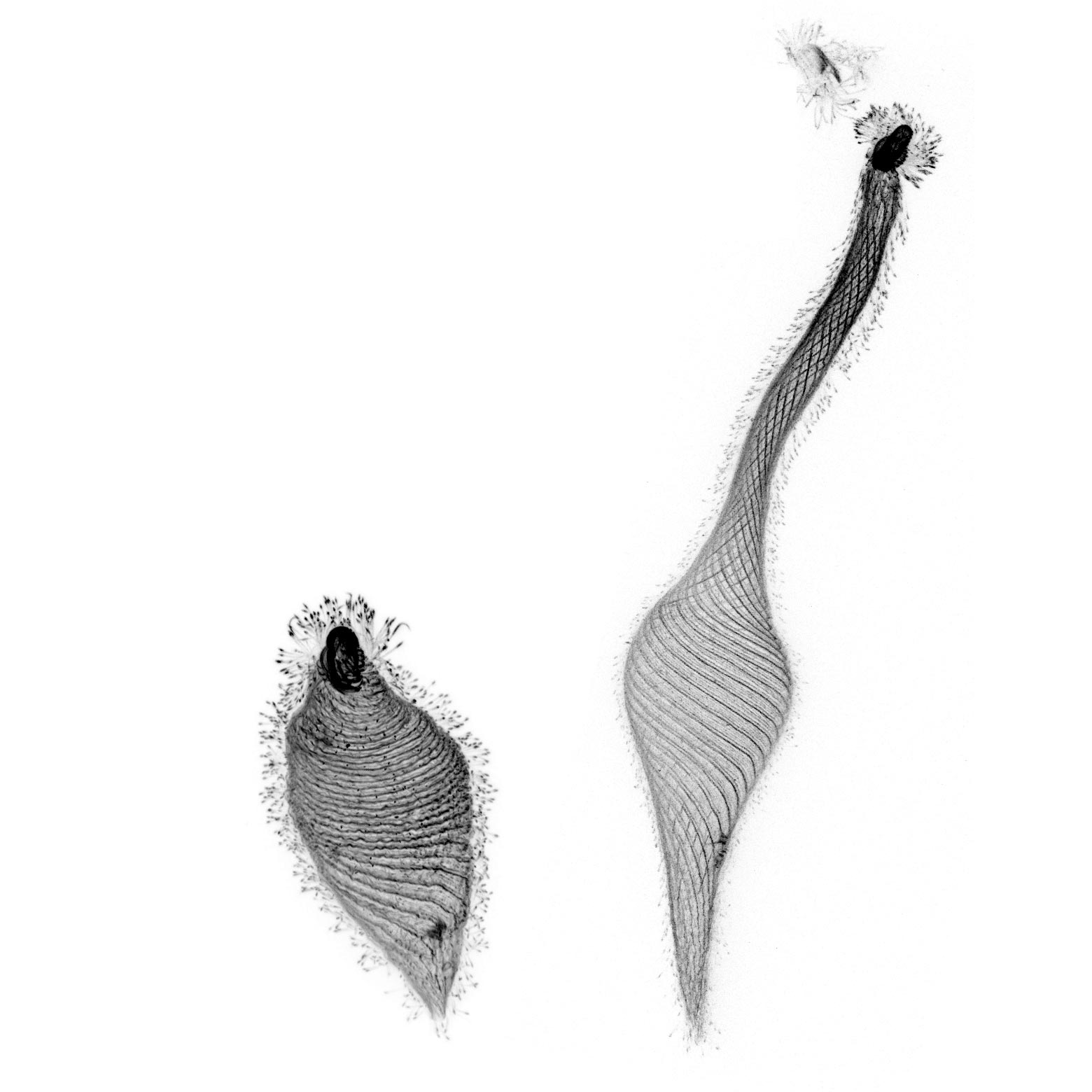
Stanford scientists have unveiled “lacrygami,” a phenomenon where Lacrymaria olor extends its structure dramatically, influenced by its cytoskeletal design, promising advances in microscopic technology.
“There are some things in life you can watch and then never unwatch,” said Manu Prakash, associate professor of bioengineering at Stanford University, calling up a video of his latest fascination, the single-cell organism Lacrymaria olor, a free-living protist he stumbled upon playing with his paper Foldscope. “It’s … just … it’s mesmerizing.”
“From the minute Manu showed it to me, I have just been transfixed by this cell,” said Eliott Flaum, a graduate student in the “curiosity-driven” Prakash Lab. Prakash and Flaum spent the last seven years studying Lacrymaria olor’s every move and recently published a paper on their work in the journal Science.
Discovering Cellular Dynamics
“The first time I came back with a fluorescence micrograph, it was just breathtaking,” Flaum said. “That image is in the paper.”
The video Prakash queued up reveals why this organism is much more than a pretty picture: a single teardrop-shaped cell swims in a droplet of pond water. In an instant, a long, thin “neck” projects out from the bulbous lower end. And it keeps going. And going. Then, just as quickly, the neck retracts back, as if nothing had happened.
In seconds, a cell that was just 40 microns tip-to-tail sprouted a neck that extended 1500 microns or more out into the world. It is the equivalent of a 6-foot human projecting its head more than 200 feet. All from a cell without a nervous system.
“It is incredibly complex behavior,” Prakash said with a smile.
Form Is Function
L. olor is featured in the journal Science because Prakash and Flaum have discovered in this behavior a new geometric mechanism previously unknown in biology. And they are the first to explain how such a simple cell can produce such incredible morphodynamics, beautiful folding and unfolding – aka origami – at the scale of a single cell, time and again without fail.
It is geometry. L. olor’s behavior is encoded in its cytoskeletal structure, just like human behavior is encoded in neural circuits.
“This is the first example of cellular origami,” Prakash said. “We’re thinking of calling it lacrygami.”
Specifically, it is a subset of traditional origami known as “curved-crease origami.” It is all based on a structure of thin, helical microtubules – ribs that wrap inside the cell’s membrane. These microtubule ribs are encased in a delicate diaphanous membrane, defining the crease pattern of peaks in a series of mountain-and-valley folds.
Microstructural Insights and Mathematical Beauty
Prakash and Flaum used transmission electron microscopy and other state-of-the-art investigatory techniques to show there are actually 15 of these stiff, helical microtubule ribbons enshrouding L. olor’s cell membrane – a cytoskeleton. These tubules coil and uncoil, leading to long projection and retraction, nesting back into themselves like the bellows of a compressed helical accordion. The gossamer of membrane tucks away inside the cell in neat, well-defined pleats.
“When you store pleats on the helical angle in this way, you can store an infinite amount of material,” Flaum explained. “Biology has figured this out.”
Geometry Is Destiny
The elegance is in the arithmetic. It is mathematically impossible for this structure to unfold in any other way – and, conversely, only one way it can retract. What is perhaps more striking to Prakash is the robustness of the architecture. In its lifetime, L. olor will perform this projection and retraction 50,000 times without flaw. He said: “L. olor is bound by its geometry to fold and unfold in this particular way.”
The key is an under-studied mathematical phenomenon occurring at the precise point where the ribs twist and the folded membrane begins to unfurl. It is a singularity – a point where the structure is folded and unfolded at the same time. It is both and neither – singular.
Grabbing a piece of paper, Prakash folds it into a cone shape and then pulls on one corner of the paper to demonstrate how this singularity (called d-cone) travels across the sheet in a neat line. And, by pushing back on the corner how the singularity travels back the exact same path to its original position.
“It unfolds and folds at this singularity every time, acting as a controller. This is the first time a geometric controller of behavior has been described in a living cell.” Prakash explained.
Recreational Biology and Future Applications
A constant theme running throughout the Prakash Lab’s work is a profound sense of wonder and playfulness that results in the energetic curiosity necessary to pursue such an idea for such a long time. It is, to put it in Prakash’s terms, old-school science. He also refers to it as recreational biology.
To demonstrate his inspiration, Prakash displayed a family tree of other single-celled organisms that he has chosen to study. True, none can do what L. olor can do, he said. But these intricate geometries come in thousands of forms. Beautiful? Certainly, but each is also hiding wonderful and unwritten rules under their sleeves.
“We started with a puzzle,” Prakash explained with all the seriousness a scientist can muster. “Ellie and I asked a very simple question: Where does this material come from? And where does it go? As our playground, we chose Tree of Life. Seven years later, here we are.”
As for practical applications, Prakash the engineer is already imagining a new era of deployable microscale “living machines” that could transform everything from space telescopes to miniature surgical robots in the operating room.
Reference: “Curved crease origami and topological singularities enable hyperextensibility of L. olor” by Eliott Flaum and Manu Prakash, 7 June 2024, Science.
DOI: 10.1126/science.adk5511
Prakash is also a senior fellow at the Stanford Woods Institute for the Environment, associate professor (by courtesy) of biology and of oceans, a member of Stanford Bio-X, the Wu Tsai Human Performance Alliance, the Maternal & Child Health Research Institute, and the Wu Tsai Neurosciences Institute.
This research was funded by the National Institutes of Health, the National Science Foundation, the Moore Foundation, the Howard Hughes Medical Institute, the Schmidt Foundation, and the Chan Zuckerberg Biohub San Francisco. Some of this work was performed at the Cell Sciences Imaging Facility at Stanford.
Never miss a breakthrough: Join the SciTechDaily newsletter.
Follow us on Google and Google News.