
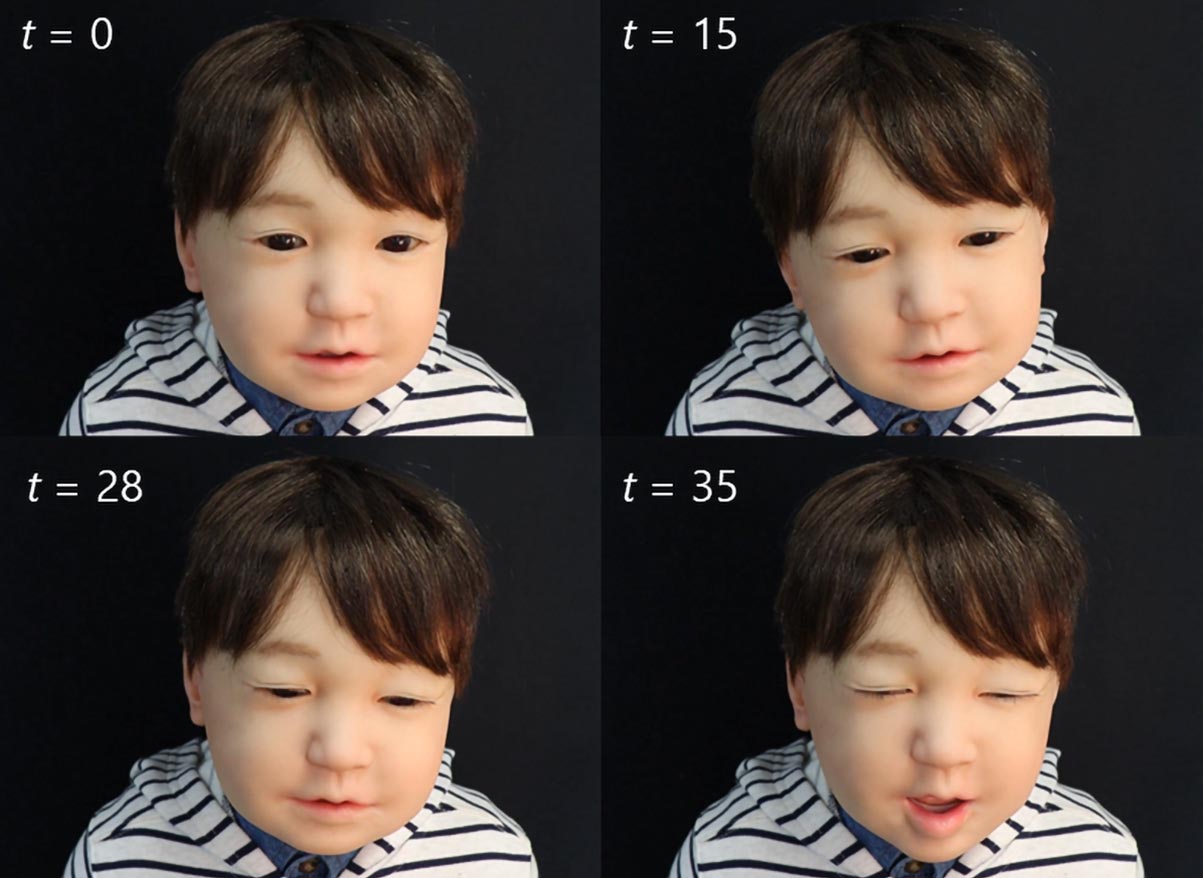
A research team from Osaka University has created a technology enabling androids to dynamically convey mood states like “excited” or “sleepy” by generating facial movements modeled as overlapping, decaying waves.
Even if an android looks remarkably human in a photograph, seeing it move in person can be unsettling. It can smile, frown, and display familiar facial expressions, but these expressions often lack a consistent emotional foundation. This disconnect can create uncertainty about its true feelings, leading to a sense of unease.
Until now, androids with highly mobile facial features have relied on a “patchwork method” to express emotions over extended periods. This approach involves pre-programming multiple action scenarios and switching between them as needed, ensuring that unnatural facial movements are minimized.
However, this poses practical challenges, such as preparing complex action scenarios beforehand, minimizing noticeable unnatural movements during transitions, and fine-tuning movements to subtly control the expressions conveyed.
Introduction video of automatic generation of dynamic arousal expression on an android robot face. Credit: Hisashi Ishihara
A New Approach: Waveform-Based Facial Expression Synthesis
In this study, lead author Hisashi Ishihara and his research group developed a dynamic facial expression synthesis technology using “waveform movements,” which represent various gestures that constitute facial movements, such as “breathing,” “blinking,” and “yawning,” as individual waves. These waves are propagated to the related facial areas and are overlaid to generate complex facial movements in real-time. This method eliminates the need for the preparation of complex and diverse action data while also avoiding noticeable movement transitions.
Furthermore, by introducing “waveform modulation,” which adjusts the individual waveforms based on the robot’s internal state, changes in internal conditions, such as mood, can be instantly reflected as variations in facial movements.

“Advancing this research in dynamic facial expression synthesis will enable robots capable of complex facial movements to exhibit more lively expressions and convey mood changes that respond to their surrounding circumstances, including interactions with humans,” says senior author Koichi Osuka. “This could greatly enrich emotional communication between humans and robots.”
Ishihara adds, “Rather than creating superficial movements, further development of a system in which internal emotions are reflected in every detail of an android’s actions could lead to the creation of androids perceived as having a heart.”
By realizing the function to adaptively adjust and express emotions, this technology is expected to significantly enhance the value of communication robots, allowing them to exchange information with humans in a more natural, humanlike manner.
Reference: “Automatic Generation of Dynamic Arousal Expression Based on Decaying Wave Synthesis for Robot Faces” by Hisashi Ishihara, Rina Hayashi, Francois Lavieille, Kaito Okamoto, Takahiro Okuyama and Koichi Osuka, 20 December 2024, Journal of Robotics and Mechatronics.
DOI: 10.20965/jrm.2024.p1481
Funding: Japan Society for the Promotion of Science
Never miss a breakthrough: Join the SciTechDaily newsletter.
Follow us on Google and Google News.
5 Comments
Let’s test him on the TV show “Old Enough”.
https://en.m.wikipedia.org/wiki/Old_Enough!
https://www.netflix.com/title/81506279
Sleepy or Creepy?
Watching that makes me wonder if the researchers are trying to find the dead center of the uncanny valley.
The eye movements are not conjugate (moving in the same direction). That is a giveaway that it is android and not living on earth. Lizards move eyes independently, not mammals.
i want one wishful thinkimg lol
i want one wishful thinkimg lol