
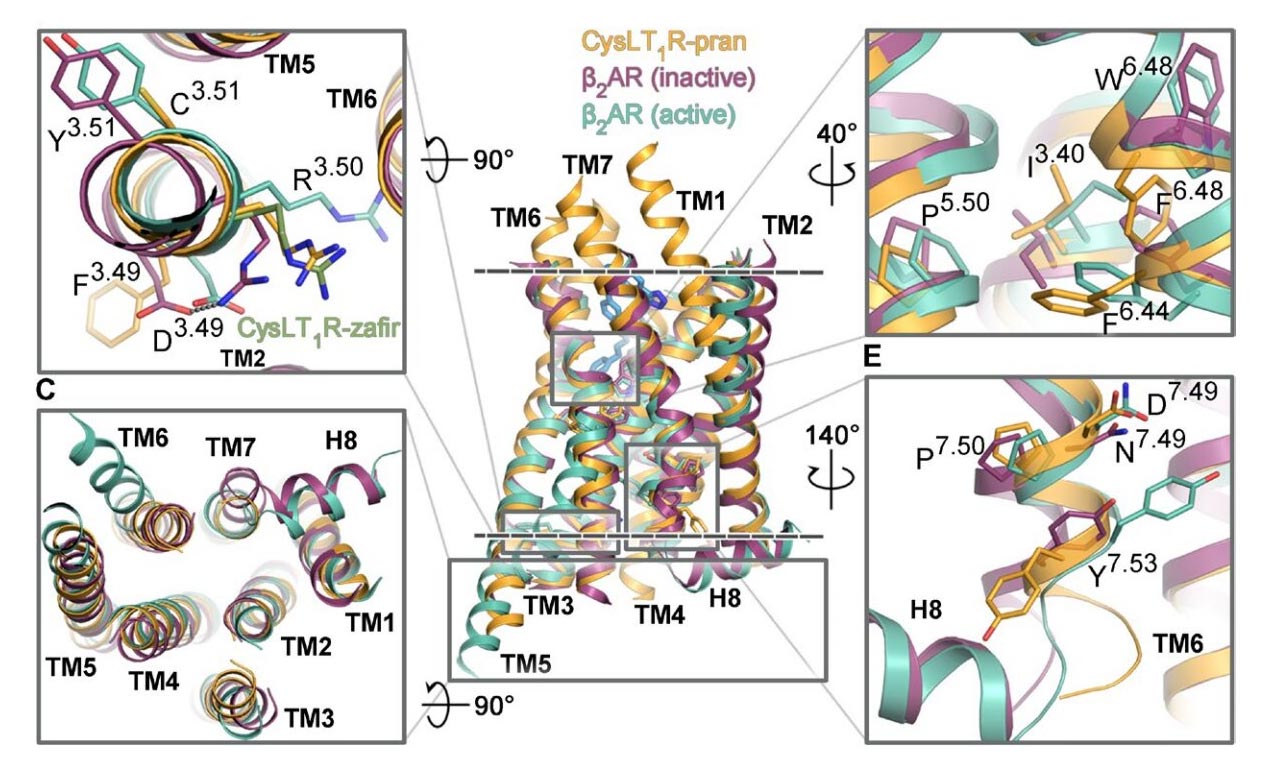
A research team from the MIPT Center for Molecular Mechanisms of Aging and Age-Related Diseases has collaborated with colleagues from the U.S., Canada, France, and Germany to determine the spatial structure of the CysLT1 receptor. The paper was published on October 9, 2019, in Science Advances.
G protein-coupled receptors (GPCRs) are molecular machines that are embedded in cell membranes. These receptors detect external impulses and send them into the cell. Light photons, lipid molecules, tiny proteins, and DNA fragments are some of the origins of the signals. A GPCR can trigger diverse events in the cell, such as division, relocation, or even death.
The “communication” between cells that is mediated by GPCRs is essential for an organism to operate. It’s no surprise that these receptors are engaged in almost every activity in our body. They are also the targets of around 40% of currently available drugs. Thus, structural biologists are interested in understanding the working mechanisms of these biological machines and generating novel medications with more selectivity and fewer adverse effects.
Structural biology is a cross-disciplinary field at the interface of physics and biology, concerned with studying the 3D arrangement of biological macromolecules, such as proteins. Structural studies involve genetic engineering, artificial protein production, purification, and crystallization. Once the protein crystal has been obtained, the physics comes in: Researchers expose the protein crystal to powerful X-rays to generate diffraction patterns. The resulting data can be mathematically processed to recover a detailed 3D atomic structure of a given protein molecule, with a precision of up to several angstroms.
Structural studies rely on powerful X-ray sources. These typically come in two kinds: synchrotrons and the more recently developed free electron lasers. In both cases, electrons are accelerated to nearly the speed of light. They are then forced to change their speed or direction of motion, leading to X-ray emission. In a synchrotron, the electrons move along a curved, almost circular trajectory. In a free electron laser, they travel through a passage between two rows of alternating oppositely directed magnets, known as an undulator.
While structural biologists have used synchrotrons since the 1970s, free electron lasers are a relatively recent addition to the protein crystallography toolkit. Introduced in the early 2010s, they generate extremely powerful radiation and enable X-ray diffraction analysis of minuscule 1-micrometer crystals. This new instrument has already brought about the discovery of several hundred structures.
Researchers from MIPT have investigated the structure of a GPCR known as CysLT1. It is involved in inflammatory processes and plays an important role in allergic diseases, including asthma, which affects about 10% of the global population. The team of biophysicists obtained the detailed 3D structure of the receptor (fig. 1) with the molecules of zafirlukast and pranlukast. These are two drugs prescribed to patients with asthma, allergic rhinitis, and urticaria.
While relatively large, 0.3-millimeter crystals with pranlukast were grown in the study, the crystals with zafirlukast only reached the size of several micrometers. The former samples were investigated at the ESRF synchrotron in Grenoble, France. The latter were examined using the Stanford University-operated Linac Coherent Light Source, a free electron laser. The researchers’ colleagues from Canada helped to explore the mechanisms of signal transmission via CysLT1.
“These are no doubt unique structures, and we’ve grown quite fond of them,” said study co-author Aleksandra Luginina from the MIPT Laboratory of Structural Biology of G Protein-Coupled Receptors. “The CysLT1 receptor’s mechanism of operation updates how we see the functioning of GPCR protein subgroups. Also, by identifying the binding sites for the zafirlukast and pranlukast molecules, we lay the basis for improving asthma medications — increasing their efficiency and reducing side effects.”
GPCRs are notoriously difficult objects for structural studies. Only a handful of labs worldwide have managed to complete research projects of this kind. The MIPT team is glad that an Institute laboratory is now among them.
Reference: “Structure-based mechanism of cysteinyl leukotriene receptor inhibition by antiasthmatic drugs” by Aleksandra Luginina, Anastasiia Gusach, Egor Marin, Alexey Mishin, Rebecca Brouillette, Petr Popov, Anna Shiriaeva, Élie Besserer-Offroy, Jean-Michel Longpré, Elizaveta Lyapina, Andrii Ishchenko, Nilkanth Patel, Vitaly Polovinkin, Nadezhda Safronova, Andrey Bogorodskiy, Evelina Edelweiss, Hao Hu, Uwe Weierstall, Wei Liu, Alexander Batyuk, Valentin Gordeliy, Gye Won Han, Philippe Sarret, Vsevolod Katritch, Valentin Borshchevskiy and Vadim Cherezov, 9 October 2019, Science Advances.
DOI: 10.1126/sciadv.aax2518
Never miss a breakthrough: Join the SciTechDaily newsletter.
Follow us on Google and Google News.