
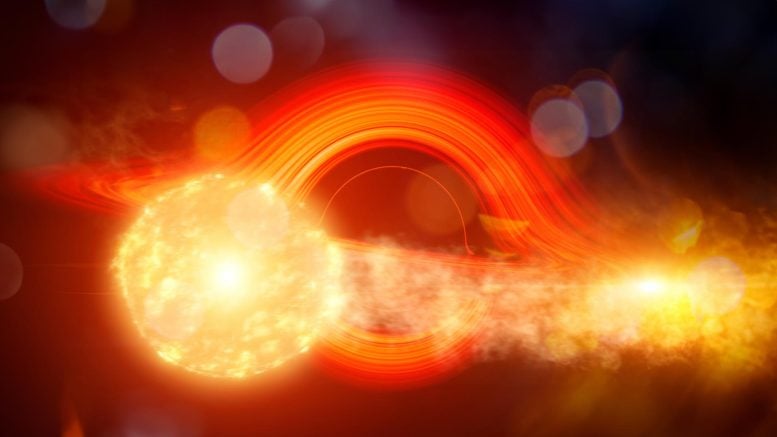
Scientists, using NASA’s Neil Gehrels Swift Observatory, have identified a black hole in a distant galaxy that appears to be recurrently consuming parts of a Sun-like star. This groundbreaking discovery was made possible by a new method of analyzing data from the observatory’s X-ray Telescope (XRT).
Using NASA’s Neil Gehrels Swift Observatory, which launched in 2004, scientists have discovered a black hole in a distant galaxy repeatedly nibbling on a Sun-like star. The object heralds a new era of Swift science made possible by a novel method for analyzing data from the satellite’s X-ray Telescope (XRT).
“Swift’s hardware, software, and the skills of its international team have enabled it to adapt to new areas of astrophysics over its lifetime,” said Phil Evans, an astrophysicist at the University of Leicester in the United Kingdom and longtime Swift team member. “Neil Gehrels, the mission’s namesake, oversaw and encouraged many of those transitions. Now, with this new ability, it’s doing even more cool science.”
Evans led a study about the unlucky star and its hungry black hole, collectively called Swift J023017.0+283603 (or Swift J0230 for short), which was published on September 7 in Nature Astronomy.
Watch to learn how an update to NASA’s Neil Gehrels Swift Observatory allowed it to catch a supersized black hole in a distant galaxy munching repeatedly on a circling star. Credit: NASA’s Goddard Space Flight Center
Tidal Disruption Events and Their Variations
When a star strays too close to a monster black hole, gravitational forces create intense tides that break the star apart into a stream of gas. The leading edge swings around the black hole, and the trailing edge escapes the system. These destructive episodes are called tidal disruption events. Astronomers see them as flares of multiwavelength light created when the debris collides with a disk of material already orbiting the black hole.
Recently, astronomers have been investigating variations in this phenomena, which they call partial or repeating tidal disruptions.
During these events, every time an orbiting star passes close to a black hole, the star bulges outward and sheds material, but survives. The process repeats until the star loses too much gas and finally breaks apart. The characteristics of the individual star and black hole system determine what kind of emission scientists observe, creating a wide array of behaviors to categorize.
Previous examples include an outburst that occurred every 114 days, potentially caused by a giant star orbiting a black hole with 78 million times the Sun’s mass. Another recurred every nine hours around a black hole with 400,000 times the Sun’s mass, likely caused by an orbiting stellar cinder called a white dwarf.
Swift J0230: A New Repeating Disruption
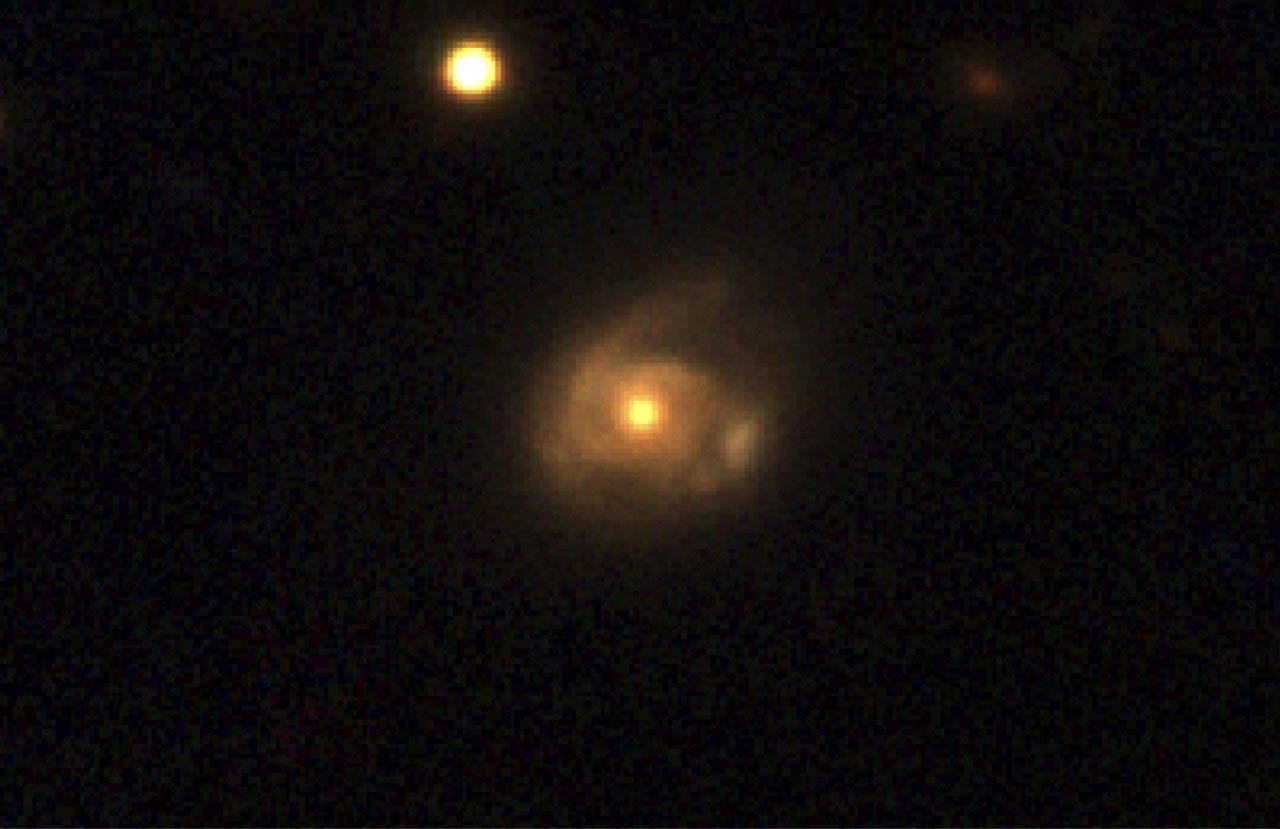
On June 22, 2022, the XRT captured Swift J0230 for the first time. It lit up in a galaxy around 500 million light-years away in the northern constellation Triangulum. Swift’s XRT observed nine additional outbursts from the same location roughly every few weeks.
Evans and his team propose that Swift J0230 is a repeating tidal disruption of a Sun-like star orbiting a black hole with over 200,000 times the Sun’s mass. They estimate the star loses around three Earth masses of material on each pass. This system provides a bridge between other types of suspected repeating disruptions and allows scientists to model how interactions between different star types and black hole sizes affect what we observe.
“We searched and searched for the event brightening in the data collected by Swift’s Ultraviolet/Optical Telescope,” said Alice Breeveld, a research fellow at the University College London’s Mullard Space Science Laboratory (MSSL) who has worked on the instrument since before the satellite launched. “But there wasn’t any sign of it. The galaxy’s variability was entirely in X-rays. That helped rule out some other potential causes.”
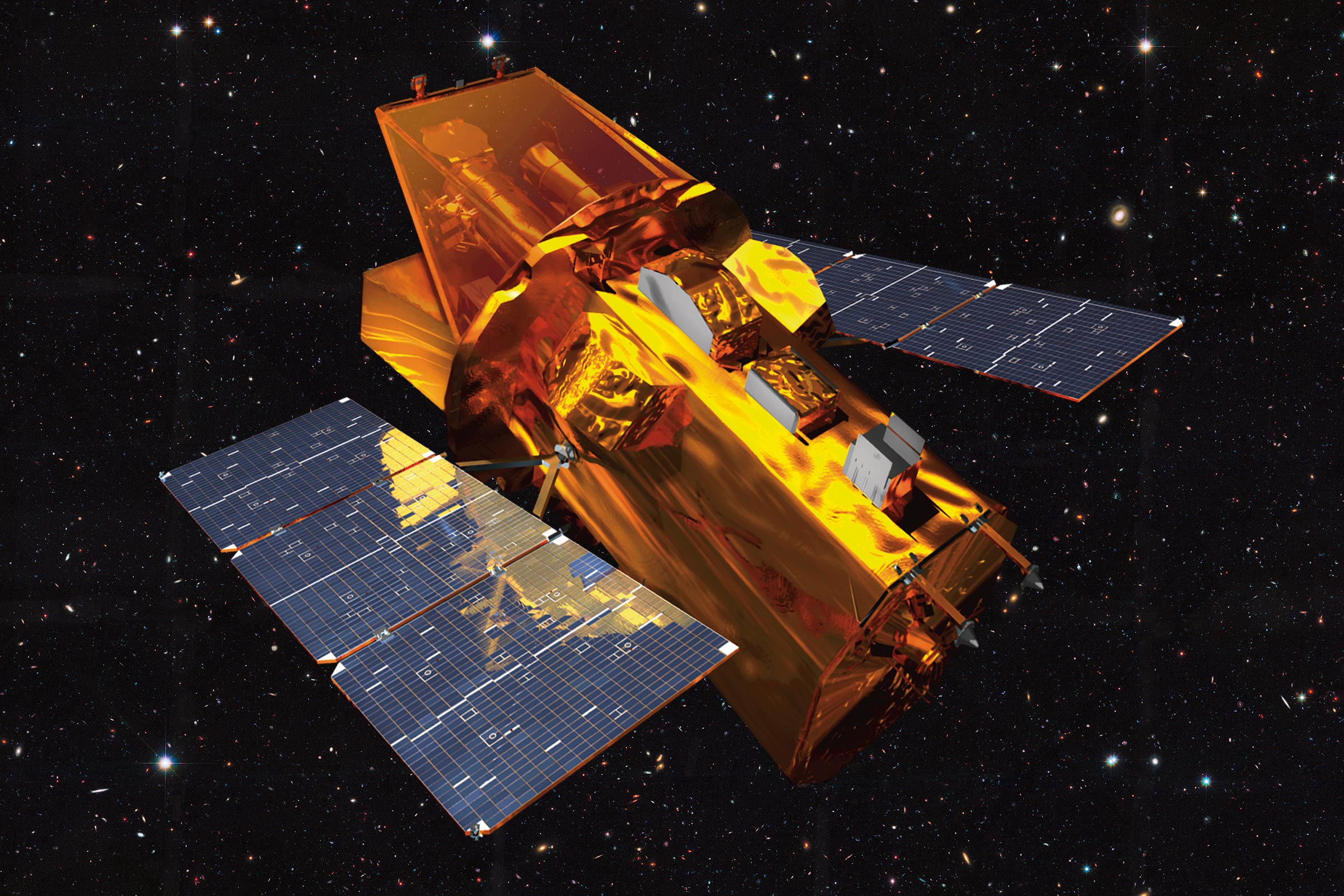
Swift J0230’s discovery was possible thanks to a new, automated search of XRT observations, developed by Evans, called the Swift X-ray Transient Detector.
After the instrument observes a portion of the sky, the data is transmitted to the ground, and the program compares it to previous XRT snapshots of the same spot. If that portion of the X-ray sky has changed, scientists get an alert. In the case of Swift J0230, Evans and his colleagues were able to rapidly coordinate additional observations of the region.
Swift was originally designed to study gamma-ray bursts, the most powerful explosions in the cosmos. Since the satellite launched, however, scientists have recognized its ability to study a whole host of celestial objects, like tidal disruptions and comets.
“Swift J0230 was discovered only about two months after Phil launched his program,” said S. Bradley Cenko, the mission’s principal investigator at NASA’s Goddard Space Flight Center in Greenbelt, Maryland. “It bodes well for the detector’s ability to identify other transient events and for Swift’s future exploring new spaces of science.”
Reference: “Monthly quasi-periodic eruptions from repeated stellar disruption by a massive black hole” by P. A. Evans, C. J. Nixon, S. Campana, P. Charalampopoulos, D. A. Perley, A. A. Breeveld, K. L. Page, S. R. Oates, R. A. J. Eyles-Ferris, D. B. Malesani, L. Izzo, M. R. Goad, P. T. O’Brien, J. P. Osborne and B. Sbarufatti, 7 September 2023, Nature Astronomy.
DOI: 10.1038/s41550-023-02073-y
Goddard manages the Swift mission in collaboration with Penn State, the Los Alamos National Laboratory in New Mexico, and Northrop Grumman Space Systems in Dulles, Virginia. Other partners include Leicester, MSSL, Brera Observatory in Italy, and the Italian Space Agency.
Never miss a breakthrough: Join the SciTechDaily newsletter.
Follow us on Google and Google News.