
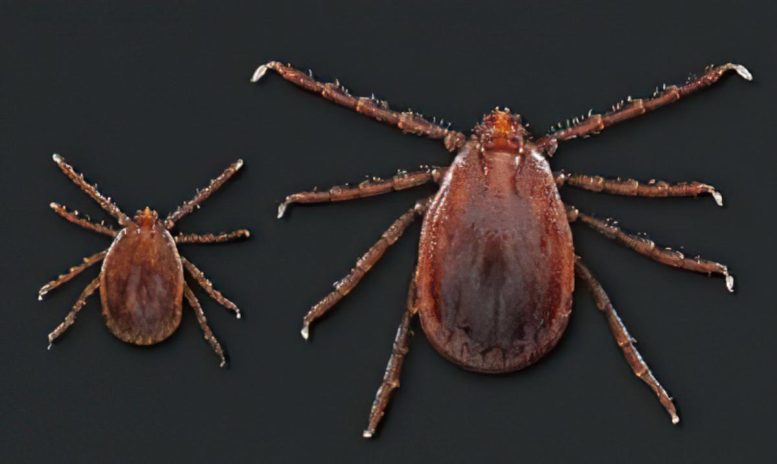
Pasture Infestation Is Estimated To Exceed 1 Million Asian Longhorned Ticks
An invasive tick species made a dramatic entrance into Ohio in 2021, swarming a farm in the southeast so aggressively that their collective bloodsucking resulted in the death of three cows, likely due to acute anemia.
This alarming situation prompted researchers at The Ohio State University to document the state’s first confirmed colony of Asian longhorned ticks in the Journal of Medical Entomology, and are now conducting research focused on monitoring and managing these pests.
Threat to Livestock but Not Humans
So far, these ticks are not deemed to be a threat to human health. They tend to favor large livestock and wildlife, such as cattle and deer. Just a handful of the hundred ticks from the farm screened for infectious agents tested positive for pathogens, including one, Anaplasma phagocytophilium, that can cause disease in animals and humans. Elsewhere this tick carries another pathogen, Theileria orientalis, that affects cattle, and cases of bovine theileriosis have been reported in Ohio.
Researchers say the tiny brown ticks – the size of a sesame seed in some life stages and pea-sized when engorged – are persistent, however: Surveillance showed they returned the following summer to the farm despite the application of pesticides in 2021.
“They are going to spread to pretty much every part of Ohio and they are going to be a long-term management problem. There is no getting rid of them,” said Risa Pesapane, senior author of the paper and an assistant professor of veterinary preventive medicine at Ohio State.
“The good news about the ticks, though, is that most tick control agents that we currently have seem to kill them. Still, managing them is not easy because of how numerous they are and how easily they can come back.”
Origin and Spread
Asian longhorned ticks originate from East Asia and were first detected in the United States in New Jersey in 2017. When Pesapane joined Ohio State in 2019 as a tick-borne disease ecologist, the ticks were reported in West Virginia – meaning it was only a matter of time before they crossed the river into Ohio, she said.
She found the first of these ticks in Ohio, on a stray dog in Gallia County in 2020, and another was collected from a cow in Jackson County in June 2021. And then a farmer from Monroe County called Ohio State later that summer to report three of his 18 cattle, heavily infested with ticks, had died.
“One of those was a healthy male bull, about 5 years old. Enormous. To have been taken down by exsanguination by ticks, you can imagine that was tens of thousands of ticks on one animal,” said Pesapane, who also has a faculty appointment in Ohio State’s School of Environment and Natural Resources.
Pesapane and colleagues collected almost 10,000 ticks within about 90 minutes on the farm, leading her to speculate that there were more than 1 million of them in the roughly 25-acre pasture.
Unique Reproduction and Resistance to Pesticides
Asian longhorned ticks’ secret colonization weapon is the ability to reproduce asexually, with each female laying up to 2,000 eggs at a time – and all 2,000 of those female offspring able to do the same.
“There are no other ticks in North America that do that. So they can just march on, with exponential growth, without any limitation of having to find a mate,” Pesapane said. “Where the habitat is ideal, and anecdotally it seems that unmowed pastures are an ideal location, there’s little stopping them from generating these huge numbers.”
Because of their ability to hide in vegetation, Asian longhorned ticks also can escape pesticides that kill only when coming into direct contact with a pest.
“It would be wisest to target them early in the season when adults become active, before they lay eggs because then you would limit how many will hatch and reproduce in subsequent years. But for a variety of reasons, I tell people you cannot spray your way out of an Asian longhorned tick infestation – it will require an integrated approach,” Pesapane said.
She and her colleagues are working as rapidly as they can at filling in knowledge gaps about these invaders and developing training materials and policy recommendations for affected industries. As one example, Pesapane said, tick inspections of livestock could provide a window for the application of an antiparasitic agent to eliminate the risk of transporting the exotic arachnids across multiple state lines.
Ohioans are encouraged to help with research efforts: People who think they’ve spotted an Asian longhorned tick can email [email protected] for instructions on how to collect the specimen and send it to Ohio State scientists as part of ongoing surveillance. To date, the lab has received Asian longhorned ticks from residents of 11 Ohio counties.
Reference: “An established population of Asian longhorned ticks (Acari: Ixodidae) in Ohio, USA” by Andreas Eleftheriou, Julia Beckett, Ningzhu Bai and Risa Pesapane, 8 August 2023, Journal of Medical Entomology.
DOI: 10.1093/jme/tjad104
More information about spotting Asian longhorned ticks and preventing tick exposure is available on Ohio State’s Bite Site.
This work was supported by the U.S. Department of Agriculture. Co-authors on the study were Andreas Eleftheriou, Julia Beckett and Ningzhu Bai, all of Ohio State.
Never miss a breakthrough: Join the SciTechDaily newsletter.
Follow us on Google and Google News.
1 Comment
What will eat the ticks?