

Close Menu
    Facebook X (Twitter) Instagram
    SciTechDaily
    • Biology
    • Chemistry
    • Earth
    • Health
    • Physics
    • Science
    • Space
    • Technology
    Facebook X (Twitter) Pinterest YouTube RSS
    SciTechDaily
    Home»Physics»Boosting Energy Production at US Wind Plants With Wake Steering
    Physics

    Boosting Energy Production at US Wind Plants With Wake Steering

    By American Institute of PhysicsMay 20, 20211 Comment3 Mins Read
    Facebook Twitter Pinterest Telegram LinkedIn WhatsApp Email Reddit
    Share
    Facebook Twitter LinkedIn Pinterest Telegram Email Reddit
    Wind Farm
    Wake steering can increase energy production for a large sampling of commercial land-based U.S. wind power plants.

    U.S. wind plants achieve a predicted annual production gain of 0.8% by using wake steering.

    Wake steering is a strategy employed at wind power plants involving misaligning upstream turbines with the wind direction to deflect wakes away from downstream turbines, which consequently increases the net production of wind power at a plant.

    In Journal of Renewable and Sustainable Energy, by AIP Publishing, researchers at the U.S. Department of Energy’s National Renewable Energy Laboratory (NREL) illustrate how wake steering can increase energy production for a large sampling of commercial land-based U.S. wind power plants.

    While some plants showed less potential for wake steering due to unfavorable meteorological conditions or turbine layout, several wind power plants were ideal candidates that could benefit greatly from wake steering control.

    Closer Turbine Spacing, Greater Output

    Overall, a predicted average annual production gain of 0.8% was found for the set of wind plants investigated. In addition, the researchers found that on wind plants using wake steering, wind turbines could be placed more closely together, increasing the amount of power produced in a given area by nearly 70% while maintaining the same cost of energy generation.
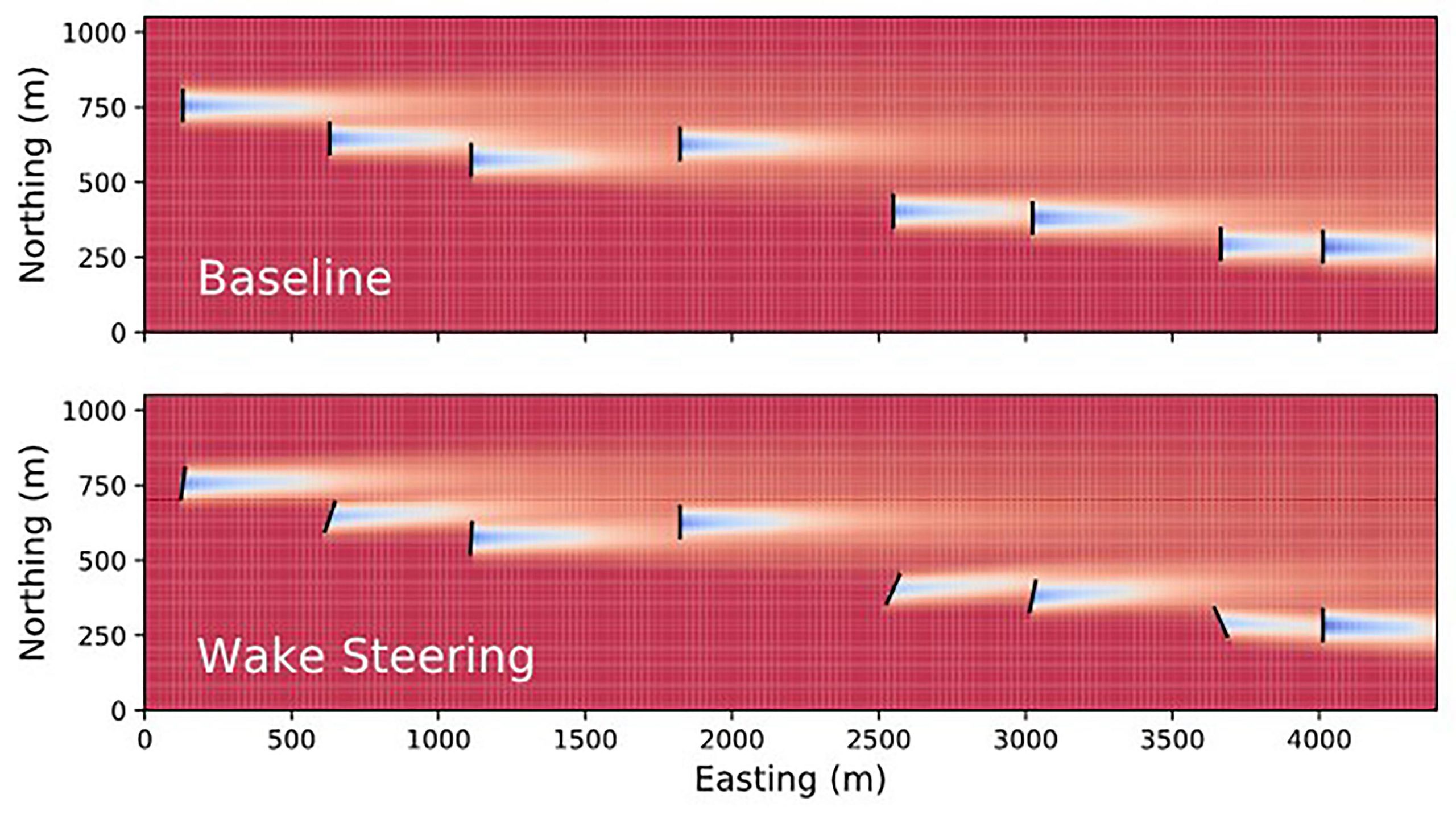
    Wind Turbine Wake Steering
    Illustration of wake steering for an example wind plant. Wind turbines are misaligned with the wind to redirect their wakes away from downstream turbines. Blue regions indicate lower wind speeds caused by wakes. Credit: Eric Simley, NREL

    “We were surprised to see that that there was still a large amount of variability in the potential energy improvement from wake steering, even after accounting for the wake losses of different wind plants,” said author David Bensason.

    Wake Effects and Steering Strategy

    Just as umbrellas may cast a shadow, wind turbines create a region of slower, more turbulent air flow downstream of their rotor, which is known as a wake. When these wakes flow into another turbine, they reduce its power production capacity.

    The wake steering strategy “steers” these wakes away from turbines by offsetting the angle between the rotor face and the incoming wind direction. This technique sacrifices the power efficiencies of a few turbines in order to increase the performance of the wind power plant as a whole. Wake steering can only increase energy production if there are wake losses to start. Consequently, the benefits of wake steering tend to increase for wind plants with higher wake losses.

    The study is one of the first to use the Gauss-Curl-Hybrid wake model, which NREL developed. This model predicts wake behavior in a wind plant more accurately than prior models and captures effects that are more prominent in large-scale plants. The researchers also combined several publicly available databases and tools that together make the investigation of wake steering potential for a large sample of U.S. wind plants possible.

    “We hope that this study, which highlighted the potential for wake steering for a large sample of existing commercial wind plants in the U.S., motivates wind plant owners to implement wake steering in their wind plants to increase energy production and contribute to making wind energy a widely deployed affordable clean energy source,” said co-author Eric Simley.

    Reference: “Evaluation of the potential for wake steering for U.S. land-based wind power plants” is authored by D. Bensason, E. Simley, O. Roberts, P. Fleming, M. Debnath, J. King, C. Bay and R. Mudafort, 18 May 2021, Journal of Renewable and Sustainable Energy.
    DOI: 10.1063/5.0039325

    Never miss a breakthrough: Join the SciTechDaily newsletter.
    Follow us on Google and Google News.

    American Institute of Physics Energy Green Energy
    Share. Facebook Twitter Pinterest LinkedIn Email Reddit

    Related Articles

    Turning Hazelnut Shells Into a Clean, Renewable Energy Source

    Colored LED Lighting Enhances Growth, Biosynthesis of Microalgae for Next-Generation Biofuel

    Charged Up: Scientists Find New Pathway to Harnessing the Sun for a Clean Energy Future

    Cornell University to Extract Energy From Manure to Heat the Campus

    Zero-Emissions Energy: Comprehensive Physics Basis for a New Fusion Reactor Design

    Energy Harvesting Goes Organic: Self-Assembled Peptides for Electricity Generation

    How Environmental Satellites Are Helping Solar Power Plants on Earth

    Fusion Researchers Find Safer, More Effective Way to Create a Star on Earth

    “Big Surprise” Discovery Increases Perovskite Solar Cell Efficiency

    1 Comment

    1. xABBAAA on May 30, 2021 7:21 am

      … all one needs to do is to add some solar panels to that wind plants, and to use two things even at once…

      Reply
    Leave A Reply Cancel Reply

    • Facebook
    • Twitter
    • Pinterest
    • YouTube

    Don't Miss a Discovery

    Subscribe for the Latest in Science & Tech!

    Trending News

    Millions Take These IBS Drugs, But a New Study Finds Serious Risks

    Scientists Unlock Hidden Secrets of 2,300-Year-Old Mummies Using Cutting-Edge CT Scanner

    Bread Might Be Making You Gain Weight Even Without Eating More Calories

    Scientists Discover Massive Magma Reservoir Beneath Tuscany

    Europe’s Most Active Volcano Just Got Stranger – Here’s Why Scientists Are Rethinking It

    Alzheimer’s Symptoms May Start Outside the Brain, Study Finds

    Millions Take This Popular Supplement – Scientists Discover a Concerning Link to Heart Failure

    The Universe Is Expanding Too Fast and Scientists Can’t Explain Why

    Follow SciTechDaily
    • Facebook
    • Twitter
    • YouTube
    • Pinterest
    • Newsletter
    • RSS
    SciTech News
    • Biology News
    • Chemistry News
    • Earth News
    • Health News
    • Physics News
    • Science News
    • Space News
    • Technology News
    Recent Posts
    • U.S. Waste Holds $5.7 Billion Worth of Crop Nutrients
    • Scientists Say a Hidden Structure May Exist Inside Earth’s Core
    • Doctors Surprised by the Power of a Simple Drug Against Colon Cancer
    • Why Popular Diabetes Drugs Like Ozempic Don’t Work for Everyone: The “Genetic Glitch”
    • Scientists Create Improved Insulin Cells That Reverse Diabetes in Mice
    Copyright © 1998 - 2026 SciTechDaily. All Rights Reserved.
    • Science News
    • About
    • Contact
    • Editorial Board
    • Privacy Policy
    • Terms of Use

    Type above and press Enter to search. Press Esc to cancel.