
Inflammation in the Brain Linked to Several Forms of Dementia Inflammation
Inflammation in the brain may be more widely implicated in dementia than was previously thought, suggests new research from the University of Cambridge. The researchers say it offers hope for potential new treatments for several types of dementia.
Inflammation is usually the body’s response to injury and stress — such as the redness and swelling that accompanies an injury or infection. However, inflammation in the brain — known as neuroinflammation — has been recognized and linked to many disorders including depression, psychosis, and multiple sclerosis. It has also recently been linked to the risk of Alzheimer’s disease.
In a study published today in the journal Brain, a team of researchers at the University of Cambridge set out to examine whether neuroinflammation also occurs in other forms of dementia, which would imply that it is common to many neurodegenerative diseases.
The team recruited 31 patients with three different types of frontotemporal dementia (FTD). FTD is a family of different conditions resulting from the build-up of several abnormal ‘junk’ proteins in the brain.
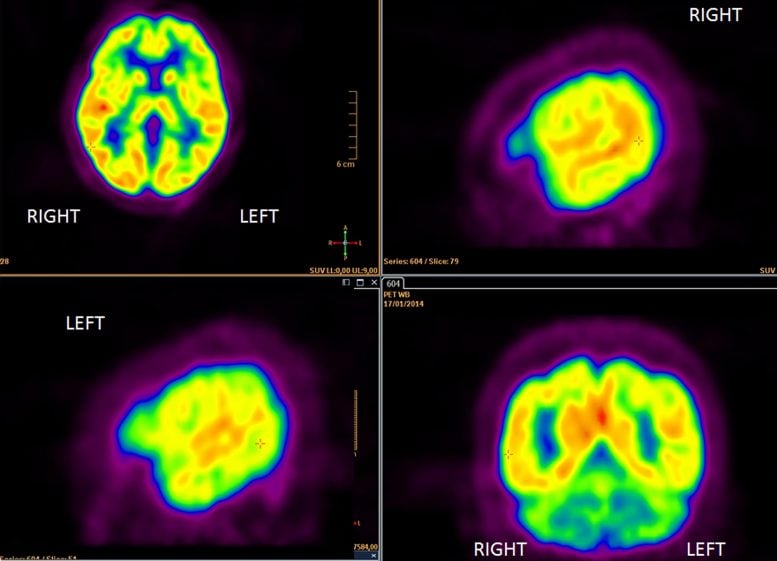
Patients underwent brain scans to detect inflammation and the junk proteins. Two Positron Emission Tomography (PET) scans each used an injection with a chemical ‘dye,’ which lights up special molecules that reveal either the brain’s inflammatory cells or the junk proteins.
In the first scan, the dye lit up the cells causing neuroinflammation. These indicate ongoing damage to the brain cells and their connections. In the second scan, the dye binds to the different types of ‘junk’ proteins found in FTD.
The researchers showed that across the brain, and in all three types of FTD, the more inflammation in each part of the brain, the more harmful build-up of the junk proteins there is. To prove the dyes were picking up the inflammation and harmful proteins, they went on to analyze under the microscope 12 brains donated after death to the Cambridge Brain Bank.
“We predicted the link between inflammation in the brain and the build-up of damaging proteins, but even we were surprised by how tightly these two problems mapped onto each other,” said Dr. Thomas Cope from the Department of Clinical Neurosciences at Cambridge.
Dr. Richard Bevan Jones added, “There may be a vicious circle where cell damage triggers inflammation, which in turn leads to further cell damage.”
The team stress that further research is needed to translate this knowledge of inflammation in dementia into testable treatments. But, this new study shows that neuroinflammation is a significant factor in more types of dementia than was previously thought.
“It is an important discovery that all three types of frontotemporal dementia have inflammation, linked to the build-up of harmful abnormal proteins in different parts of the brain. The illnesses are in other ways very different from each other, but we have found a role for inflammation in all of them,” says Professor James Rowe from the Cambridge Centre for Frontotemporal Dementia.
“This, together with the fact that it is known to play a role in Alzheimer’s, suggests that inflammation is part of many other neurodegenerative diseases, including Parkinson’s disease and Huntington’s disease. This offers hope that immune-based treatments might help slow or prevent these conditions.”
Reference: “Neuroinflammation and protein aggregation co-localize across the frontotemporal dementia spectrum” by Bevan-Jones, WR & Cope, TE et al., 17 March 2020, Brain.
DOI: 10.1093/brain/awaa033
The research was supported by Wellcome, the Medical Research Council, National Institute for Health Research Cambridge Biomedical Research Centre, Association of British Neurologists, Patrick Berthoud Charitable Trust, and the Lundbeck Foundation.
Never miss a breakthrough: Join the SciTechDaily newsletter.
Follow us on Google and Google News.