
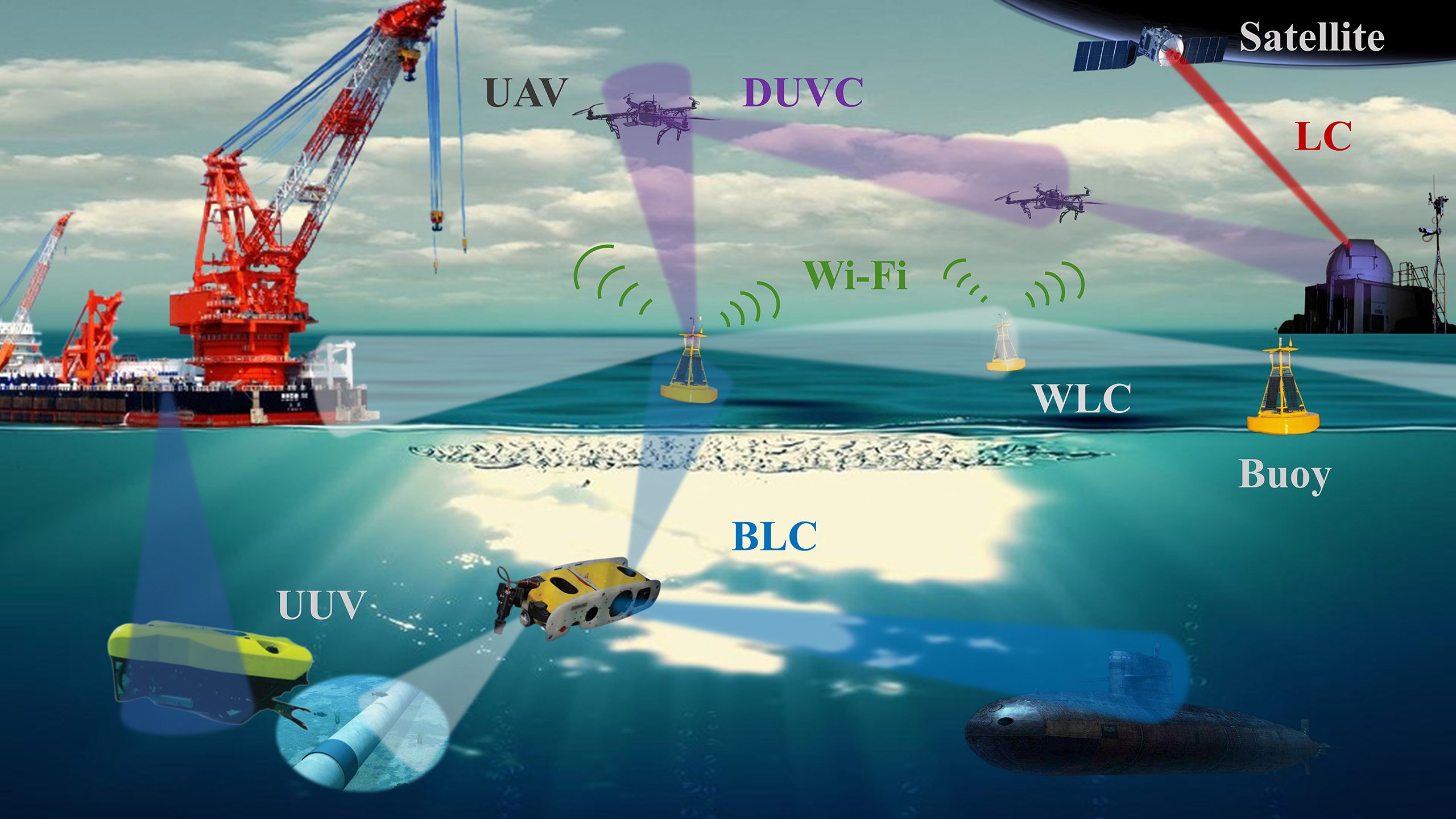
The latest network architecture utilizes a variety of light sources to surmount obstacles posed by the environment.
Scientists have created a communication network entirely based on light that enables seamless connectivity across space, air, and underwater environments. The new network design combines different types of light sources to ensure connectivity no matter the environment.
“In today’s world, data transmission is critical for communication, navigation, emergency response, research, and commercial activities,” said research team leader Yongjin Wang from Nanjing University of Posts and Telecommunications and Suzhou Lighting Chip Monolithic Optoelectronics Technology Co. Ltd., both in China. “This new wireless network enables uninterrupted connectivity across environments, facilitating two-way real-time data transmission between the network nodes that carry out communication and data exchange within and between networks.”
In the Optica Publishing Group journal Optics Express, the researchers describe the completely light-based communication network and demonstrate real-time video communication between network nodes. They also show that it can support both wired and wireless device access simultaneously and can carry out bidirectional data transmission between network nodes. Both capabilities are key for providing various services to different users at once.
“The all-light communication could be used in oceans and lakes, for example, where sensors gather ecological data and communicate with surface buoys,” said Wang. “The data could then be sent wirelessly over the water surface or across long-distance transmission links between cities. The network can also connect to the internet via a modem, granting people who might be in a remote ocean location, for example, access to the backbone network for information sharing.”
Building an integrated network
Wireless light communication networks are often designed for specific scenarios and lack interoperability with other communication systems. Creating space-air-sea interconnections requires the daunting task of bringing together multiple technologies in a way that creates a seamless communication network. To accomplish this, the researchers used four spectra of light to establish wireless light communication links for four different environments or applications.
The researchers performed experiments that showed that the all-light communication network could accomplish full-duplex real-time video communication and addressable transmission of sensors, images, and audio files via wired and wireless access. Credit: Yongjin Wang, Nanjing University of Posts and Telecommunications
They used blue light for underwater communication because seawater has a reduced absorption window for blue-green light, allowing it to travel farther underwater compared to other wavelengths. This can allow the system to be used to control unmanned underwater vehicles or establish communication between underwater devices and buoys. White LEDs are used to transmit information between objects such as buoys or ships that are above water.
For connections with airborne devices such as drones, deep ultraviolet light is used. This provides solar-blind communication, which prevents interference from sunlight. Finally, for point-to-point communication in free space, near-infrared laser diodes were applied because they emit directional light with high optical power. The researchers also designed the network in a way that allows wireless or wired access to the Internet based on the TCP/IP scheme, which makes it useful for Internet of Things applications.
Connecting the light sources
“It was important to establish a unified transmission mode from communication with blue light, white light, deep UV wavelengths, and laser diodes so we can integrate them using Ethernet switches,” said Wang. “To make this work possible, the LEDs and the modulation schemes determine the network throughput while the avalanche photodiode limits the transmission range, and an optical bandpass filter isolates the desired light signals from those in the other spectra.”
The researchers showed that the all-light communication network could accomplish full-duplex real-time video communication and transmission of sensor data, images, and audio files via wired and wireless access. Full-duplex video means that video can be transmitted and received simultaneously, which is necessary for applications such as video conferencing. When 2560 × 1440- and 1920 × 1080-pixel real-time videos at 22 frames per second were fed into the network, they remained clear with little lag. Using a network packet analysis tool, a maximum packet loss ratio of 5.80% and a transmission delay below 74 milliseconds was measured.
Now, the researchers aim to enhance the throughput of the all-light communication network by using wavelength division multiplexing to eliminate the bottleneck caused by LEDs. This will help improve the overall efficiency and performance of the network. They are also working to allow mobile nodes, rather than just fixed nodes, which requires tackling the challenge of light alignment. This is particularly crucial for use with underwater equipment and drones.
Reference: “All-light communication network for space-air-sea integrated interconnection” by Yongjin Wang, Zheng Shi, Hongbo Zhu, Ziqian Qi, Pengzhan Liu, Yingze Liang and Linning Wang, 10 March 2024, Optics Express.
DOI: 10.1364/OE.514930
Never miss a breakthrough: Join the SciTechDaily newsletter.
Follow us on Google and Google News.