
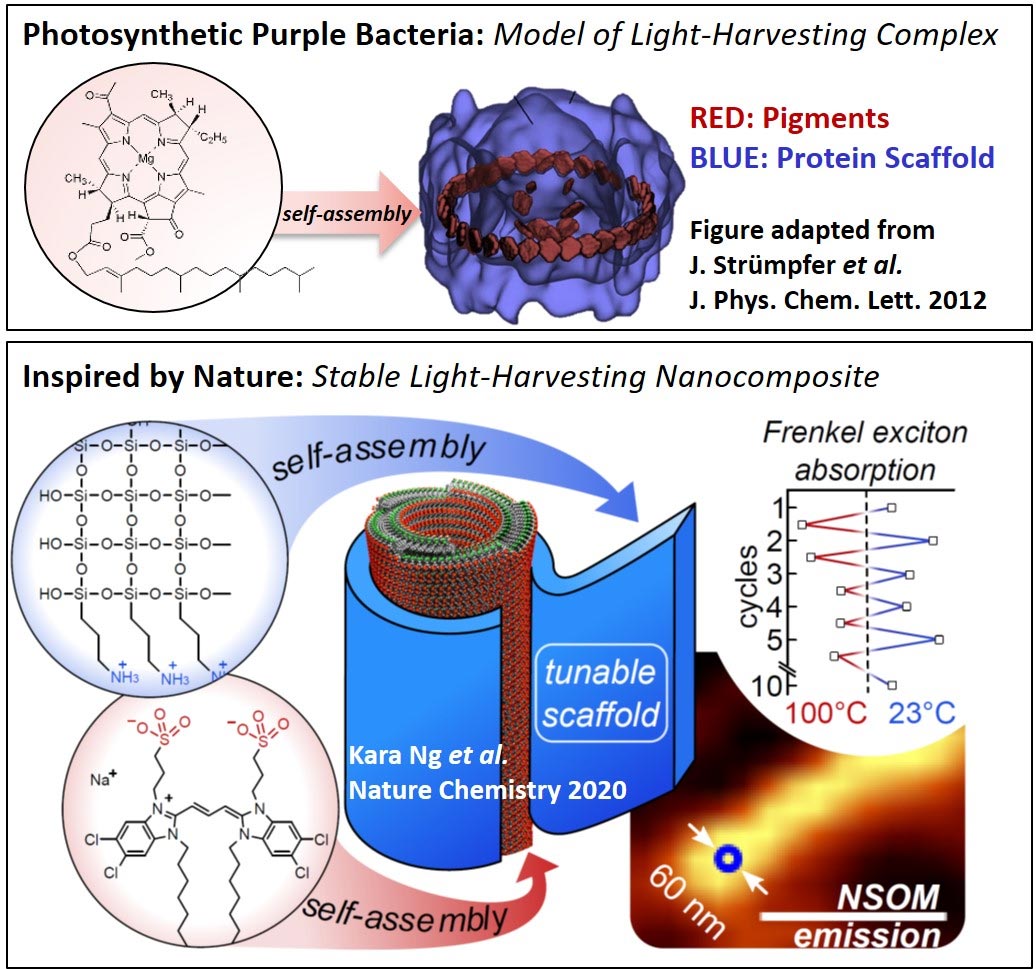
Scientists created a bio-inspired scaffold that stabilizes artificial solar materials under harsh conditions, advancing solar harvesting innovation.
Inspired by nature, researchers at The City College of New York (CCNY) can demonstrate a synthetic strategy to stabilize bio-inspired solar energy harvesting materials. Their findings, published in the journal Nature Chemistry, could be a significant breakthrough in functionalizing molecular assemblies for future solar energy conversion technologies.
In almost every corner of the world, despite extreme heat or cold temperature conditions, you will find photosynthetic organisms striving to capture solar energy. Uncovering nature’s secrets on how to harvest light so efficiently and robustly could transform the landscape of sustainable solar energy technologies, especially in the wake of rising global temperatures.
Scaffolds in Natural Light Harvesting
In photosynthesis, the first step (that is, light-harvesting) involves the interaction between light and the light-harvesting antenna, which is composed of fragile materials known as supra-molecular assemblies. From leafy green plants to tiny bacteria, nature designed a two-component system: the supra-molecular assemblies are embedded within protein or lipid scaffolds. It is not yet clear what role this scaffold plays, but recent research suggests that nature may have evolved these sophisticated protein environments to stabilize their fragile supra-molecular assemblies.
“Although we can’t replicate the complexity of the protein scaffolds found in photosynthetic organisms, we were able to adapt the basic concept of a protective scaffold to stabilize our artificial light-harvesting antenna,” said Dr. Kara Ng. Her co-authors include Dorthe M. Eisele and Ilona Kretzschmar, both professors at CCNY, and Seogjoo Jang, professor at Queens College.
Thus far, translating nature’s design principles to large-scale photovoltaic applications has been unsuccessful.
“The failure may lie in the design paradigm of current solar cell architectures,” said Eisele. However, she and her research team, “do not aim to improve the solar cell designs that already exist. But we want to learn from nature’s masterpieces to inspire entirely new solar energy harvesting architectures,” she added.
Silane Molecules Create a Stabilizing Scaffold
Inspired by nature, the researchers demonstrate how small, cross-linking molecules can overcome barriers towards functionalization of supra-molecular assemblies. They found that silane molecules can self-assemble to form an interlocking, stabilizing scaffold around an artificial supra-molecular light-harvesting antenna.
“We have shown that these intrinsically unstable materials, can now survive in a device, even through multiple cycles of heating and cooling,” said Ng. Their work provides proof-of-concept that a cage-like scaffold design stabilizes supra-molecular assemblies against environmental stressors, such as extreme temperature fluctuations, without disrupting their favorable light-harvesting properties.
Reference: “Frenkel excitons in heat-stressed supramolecular nanocomposites enabled by tunable cage-like scaffolding” by Kara Ng, Megan Webster, William P. Carbery, Nikunjkumar Visaveliya, Pooja Gaikwad, Seogjoo J. Jang, Ilona Kretzschmar and Dorthe M. Eisele, 16 November 2020, Nature Chemistry.
DOI: 10.1038/s41557-020-00563-4
The research was supported by CCNY’s Martin and Michele Cohen Fund for Science, the Solar Photochemistry Program of the U.S. Department of Energy, Office of Basic Energy Sciences and the National Science Foundation (NSF CREST IDEALS and NSF-CAREER).
Never miss a breakthrough: Join the SciTechDaily newsletter.
Follow us on Google and Google News.