
A new measuring method helps understand the physics of high-temperature superconductivity
From sustainable energy to quantum computers: high-temperature superconductors have the potential to revolutionize today’s technologies. Despite intensive research, however, we still lack the necessary basic understanding to develop these complex materials for widespread application. “Higgs spectroscopy” could bring about a watershed as it reveals the dynamics of paired electrons in superconductors. An international research consortium centered around the Helmholtz-Zentrum Dresden-Rossendorf (HZDR) and the Max Planck Institute for Solid State Research (MPI-FKF) is now presenting the new measuring method in the journal Nature Communications. Remarkably, the dynamics also reveal typical precursors of superconductivity even above the critical temperature at which the materials investigated attain superconductivity.
Superconductors transport electric current without a loss of energy. Utilizing them could dramatically reduce our energy requirements – if it weren’t for the fact that superconductivity requires temperatures of -140 degrees Celsius (-220 degrees Fahrenheit) and below. Materials only ‘turn on’ their superconductivity below this point. All known superconductors require elaborate cooling methods, which makes them impractical for everyday purposes. There is a promise of progress in high-temperature superconductors such as cuprates – innovative materials based on copper oxide. The problem is that despite many years of research efforts, their exact mode of operation remains unclear. Higgs spectroscopy might change that.
Higgs spectroscopy allows new insights into high-temperature superconductivity
“Higgs spectroscopy offers us a whole new ‘magnifying glass’ to examine the physical processes,” Dr. Jan-Christoph Deinert reports. The researcher at the HZDR Institute of Radiation Physics is working on the new method alongside colleagues from the MPI-FKF, the Universities of Stuttgart and Tokyo, and other international research institutions. What the scientists are most keen to find out is how electrons form pairs in high-temperature superconductors.
In superconductivity, electrons combine to create “Cooper pairs,” which enables them to move through the material in pairs without any interaction with their environment. But what makes two electrons pair up when their charge actually makes them repel each other? For conventional superconductors, there is a physical explanation: “The electrons pair up because of crystal lattice vibrations,” explains Prof. Stefan Kaiser, one of the main authors of the study, who is researching the dynamics in superconductors at MPI-FKF and the University of Stuttgart. One electron distorts the crystal lattice, which then attracts the second electron. For cuprates, however, it has so far been unclear which mechanism acts in the place of lattice vibrations. “One hypothesis is that the pairing is due to fluctuating spins, i.e. magnetic interaction,” Kaiser explains. “But the key question is: Can their influence on superconductivity and in particular on the properties of the Cooper pairs be measured directly?”
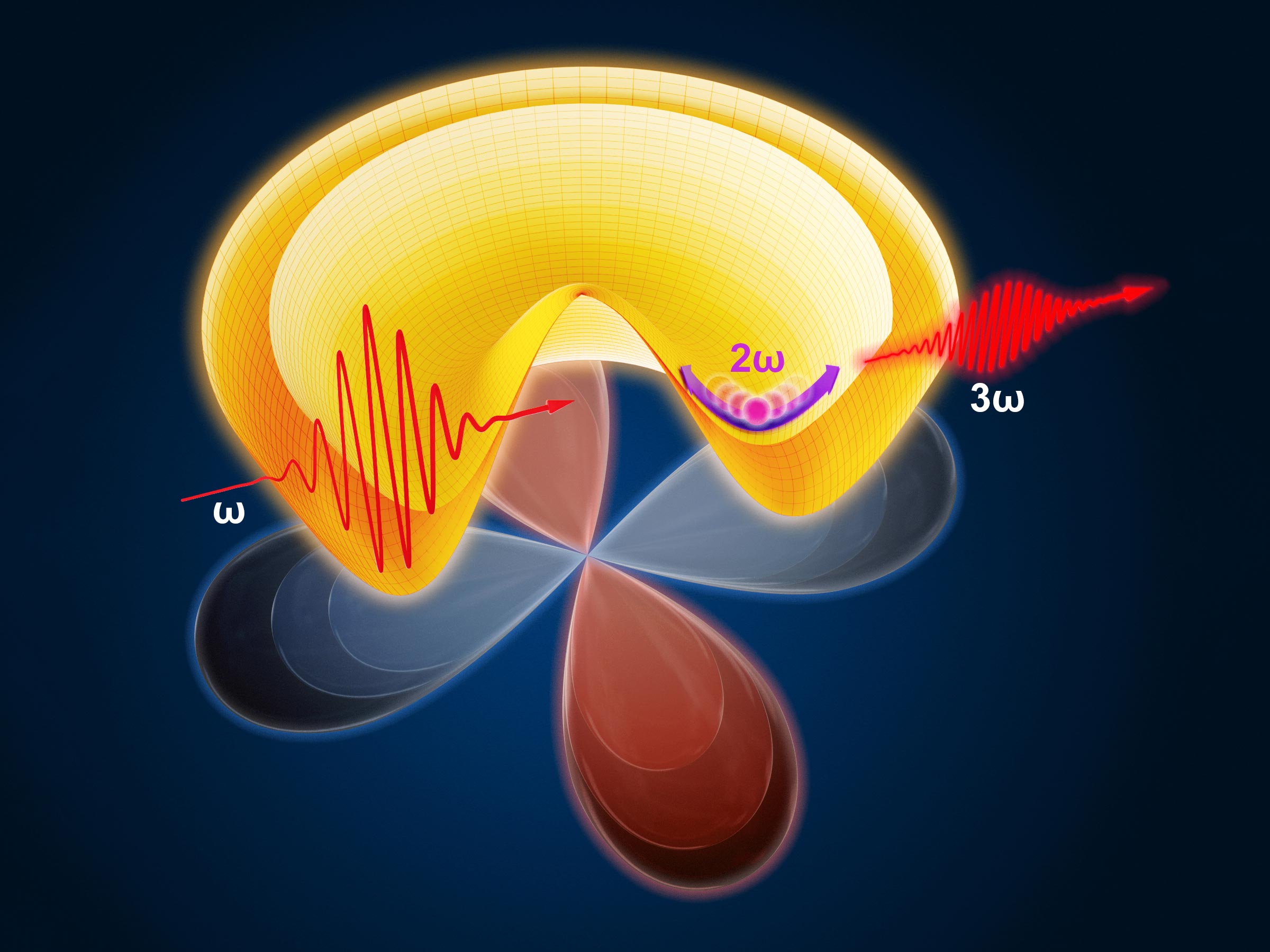
At this point “Higgs oscillations” enter the stage: In high-energy physics, they explain why elementary particles have mass. But they also occur in superconductors, where they can be excited by strong laser pulses. They represent the oscillations of the order parameter – the measure of a material’s superconductive state, in other words, the density of the Cooper pairs. So much for the theory. A first experimental proof succeeded a few years ago when researchers at the University of Tokyo used an ultrashort light pulse to excite Higgs oscillations in conventional superconductors – like setting a pendulum in motion. For high-temperature superconductors, however, such a one-off pulse is not enough, as the system is damped too much by interactions between the superconducting and non-superconducting electrons and the complicated symmetry of the ordering parameter.
Terahertz light source keeps the system oscillating
Thanks to Higgs spectroscopy, the research consortium around MPI-FKF and HZDR has now achieved the experimental breakthrough for high-temperature superconductors. Their trick was to use a multi-cyclic, extremely strong terahertz pulse that is optimally tuned to Higgs oscillation and can maintain it despite the damping factors – continuously prodding the metaphorical pendulum. With the high-performance terahertz light source TELBE at HZDR, the researchers are able to send 100,000 such pulses through the samples per second. “Our source is unique in the world due to its high intensity in the terahertz range combined with a very high repetition rate,” Deinert explains. “We can now selectively drive Higgs oscillations and measure them very precisely.”
This success is owed to close cooperation between theoretical and experimental scientists. The idea was hatched at MPI-FKF; the experiment was conducted by the TELBE team, led by Dr. Jan-Christoph Deinert and Dr. Sergey Kovalev at HZDR under then-group leader Prof. Michael Gensch, who is now researching at the German Aerospace Center and TU Berlin: “The experiments are of particular importance for the scientific application of large-scale research facilities in general. They demonstrate that a high-power terahertz source such as TELBE can handle a complex investigation using nonlinear terahertz spectroscopy on a complicated series of samples, such as cuprates.”
That is why the research team expects to see high demand in the future: “Higgs spectroscopy as a methodological approach opens up entirely new potentials,” explains Dr. Hao Chu, primary author of the study and postdoc at the Max Planck-UBC-UTokyo Center for Quantum Materials. “It is the starting point for a series of experiments that will provide new insights into these complex materials. We can now take a very systematic approach.”
Just above the critical temperature: Where does superconductivity start?
Conducting several series of measurements, the researchers first proved that their method works for typical cuprates. Below the critical temperature, the research team was not only able to excite Higgs oscillations, but also proved that a new, previously unobserved excitation interacts with the Cooper pairs’ Higgs oscillations. Further experiments will have to reveal whether these interactions are magnetic interactions, as is fiercely debated in expert circles. Furthermore, the researchers saw indications that Cooper pairs can also form above the critical temperature, albeit without oscillating together. Other measuring methods have previously suggested the possibility of such early pair formation. Higgs spectroscopy could support this hypothesis and clarify when and how the pairs form and what causes them to oscillate together in the superconductor.
Reference: “Phase-resolved Higgs response in superconducting cuprates” by Hao Chu, Min-Jae Kim, Kota Katsumi, Sergey Kovalev, Robert David Dawson, Lukas Schwarz, Naotaka Yoshikawa, Gideon Kim, Daniel Putzky, Zhi Zhong Li, Hélène Raffy, Semyon Germanskiy, Jan-Christoph Deinert, Nilesh Awari, Igor Ilyakov, Bertram Green, Min Chen, Mohammed Bawatna, Georg Cristiani, Gennady Logvenov, Yann Gallais, Alexander V. Boris, Bernhard Keimer, Andreas P. Schnyder, Dirk Manske, Michael Gensch, Zhe Wang, Ryo Shimano and Stefan Kaiser, 14 April 2020, Nature Communications.
DOI: 10.1038/s41467-020-15613-1
Never miss a breakthrough: Join the SciTechDaily newsletter.
Follow us on Google and Google News.