

Close Menu
    Facebook X (Twitter) Instagram
    SciTechDaily
    • Biology
    • Chemistry
    • Earth
    • Health
    • Physics
    • Science
    • Space
    • Technology
    Facebook X (Twitter) Pinterest YouTube RSS
    SciTechDaily
    Home»Technology»New Layered Superconducting Material Achieves Unparalleled Customizability and Higher Critical Temperature
    Technology

    New Layered Superconducting Material Achieves Unparalleled Customizability and Higher Critical Temperature

    By Tokyo Metropolitan UniversityOctober 11, 2019No Comments3 Mins Read
    Facebook Twitter Pinterest Telegram LinkedIn WhatsApp Email Reddit
    Share
    Facebook Twitter LinkedIn Pinterest Telegram Email Reddit

    Artist Concept Multi Layered Superconductor

    Modified multi-layered bismuth superconductor for higher critical temperatures.

    Scientists from Tokyo Metropolitan University have created a new layered superconducting material with a conducting layer made of bismuth, silver, tin, sulfur, and selenium. The conducting layer features four distinct sublayers; by introducing more elements, they were able to achieve unparalleled customizability and a higher “critical temperature” below which superconductivity is observed, a key objective of superconductor research. Their design strategy may be applied to engineer new and improved superconducting materials.

    Once an academic curiosity, superconductors are now at the cutting edge of real technological innovations. Superconducting magnets are seen in everyday MRI machines, and particle accelerators for medical treatments, not to mention the new Chuo Shinkansen maglev train connecting Tokyo to Nagoya currently being built. Recently, a whole new class of “layered” superconducting structures has been studied, consisting of alternate layers of superconducting and insulating two-dimensional crystalline layers. In particular, the customizability of the system has garnered particular interest in light of its potential to create ultra-efficient thermoelectric devices and a whole new class of “high temperature” superconducting materials.
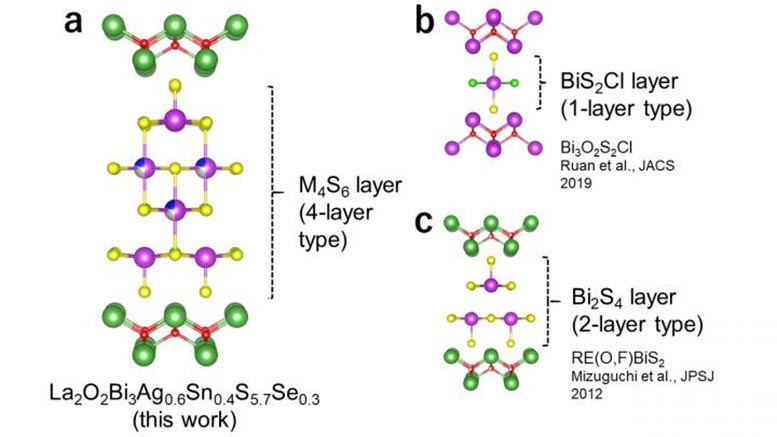
    Crystalline Structure of Newly Created Superconductor
    (a) Crystalline structure of the newly created superconductor. It has four sublayers in the conducting layer. This is in contrast to (b) and (c) which only have 1 and 2 layers respectively. The newly developed structure allows more customization to tune its superconducting properties. Credit: Tokyo Metropolitan University

    A team led by Associate Professor Yoshikazu Mizuguchi from Tokyo Metropolitan University recently created a bismuth sulfide-based layered superconductor; their work has already revealed novel thermoelectric properties and an elevated “critical temperature” below which superconductivity is observed. Now, working with a team from the University of Yamanashi, they have taken a multi-layered version of the system, where the conducting layer consists of four atomic layers, and begun swapping out small proportions of different atomic species to probe how the material changes.

    Starting with a conducting layer made of bismuth, silver, and sulfur, they tried substituting some of the silver for tin. By varying the amount of silver, they were able to raise the critical temperature from 0.5K to above 2.0K. Interestingly, they found that this was accompanied by the disappearance of an anomaly in its resistivity at significantly higher temperatures. Though the reason behind this is not yet understood, it is clear that the addition of tin has significantly modified the electronic structure of the material. Furthermore, they took their best bismuth, silver, sulfur, and tin combination and substituted some of the sulfur for selenium, a modification known to improve superconducting properties in their original bismuth sulfide material. Not only did they raise the critical temperature further to 3.0K, but they also found that the response to magnetic fields showed signatures of “bulk” superconductivity, providing clear proof that they could in fact access both the advantages of reduced dimensionality and bulk materials.

    By changing the composition and number of layers, the team believe they are on the verge of achieving bottom-up engineering of new, tailored bismuth sulfide-based superconducting materials.

    Their research was published in the journal Scientific Reports.

    ###

    This work was supported by JSPS KAKENHI Grant Nos. 15H05886, 15H05884. 16H04493. 17K19058, 16K05454 and 15H03693, and a Tokyo Metropolitan Government Advanced Research Grant, Number (H31-1).

    Reference: “Bulk superconductivity in a four-layer-type Bi-based compound La2O2Bi3Ag0.6Sn0.4S5.7Se0.3” by Rajveer Jha, Yosuke Goto, Tatsuma D. Matsuda, Yuji Aoki, Masanori Nagao, Isao Tanaka and Yoshikazu Mizuguchi, 19 September 2019, Scientific Reports.
    DOI: 10.1038/s41598-019-49934-z

    Never miss a breakthrough: Join the SciTechDaily newsletter.
    Follow us on Google and Google News.

    Materials Science Particle Physics Superconductor Tokyo Metropolitan University
    Share. Facebook Twitter Pinterest LinkedIn Email Reddit

    Related Articles

    Breakthrough in Understanding the Physics of High-Temperature Superconductivity

    Discovery of Light-Induced Switching Mechanism Advances Optically Controlled Quantum Computation

    Devices to Process Ultra-High-Speed Wireless Data and Harvest Energy for Power Simultaneously

    Flexible Electrolyte Sheet Breakthrough for Advanced Lithium Metal Batteries

    After Decades of Trying, Physicists Observe Kondo Cloud Quantum Phenomenon for the First Time

    New Method for Analyzing Metal Developed by U.S. Army Researchers

    Hole-y Superconductor: Entirely New State of Matter Discovered

    New Technology Can Instantly Identify Airborne Chemicals – Down to Parts-Per-Billion

    A New Method for Observing High-Temperature Superconductors

    Leave A Reply Cancel Reply

    • Facebook
    • Twitter
    • Pinterest
    • YouTube

    Don't Miss a Discovery

    Subscribe for the Latest in Science & Tech!

    Trending News

    The Universe Is Expanding Too Fast and Scientists Can’t Explain Why

    “Like Liquid Metal”: Scientists Create Strange Shape-Shifting Material

    Early Warning Signals of Esophageal Cancer May Be Hiding in Plain Sight

    Common Blood Pressure Drug Shows Surprising Power Against Deadly Antibiotic-Resistant Superbug

    Scientists Uncover Dangerous Connection Between Serotonin and Heart Valve Disease

    Scientists Discover a “Protector” Protein That Could Help Reverse Hair Loss

    Bone-Strengthening Discovery Could Reverse Osteoporosis

    Scientists Uncover Hidden Trigger Behind Stem Cell Aging

    Follow SciTechDaily
    • Facebook
    • Twitter
    • YouTube
    • Pinterest
    • Newsletter
    • RSS
    SciTech News
    • Biology News
    • Chemistry News
    • Earth News
    • Health News
    • Physics News
    • Science News
    • Space News
    • Technology News
    Recent Posts
    • A Common Diabetes Drug May Hold the Key to Stopping HIV From Coming Back
    • Ancient “Syphilis-Like” Disease in Vietnam Challenges Key Scientific Assumptions
    • Drinking Alcohol To Cope in Your 20s Could Damage Your Brain for Life
    • Scientists Crack Alfalfa’s Chromosome Mystery After Decades of Debate
    • Ancient Ant-Plant Alliance Collapses As Predatory Wasps Move In
    Copyright © 1998 - 2026 SciTechDaily. All Rights Reserved.
    • Science News
    • About
    • Contact
    • Editorial Board
    • Privacy Policy
    • Terms of Use

    Type above and press Enter to search. Press Esc to cancel.