
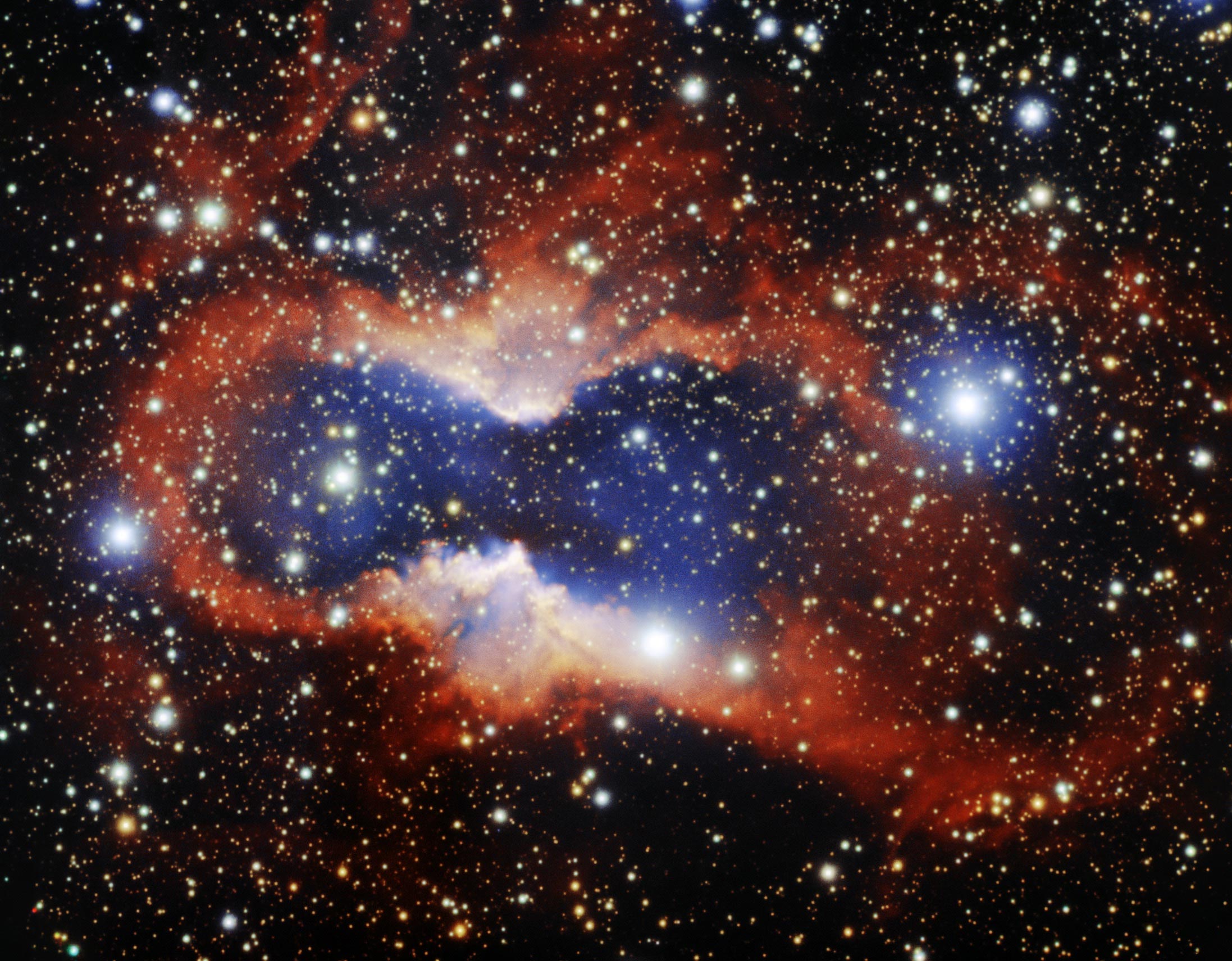
The latest image from the international Gemini Observatory showcases the striking planetary nebula CVMP 1. This object is the result of the death throes of a giant star and is a glorious but relatively short-lived astronomical spectacle. As the progenitor star of this planetary nebula slowly cools, this celestial hourglass will run out of time and will slowly fade from view over many thousands of years.
Located roughly 6500 light-years away in the southern constellation of Circinus (The Compass) this astronomical beauty formed during the final death throes of a massive star. CVMP 1 is a planetary nebula; it emerged when an old red giant star blew off its outer layers in the form of a tempestuous stellar wind [1]. As this cast-aside stellar atmosphere sped outwards into interstellar space, the hot, exposed core of the progenitor star began to energize the ejected gases and cause them to glow. This formed the beautiful hourglass shape captured in this observation from the international Gemini Observatory, a facility of NSF’s National Optical-Infrared Astronomy Research Laboratory.
Planetary nebulae like CVMP 1 are formed by only certain stars — those with a mass somewhere between 0.8 and 8 times that of our own Sun [2]. Less massive stars will gently fizzle out, transitioning into white dwarfs at the end of their long lives, whereas more massive stars live fast and die young, ending their lives in gargantuan explosions known as supernovae. For stars lying between these extremes, however, the final stretch of their lives results in a striking astronomical display such as the one seen in this image. Unfortunately, the spectacle provided by a planetary nebula is as brief as it is glorious; these objects typically persist for only 10,000 years — a tiny stretch of time compared to the lifespan of most stars, which lasts billions of years.

One of the largest and most detailed celestial images ever made, the picture was released on May 9, 2003, by the Space Telescope Science Institute and NOAO in honor of Astronomy Day 2003, which took place the following day. The radiant “tie-die” colors of the planetary nebula, located in the constellation Aquarius about 650 light-years distant from Earth, correspond to glowing oxygen (blue) and hydrogen and nitrogen (red).
Credit: NASA, NOAO, ESA, the Hubble Helix Nebula Team, M. Meixner (STScI), and T.A. Rector (NRAO)
These short-lived planetary nebulae come in myriad shapes and sizes, and several particularly striking forms are well known, such as the Helix Nebula which is captured in the image above from 2003 which combined OIR Lab facilities at Kitt Peak National Observatory with the Hubble Space Telescope. The great diversity of shapes stems from the diversity of progenitor star systems, whose characteristics can greatly influence the ensuing planetary nebula. The presence of companion stars, orbiting planets, or even the rotation of the original red giant star can help determine the shape of a planetary nebula, but we don’t yet have a detailed understanding of the processes sculpting these beautiful astronomical fireworks displays.
But CVMP 1 is intriguing for more than just its aesthetic value. Astronomers have found that the gases making up the hourglass are highly enriched with helium and nitrogen, and that CVMP 1 is one of the largest planetary nebulae known. These clues together suggest that CVMP 1 is highly evolved, making it an ideal object to help astronomers understand the later lives of planetary nebulae.
Astronomical measurements have revealed the characteristics of CVMP 1’s central star. By measuring the light emitted from the gas in the planetary nebula, astronomers infer that the temperature of the central star is at least 130,000 degrees C (230,000 degrees F). Despite this scorching temperature, the star is doomed to steadily cool over thousands of years. Eventually, the light it emits will have too little energy to ionize gas in the planetary nebula, causing the striking hourglass shown in this image to fade from view.
The international Gemini Observatory, comprises telescopes in the northern and southern hemispheres, which together can access the entire night sky. Similar to many large observatories, a small fraction of the observing time of the Gemini telescopes is set aside for the creation of color images that can share the beauty of the Universe with the public. Objects are chosen for their aesthetic appeal — such as this striking celestial hourglass.
Notes
[1] Despite their name, planetary nebulae have nothing to do with planets. This misnomer originates from the round, planet-like appearance of these objects when viewed through early telescopes. As telescopes improved, the striking beauty and stellar origin of planetary nebulae became more obvious, but their original name has persisted.
[2] Which in turn implies that our own Sun will form a planetary nebula after burning through its hydrogen fuel, around 5 billion years from now.
Never miss a breakthrough: Join the SciTechDaily newsletter.
Follow us on Google and Google News.
1 Comment
“As this cast-aside stellar atmosphere sped outwards into interstellar space, the hot, exposed core of the progenitor star began to energize the ejected gases and cause them to glow. This formed the beautiful hourglass shape captured in this observation from the international Gemini Observatory, a facility of NSF’s National Optical-Infrared Astronomy Research Laboratory.”
Stars are round, how do they “blow off” their outer layers into an hour glass form? Or energize the ejecta for that matter? All of these assertions are pure speculation based on guesses, yet are always stated as fact. In a word, you guys don’t really have a clue what your observing or how to explain it.