
Close Menu
    Facebook X (Twitter) Instagram
    SciTechDaily
    • Biology
    • Chemistry
    • Earth
    • Health
    • Physics
    • Science
    • Space
    • Technology
    Facebook X (Twitter) Pinterest YouTube RSS
    SciTechDaily
    Home»Health»Hidden Antibiotic Potential of Cannabis Uncovered – “Real Therapeutic Potential”
    Health

    Hidden Antibiotic Potential of Cannabis Uncovered – “Real Therapeutic Potential”

    By McMaster UniversityFebruary 26, 20201 Comment3 Mins Read
    Facebook Twitter Pinterest Telegram LinkedIn WhatsApp Email Reddit
    Share
    Facebook Twitter LinkedIn Pinterest Telegram Email Reddit
    McMaster Cannabis Researchers
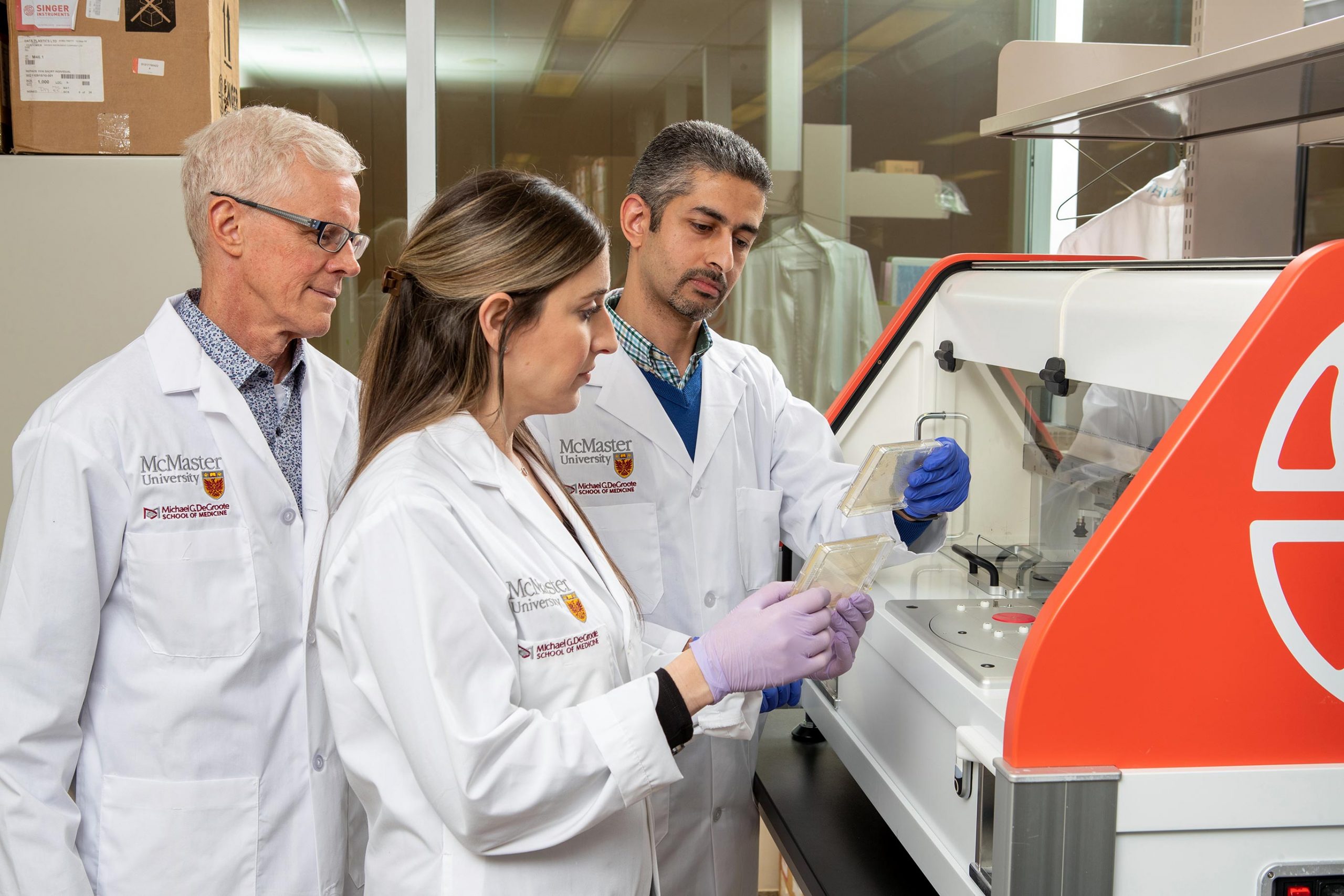
    Professor Eric Brown (left); research associate Maya Farha (centre), and postdoctoral fellow Omar El-Halfawy, are authors of the study and members of the Michael G. DeGroote Institute for Infectious Disease Research and Department of Biochemistry and Biomedical Sciences at McMaster University. Credit: McMaster University

    McMaster University researchers have identified an antibacterial compound made by cannabis plants that may serve as a lead for new drug development.

    An interdisciplinary team of McMaster researchers found that the chemical compound, or cannabinoid, called cannabigerol (CBG) is not only antibacterial but also effective in mice against a resilient family of bacteria known as methicillin-resistant Staphylococcus aureus (MRSA).

    The findings were published in the journal American Chemical Society Infectious Diseases.

    “In this study, we investigated 18 commercially available cannabinoids and they all showed antibiotic activity, some much more than others,” said study lead Eric Brown, professor of biochemistry and biomedical sciences at McMaster.

    “The findings suggest real therapeutic potential for cannabinoids as antibiotics.” Eric Brown, professor of biochemistry and biomedical sciences at McMaster

    “The one we focused on was a non-psychoactive cannabinoid called CBG, as it had the most promising activity. We synthesized that cannabinoid in mass quantity which gave us sufficient compound to go deep into the research.”

    The research team found that CBG had antibacterial activity against drug-resistant MRSA. It prevented the ability of that bacteria to form biofilms, which are communities of microorganisms that attach to each other and to surfaces; and it destroyed preformed biofilms and cells resistant to antibiotics. CBG achieved this by targeting the cell membrane of the bacteria.

    These findings in the laboratory were supported when mice with an MRSA infection were given CBG.

    “CBG proved to be marvelous at tackling pathogenic bacteria,” Brown said. “The findings suggest real therapeutic potential for cannabinoids as antibiotics.”

    One caveat noted by the research team is the toxicity of CBG on the host cells which makes the study’s findings an important lead rather than a likely final product, Brown said.

    “It opens a therapeutic window, but a narrow one, to develop this into a drug,” he said. “The next steps are to try to make the compound better in that it is more specific to the bacteria and has a lower chance of toxicity.”

    The Brown lab has been studying the antibiotic potential of cannabis for the past two years since the legalization of marijuana in Canada.

    “This research became top of mind for us, in part, because we are in Canada,” Brown said. “There has been some stigma of investing in this kind of research, but there’s increasing anecdotal evidence of the medicinal use of cannabis. The stigma seems to be waning.”

    Brown said the study was reliant on his collaborator, Jakob Magolan, a McMaster associate professor of biochemistry and biomedical sciences who specializes in drug development using organic synthetic chemistry.

    “The labs of Jake and I are just steps away from each other and our teams are talking to each other all the time,” Brown said. “This is just one of many exciting projects we’re involved with that combine scientists with very different but complementary expertise.”

    Reference: “Uncovering the Hidden Antibiotic Potential of Cannabis” by Maya A. Farha, Omar M. El-Halfawy, Robert T. Gale, Craig R. MacNair, Lindsey A. Carfrae, Xiong Zhang, Nicholas G. Jentsch, Jakob Magolan and Eric D. Brown, 4 February 2020, American Chemical Society Infectious Diseases.
    DOI: 10.1021/acsinfecdis.9b00419

    The study was funded by McMaster’s Michael G. DeGroote Centre for Medicinal Cannabis Research, Faculty of Health Sciences and Michael G. DeGroote Institute for Infectious Disease Research.

    Never miss a breakthrough: Join the SciTechDaily newsletter.
    Follow us on Google and Google News.

    Antibiotics Biochemistry Cannabis McMaster University
    Share. Facebook Twitter Pinterest LinkedIn Email Reddit

    Related Articles

    Improving Antibiotic Treatment: Scientists Test “Smart” Red Blood Cells

    New Molecule Discovered in Chestnut Leaves Disarms Dangerous Staph Bacteria

    Antibiotics Can Treat Human Diseases Like Cancer – Not Just Bacterial Infections

    Doctors Still Reluctant to Prescribe Medical Cannabis for Pain Relief

    “Hidden” Genes in Bacteriophages Could Be Key in Development of New Antibiotics

    Search for New Antibiotics to Combat “Two of the Most Wicked Healthcare Problems We Face”

    Leap Forward in the Development of New Glycopeptide Antibiotic to Fight Superbugs

    New Antibiotics Discovered With Unique Way to Kill Bacteria

    Study Finds No Evidence to Suggest Cannabis Helps Patients Stop Using Opioids

    1 Comment

    1. kamir bouchareb st on February 27, 2020 4:31 am

      good

      Reply
    Leave A Reply Cancel Reply

    • Facebook
    • Twitter
    • Pinterest
    • YouTube

    Don't Miss a Discovery

    Subscribe for the Latest in Science & Tech!

    Trending News

    Bone-Strengthening Discovery Could Reverse Osteoporosis

    Scientists Uncover Hidden Trigger Behind Stem Cell Aging

    Scientists Find Way to Reverse Fatty Liver Disease Without Changing Diet

    Could Humans Regrow Limbs? New Study Reveals Promising Genetic Pathway

    Scientists Reveal Eating Fruits and Vegetables May Increase Your Risk of Lung Cancer

    Scientists Reverse Brain Aging With Simple Nasal Spray

    Scientists Uncover Potential Brain Risks of Popular Fish Oil Supplements

    Scientists Discover a Surprising Way To Make Bread Healthier and More Nutritious

    Follow SciTechDaily
    • Facebook
    • Twitter
    • YouTube
    • Pinterest
    • Newsletter
    • RSS
    SciTech News
    • Biology News
    • Chemistry News
    • Earth News
    • Health News
    • Physics News
    • Science News
    • Space News
    • Technology News
    Recent Posts
    • AI Meets Quantum Computing and the Predictions Get Scary Accurate
    • Wind Farms Are Disrupting Ocean Currents, Moving Millions of Tons of Mud Each Year
    • Scientists Discover Massive Magma Reservoir Beneath Tuscany
    • Scientists Create “Neurobots” – Living Machines With Their Own Nervous Systems
    • Europe’s Most Active Volcano Just Got Stranger – Here’s Why Scientists Are Rethinking It
    Copyright © 1998 - 2026 SciTechDaily. All Rights Reserved.
    • Science News
    • About
    • Contact
    • Editorial Board
    • Privacy Policy
    • Terms of Use

    Type above and press Enter to search. Press Esc to cancel.