
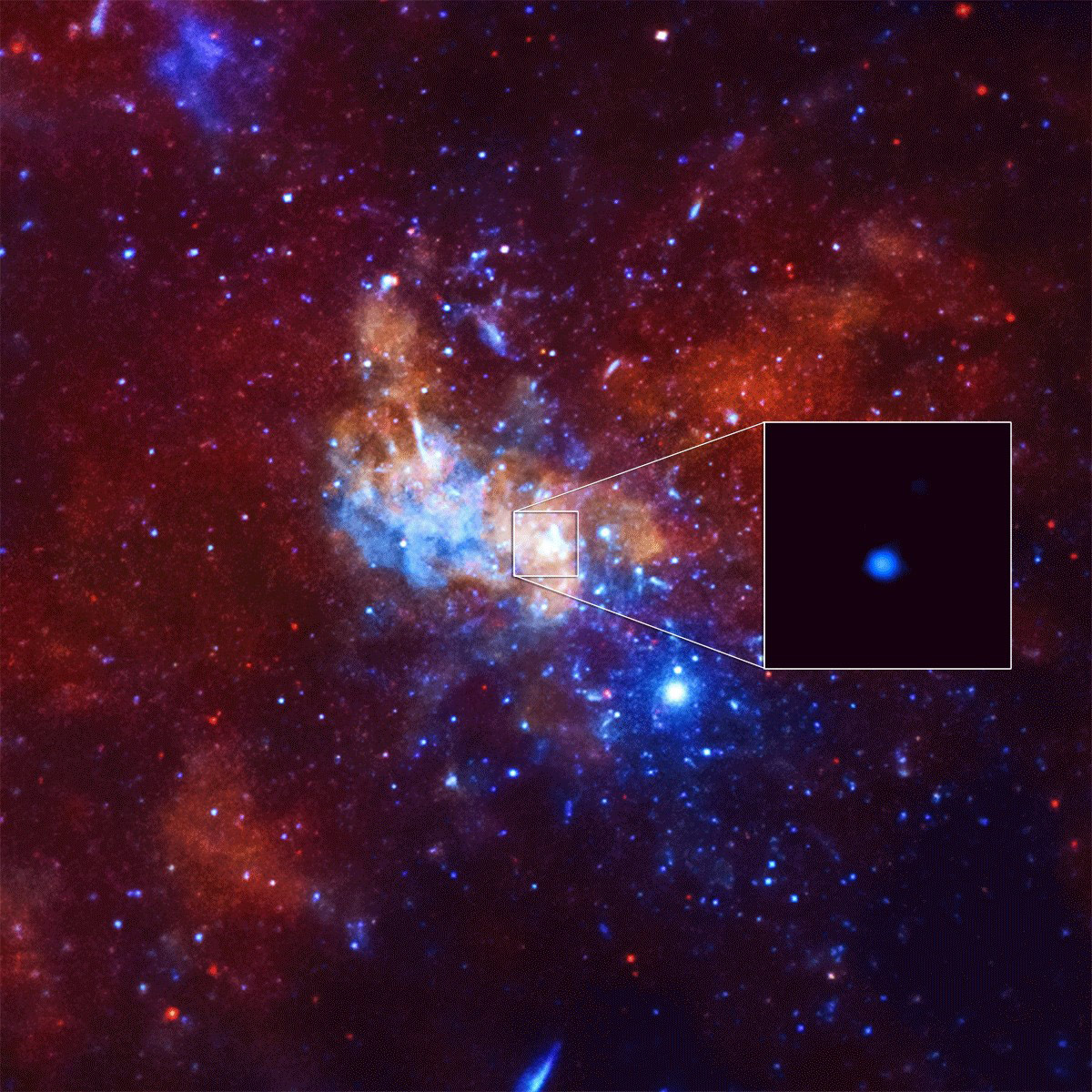
Using NASA’s Chandra X-ray Observatory, a team of astronomers has detected a record-breaking outburst from a supermassive black hole at the center of our galaxy.
Astronomers have observed the largest X-ray flare ever detected from the supermassive black hole at the center of the Milky Way galaxy. This event, detected by NASA’s Chandra X-ray Observatory, raises questions about the behavior of this giant black hole and its surrounding environment.
The supermassive black hole at the center of our galaxy, called Sagittarius A*, or Sgr A*, is estimated to contain about 4.5 million times the mass of our sun.
Astronomers made the unexpected discovery while using Chandra to observe how Sgr A* would react to a nearby cloud of gas known as G2.
“Unfortunately, the G2 gas cloud didn’t produce the fireworks we were hoping for when it got close to Sgr A*,” said lead researcher Daryl Haggard of Amherst College in Massachusetts. “However, nature often surprises us and we saw something else that was really exciting.”
On September 14, 2013, Haggard and her team detected an X-ray flare from Sgr A* 400 times brighter than its usual, quiet state. This “megaflare” was nearly three times brighter than the previous brightest X-ray flare from Sgr A* in early 2012. After Sgr A* settled down, Chandra observed another enormous X-ray flare 200 times brighter than usual on October 20, 2014.
Astronomers estimate that G2 was closest to the black hole in the spring of 2014, 15 billion miles away. The Chandra flare observed in September 2013 was about a hundred times closer to the black hole, making the event unlikely related to G2.
The researchers have two main theories about what caused Sgr A* to erupt in this extreme way. The first is that an asteroid came too close to the supermassive black hole and was torn apart by gravity. The debris from such a tidal disruption became very hot and produced X-rays before disappearing forever across the black hole’s point of no return, or event horizon.
“If an asteroid was torn apart, it would go around the black hole for a couple of hours – like water circling an open drain – before falling in,” said co-author Fred Baganoff of the Massachusetts Institute of Technology in Cambridge, Massachusetts. “That’s just how long we saw the brightest X-ray flare last, so that is an intriguing clue for us to consider.”
If this theory holds up, it means astronomers may have found evidence for the largest asteroid to produce an observed X-ray flare after being torn apart by Sgr A*.
A second theory is that the magnetic field lines within the gas flowing towards Sgr A* could be tightly packed and become tangled. These field lines may occasionally reconfigure themselves and produce a bright outburst of X-rays. These types of magnetic flares are seen on the sun, and the Sgr A* flares have similar patterns of intensity.
“The bottom line is the jury is still out on what’s causing these giant flares from Sgr A*,” said co-author Gabriele Ponti of the Max Planck Institute for Astrophysics in Garching, Germany. “Such rare and extreme events give us a unique chance to use a mere trickle of infalling matter to understand the physics of one of the most bizarre objects in our galaxy.”
In addition to the giant flares, the G2 observing campaign with Chandra also collected more data on a magnetar: a neutron star with a strong magnetic field, located close to Sgr A*. This magnetar is undergoing a long X-ray outburst, and the Chandra data are allowing astronomers to better understand this unusual object.
These results were presented at the 225th meeting of the American Astronomical Society being held in Seattle. NASA’s Marshall Space Flight Center in Huntsville, Alabama, manages the Chandra program for NASA’s Science Mission Directorate in Washington. The Smithsonian Astrophysical Observatory in Cambridge, Massachusetts, controls Chandra’s science and flight operations.
NASA is exploring our solar system and beyond to understand the universe and our place in it. The agency seeks to unravel the secrets of our universe, its origins, and evolution, and search for life among the stars.
Never miss a breakthrough: Join the SciTechDaily newsletter.
Follow us on Google and Google News.