
Close Menu
    Facebook X (Twitter) Instagram
    SciTechDaily
    • Biology
    • Chemistry
    • Earth
    • Health
    • Physics
    • Science
    • Space
    • Technology
    Facebook X (Twitter) Pinterest YouTube RSS
    SciTechDaily
    Home»Space»Survey of Galaxies Reveals Supermassive Black Holes
    Space

    Survey of Galaxies Reveals Supermassive Black Holes

    By Chandra X-ray ObservatoryDecember 17, 2012No Comments3 Mins Read
    Facebook Twitter Pinterest Telegram LinkedIn WhatsApp Email Reddit
    Share
    Facebook Twitter LinkedIn Pinterest Telegram Email Reddit
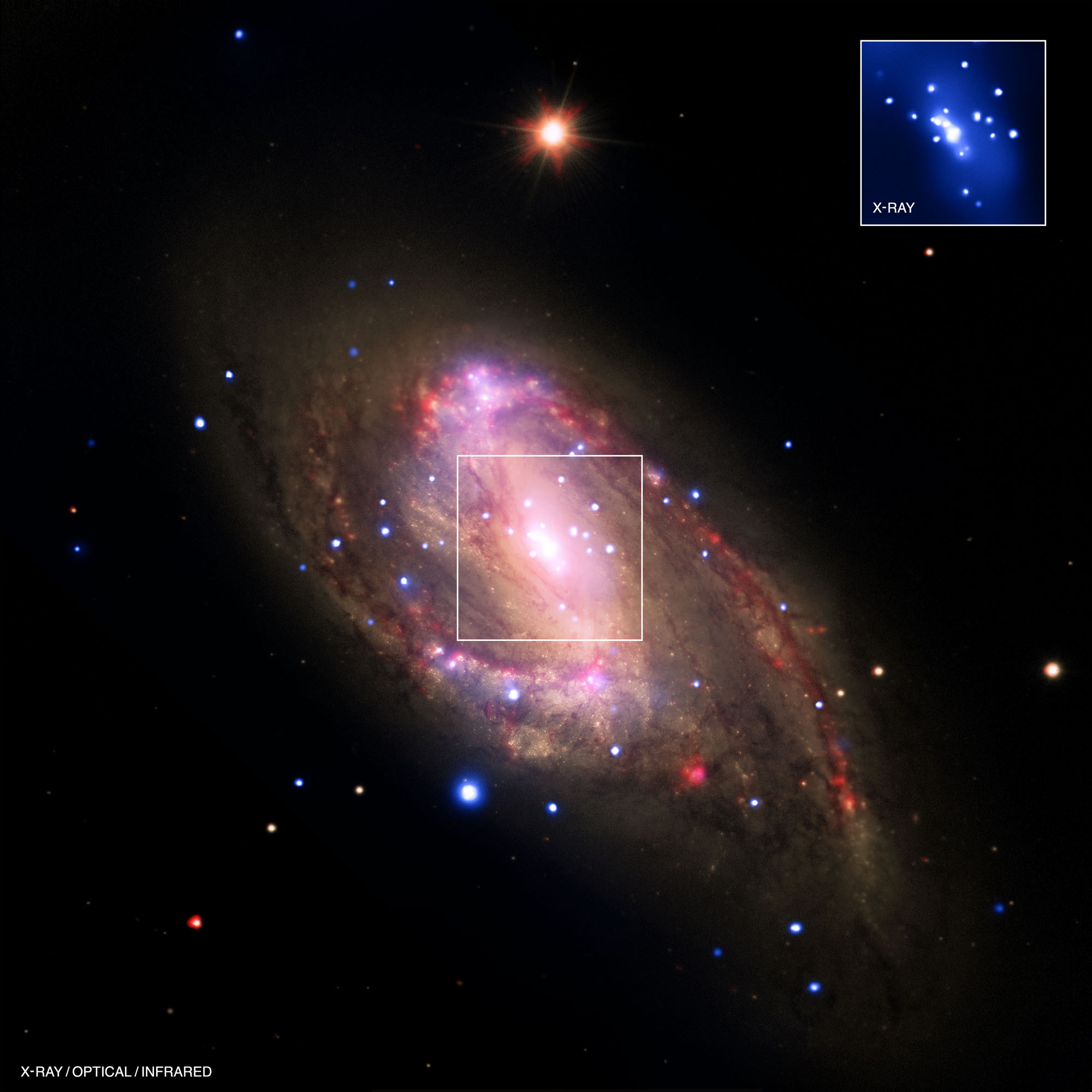
    Galaxy NGC 3627
    This composite image shows the spiral galaxy NGC 3627, located about 30 million light-years from Earth. Credit: NASA/CXC/Ohio State Univ./C.Grier et al.; Optical: NASA/STScI, ESO/WFI; Infrared: NASA/JPL-Caltech

    Using data from Chandra observations of 62 nearby galaxies and data from the Spitzer Infrared Nearby Galaxy Survey, scientists have shown that 37 of the galaxies contain X-ray sources in their centers that are most likely powered by central supermassive black holes.

    The spiral galaxy NGC 3627 is located about 30 million light-years from Earth. This composite image includes X-ray data from NASA’s Chandra X-ray Observatory (blue), infrared data from the Spitzer Space Telescope (red), and optical data from the Hubble Space Telescope and the Very Large Telescope (yellow). The inset shows the central region, which contains a bright X-ray source that is likely powered by material falling onto a supermassive black hole.

    A search using archival data from previous Chandra observations of a sample of 62 nearby galaxies has shown that 37 of the galaxies, including NGC 3627, contain X-ray sources in their centers. Most of these sources are likely powered by central supermassive black holes. The survey, which also used data from the Spitzer Infrared Nearby Galaxy Survey, found that seven of the 37 sources are new supermassive black hole candidates.

    Confirming previous Chandra results, this study finds the fraction of galaxies found to be hosting supermassive black holes is much higher than found with optical searches. This shows the ability of X-ray observations to find black holes in galaxies where relatively low-level black hole activity has either been hidden by obscuring material or washed out by the bright optical light of the galaxy.

    The combined X-ray and infrared data suggest that the nuclear activity in a galaxy is not necessarily related to the amount of star formation in the galaxy, contrary to some early claims. In contrast, these new results suggest that the mass of the supermassive black hole and the rate at which the black hole accretes matter are both greater for galaxies with greater total masses.

    A paper describing these results was published in The Astrophysical Journal. The authors are Catherine Grier and Smita Mathur of The Ohio State University in Columbus, OH; Himel GHosh of CNRS/CEA-Saclay in Guf-sur-Yvette, France and Laura Ferrarese from Herzberg Institute of Astrophysics in Victoria, Canada.

    NASA’s Marshall Space Flight Center in Huntsville, Alabama, manages the Chandra program for NASA’s Science Mission Directorate in Washington. The Smithsonian Astrophysical Observatory controls Chandra’s science and flight operations from Cambridge, Mass.

    Never miss a breakthrough: Join the SciTechDaily newsletter.
    Follow us on Google and Google News.

    Astronomy Astrophysics Black Hole Chandra X-ray Observatory
    Share. Facebook Twitter Pinterest LinkedIn Email Reddit

    Related Articles

    “X-Ray Magnifying Glass” Provides Unprecedented Look at Black Hole in the Early Universe

    Astronomers Use “X-Ray Magnifying Glass” To Enhance View of Distant Black Holes

    Spectacular Set of Massive Concentric Rings Around a Black Hole

    Astronomers Spot Unusual, Enormous Rings Around a Black Hole

    World’s Most Powerful Telescopes Unite in Unprecedented Observations of Famous Black Hole

    Record-Breaking Jet of Particles Spied From a Supermassive Black Hole in the Early Universe

    Massive X-ray Jet – Extending for 160,000 Light-Years – Spied From Supermassive Black Hole in Early Universe

    Deepening Mystery: Astronomers on the Hunt for a Missing Supermassive Black Hole [Video]

    Deepening Astronomical Mystery: On the Hunt for a Missing Giant Black Hole

    Leave A Reply Cancel Reply

    • Facebook
    • Twitter
    • Pinterest
    • YouTube

    Don't Miss a Discovery

    Subscribe for the Latest in Science & Tech!

    Trending News

    Breakthrough Bowel Cancer Trial Leaves Patients Cancer-Free for Nearly 3 Years

    Natural Compound Shows Powerful Potential Against Rheumatoid Arthritis

    100,000-Year-Old Neanderthal Fossils in Poland Reveal Unexpected Genetic Connections

    Simple “Gut Reset” May Prevent Weight Gain After Ozempic or Wegovy

    2.8 Days to Disaster: Scientists Warn Low Earth Orbit Could Suddenly Collapse

    Common Food Compound Shows Surprising Power Against Superbugs

    5 Simple Ways To Remember More and Forget Less

    The Atomic Gap That Could Cost the Semiconductor Industry Billions

    Follow SciTechDaily
    • Facebook
    • Twitter
    • YouTube
    • Pinterest
    • Newsletter
    • RSS
    SciTech News
    • Biology News
    • Chemistry News
    • Earth News
    • Health News
    • Physics News
    • Science News
    • Space News
    • Technology News
    Recent Posts
    • The Hidden Risk of Taking Breaks From Weight-Loss Drugs Like Ozempic
    • Total Solar Eclipse Made Cities Go Eerily Quiet Beneath the Surface
    • This Common Plant Could Be an Unexpected New Source of Protein
    • Birds in Cities Fear Women More Than Men and Scientists Don’t Know Why
    • Scientists Warn That This Common Pet Fish Can Wreck Entire Ecosystems
    Copyright © 1998 - 2026 SciTechDaily. All Rights Reserved.
    • Science News
    • About
    • Contact
    • Editorial Board
    • Privacy Policy
    • Terms of Use

    Type above and press Enter to search. Press Esc to cancel.