
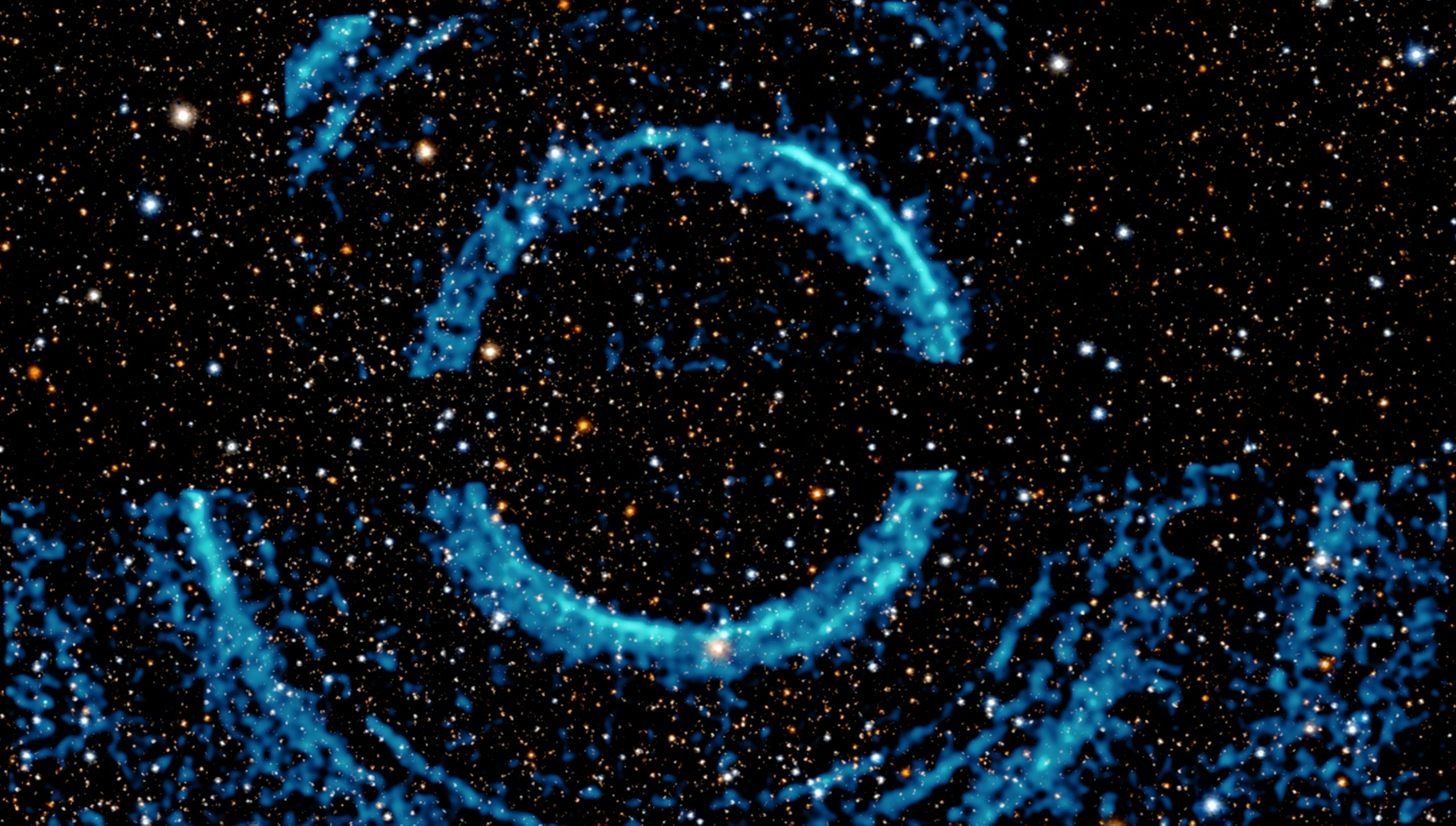
Chandra and Swift telescopes revealed eight glowing rings around the black hole V404 Cygni, created by X-rays bouncing off cosmic dust. These “light echoes” allowed astronomers to measure the distances and compositions of intervening dust clouds, finding mixtures of graphite and silicates.
A spectacular set of rings around a black hole has been captured using NASA’s Chandra X-ray Observatory and Neil Gehrels Swift Observatory. The X-ray images of the giant rings have revealed new information about dust located in our Galaxy, using a similar principle to the X-rays performed in doctor’s offices and airports.
The black hole is part of a binary system called V404 Cygni, located about 7,800 light-years away from Earth. The black hole is actively pulling material away from a companion star — with about half the mass of the Sun — into a disk around the invisible object. This material glows in X-rays, so astronomers refer to these systems as “X-ray binaries.”
Light Echoes: X-rays Bounce off Dust
On June 5, 2015, Swift discovered a burst of X-rays from V404 Cygni. The burst created the high-energy rings from a phenomenon known as light echoes. Instead of sound waves bouncing off a canyon wall, the light echoes around V404 Cygni were produced when a burst of X-rays from the black hole system bounced off of dust clouds between V404 Cygni and Earth. Cosmic dust is not like household dust but is more like smoke, and consists of tiny, solid particles.
In a new composite image, X-rays from Chandra (light blue) have been combined with optical data from the Pan-STARRS telescope on Hawaii that show the stars in the field of view. The image contains eight separate concentric rings. Each ring is created by X-rays from V404 Cygni flares observed in 2015 that reflect off different dust clouds. (An artist’s illustration, shown below, explains how the rings seen by Chandra and Swift were produced. To simplify the graphic, the illustration shows only four rings instead of eight.)

The team analyzed 50 Swift observations made in 2015 between June 30 and August 25. Chandra observed the system on July 11 and 25. It was such a bright event that the operators of Chandra purposely placed V404 Cygni in between the detectors so that another bright burst would not damage the instrument.
The rings tell astronomers not only about the black hole’s behavior, but also about the landscape between V404 Cygni and Earth. For example, the diameter of the rings in X-rays reveals the distances to the intervening dust clouds the light ricocheted off. If the cloud is closer to Earth, the ring appears to be larger and vice versa. The light echoes appear as narrow rings rather than wide rings or haloes because the X-ray burst lasted only a relatively short period of time.
New Insights into Dust Composition
The researchers also used the rings to probe the properties of the dust clouds themselves. The authors compared the X-ray spectra — that is, the brightness of X-rays over a range of wavelengths — to computer models of dust with different compositions. Different compositions of dust will result in different amounts of the lower energy X-rays being absorbed and prevented from being detected with Chandra. This is a similar principle to how different parts of our body or our luggage absorb different amounts of X-rays, giving information about their structure and composition.
The team determined that the dust most likely contains mixtures of graphite and silicate grains. In addition, by analyzing the inner rings with Chandra, they found that the densities of the dust clouds changes are not uniform in all directions. Previous studies have assumed that they did not.
For more on this discovery, read Astronomers Spot Unusual, Enormous Rings Around a Black Hole.
This result is related to a similar finding of the X-ray binary Circinus X-1, which contains a neutron star rather than a black hole, published in a paper in the June 20, 2015, issue of The Astrophysical Journal, titled, “Lord of the Rings: A Kinematic Distance to Circinus X-1 from a Giant X-Ray Light Echo” (preprint). This study was also led by Sebastian Heinz.
The V404 Cygni results were led by the same astronomer, Sebastian Heinz of the University of Wisconsin in Madison. This paper was published in the July 1, 2016 issue of The Astrophysical Journal (preprint). The co-authors of the study are Lia Corrales (University of Michigan); Randall Smith (Center for Astrophysics | Harvard & Smithsonian); Niel Brandt (The Pennsylvania State University); Peter Jonker (Netherlands Institute for Space Research); Richard Plotkin (University of Nevada, Reno) and Joey Neilson (Villanova University).
NASA’s Marshall Space Flight Center manages the Chandra program. The Smithsonian Astrophysical Observatory’s Chandra X-ray Center controls science from Cambridge, Massachusetts, and flight operations from Burlington, Massachusetts.
Never miss a breakthrough: Join the SciTechDaily newsletter.
Follow us on Google and Google News.
1 Comment
excess matter ejected, striking energy (the magnetic field)