
Close Menu
    Facebook X (Twitter) Instagram
    SciTechDaily
    • Biology
    • Chemistry
    • Earth
    • Health
    • Physics
    • Science
    • Space
    • Technology
    Facebook X (Twitter) Pinterest YouTube RSS
    SciTechDaily
    Home»Space»CID-42: A Recoiling, Supermassive Black Hole?
    Space

    CID-42: A Recoiling, Supermassive Black Hole?

    By Harvard-Smithsonian Center for AstrophysicsJanuary 23, 20152 Comments3 Mins Read
    Facebook Twitter Pinterest Telegram LinkedIn WhatsApp Email Reddit
    Share
    Facebook Twitter LinkedIn Pinterest Telegram Email Reddit
    A Recoiling Supermassive Black Hole
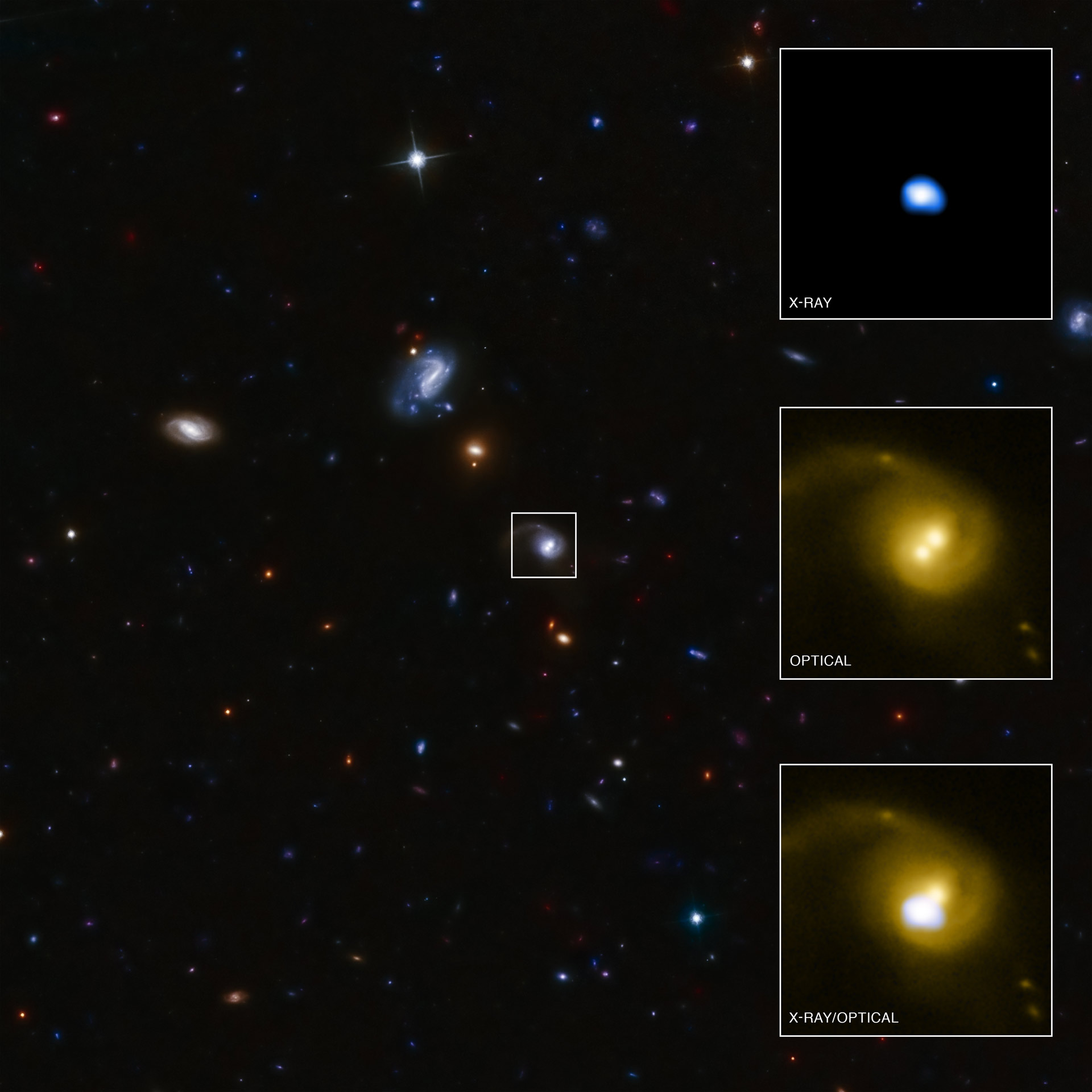
    (Click for full image) The galaxy at the center of this image from the Hubble Space Telescope contains an X-ray source, CID-42, which is suspected of being the merged remnant of a pair of supermassive black holes and of being ejected from the host galaxy at a speed of several million miles per hour. Credit: X-ray: NASA/CXC/SAO/F.Civano et al; Optical: NASA/STScI; Optical (wide field): CFHT, NASA/STScI

    New research from the Harvard-Smithsonian Center for Astrophysics provides new insights from deep VLA data on the potentially recoiling black hole CID-42 in the COSMOS field.

    When galaxies collide, the central supermassive black holes that reside at their cores will end up orbiting one another in a binary pair, at least according to current simulations. Einstein’s general theory of relativity predicts that masses in a binary system should radiate gravitational waves, analogous to the way that accelerating electrical charges radiate electromagnetic waves but very much weaker.

    As they radiate away their energy in these waves, orbiting black holes will gradually come closer together until eventually they merge in a coalescence event that is expected to emit a strong burst of gravitational waves. Relativity predicts that the gravitational radiation from black hole coalescence will be preferentially emitted in one direction that depends on the spin- and mass-ratios of the two black holes. In order to conserve momentum, therefore, the newly formed single supermassive black hole will recoil. Indeed, recoiling supermassive black holes are predicted to be one of the key observable signatures of such binary mergers. As they speed away from the center of the galaxy, they are expected to carry along with them their local environments (the discs and hot gas regions).

    Amazingly, a few of these bizarre, recoiling candidates have apparently been serendipitously spotted (they are so far only candidates because their character is not yet confirmed). One of them is an X-ray source known as CID-42, which the Hubble Space Telescope resolves into two bright components only a few thousand light-years apart (a relatively small distance in galactic terms). CfA astronomers Francesca Civano, Xiawei Wang, Avi Loeb, and Martin Elvis, together with their colleagues, used the Very Large Array radio facility to study the radio emission emitted by charged particles accelerated by the black holes in CID-42, and analyzed their data together with that from other facilities in an effort to confirm it as a recoil object. They find that all of the radio emissions can be attributed to one of the two bright components, which also is the source of the X-ray emission. This source, their analysis concludes (although still not unequivocally), could indeed be a long-sought example of a recoiling black hole. The new research is a major step towards confirming the existence of these exotic objects, but further observations are still needed.

    Reference: “New insights from deep VLA data on the potentially recoiling black hole CID-42 in the COSMOS field” by Mladen Novak, Vernesa Smolcic, Francesca Civano, Marco Bondi, Paolo Ciliegi, Xiawei Wang, Abraham Loeb, Julie Banfield, Stephen Bourke, Martin Elvis, Gregg Hallinan, Huib T. Intema, Hans-Rainer Klockner, Kunal Mooley and Felipe Navarrete, 24 December 2014, MNRAS.
    DOI: 10.1093/mnras/stu2473
    arXiv: 1412.0004

    Never miss a breakthrough: Join the SciTechDaily newsletter.
    Follow us on Google and Google News.

    Astronomy Astrophysics Black Hole Harvard-Smithsonian Center for Astrophysics Popular
    Share. Facebook Twitter Pinterest LinkedIn Email Reddit

    Related Articles

    Black Hole Lights Up Years After Ripping Star to Shreds – “We’ve Never Seen Anything Like This Before”

    Scientists Have Spotted the Farthest Galaxy Ever – It May Be Home to the Oldest Stars in the Universe

    Astronomers Spy Quartet of Enormous Cavities From Giant Black Holes

    Astronomers Use “X-Ray Magnifying Glass” To Enhance View of Distant Black Holes

    Astronomers Spot Unusual, Enormous Rings Around a Black Hole

    Telescopes Unite in Unprecedented Observations of Famous Black Hole Across the Entire Electromagnetic Spectrum

    Massive X-ray Jet – Extending for 160,000 Light-Years – Spied From Supermassive Black Hole in Early Universe

    Astronomers Detect a Supermassive Black Hole on the Move – Unusual Motion Thus Far Unexplained

    Stranger Than Fiction: The Monster in the Middle of the Milky Way Is…Spinning Slowly?

    2 Comments

    1. Douglas Dwyer on January 24, 2015 11:00 am

      This pair of bodies in orbit will make a part of their momentum available to any masses that fall into their gravity well and project some of this mass into a new spiral the balance of the gas and dust to end up falling into the black holes..

      Reply
    2. Nelson Simonson on January 25, 2015 9:52 pm

      The article states, “One of them (the recoiling candidates)… resolves into two bright components only a few thousand light-years apart.” Does this mean the two black holes have recoiled from their merged galaxy prior to their collapsing into a single black hole?

      Reply
    Leave A Reply Cancel Reply

    • Facebook
    • Twitter
    • Pinterest
    • YouTube

    Don't Miss a Discovery

    Subscribe for the Latest in Science & Tech!

    Trending News

    The Universe Is Expanding Too Fast and Scientists Can’t Explain Why

    “Like Liquid Metal”: Scientists Create Strange Shape-Shifting Material

    Early Warning Signals of Esophageal Cancer May Be Hiding in Plain Sight

    Common Blood Pressure Drug Shows Surprising Power Against Deadly Antibiotic-Resistant Superbug

    Scientists Uncover Dangerous Connection Between Serotonin and Heart Valve Disease

    Scientists Discover a “Protector” Protein That Could Help Reverse Hair Loss

    Bone-Strengthening Discovery Could Reverse Osteoporosis

    Scientists Uncover Hidden Trigger Behind Stem Cell Aging

    Follow SciTechDaily
    • Facebook
    • Twitter
    • YouTube
    • Pinterest
    • Newsletter
    • RSS
    SciTech News
    • Biology News
    • Chemistry News
    • Earth News
    • Health News
    • Physics News
    • Science News
    • Space News
    • Technology News
    Recent Posts
    • Ancient “Syphilis-Like” Disease in Vietnam Challenges Key Scientific Assumptions
    • Drinking Alcohol To Cope in Your 20s Could Damage Your Brain for Life
    • Scientists Crack Alfalfa’s Chromosome Mystery After Decades of Debate
    • Ancient Ant-Plant Alliance Collapses As Predatory Wasps Move In
    • Scientists Discover Tiny New Spider That Hunts Prey 6x Its Size
    Copyright © 1998 - 2026 SciTechDaily. All Rights Reserved.
    • Science News
    • About
    • Contact
    • Editorial Board
    • Privacy Policy
    • Terms of Use

    Type above and press Enter to search. Press Esc to cancel.