
A clinical study conducted by scientists at British American Tobacco has revealed that when smokers switch completely from cigarettes to glo, their exposure to certain cigarette smoke toxicants is significantly reduced, in some cases to levels comparable to those seen in smokers who quit smoking completely.
These results add to evidence suggesting that glo may have the potential to be substantially reduced risk compared to smoking conventional cigarettes.
Glo is a tobacco heating product (THP) designed to heat rather than burn tobacco. This means it does not produce smoke and certain toxicants associated with tobacco combustion are substantially reduced. Previous studies revealed toxicant levels in the heated tobacco vapor from glo to be around 90-95% less than in cigarette smoke.
“Products like glo are very new and consumers and regulators alike understandably want as much information as possible about them. Understanding how vapor from glo compares to cigarette smoke is, therefore, a core component of our scientific research,” said Dr. James Murphy, Head of Reduced Risk Substantiation at British American Tobacco. “Clinical studies, which are studies involving real people, are an extremely important component of that,” he said.
Because glo vapor has lower levels of toxicants than cigarette smoke, it should in principle expose consumers to much less toxicants. The results of this study indicate that this is indeed the case. The results are presented today at the annual conference of the Society for Nicotine and Tobacco Research in Baltimore, Maryland, USA.
Clinical Study
This clinical study was conducted in Japan because THPs like glo are popular there. One hundred and eighty people participated in the study, which was conducted over a period of eight days in a clinic. They were all smokers for at least three years prior to enrolment.
For the first two days, study participants continued to smoke as normal and their urine was collected to measure levels of chemicals. Blood and breath were also collected for analysis.
For the next five days, participants were randomly allocated to either continue smoking, switch to using a THP, or quit smoking. Urine, blood, and breath samples were again collected for analysis.
Exposure to certain smoke toxicants was determined by measuring the levels of certain chemicals in the urine. These could be the toxicants themselves or their metabolites – which is what the body breaks it down into – called biomarkers of exposure. Toxicants measured included those identified by the World Health Organisation as being of concern in cigarette smoke.
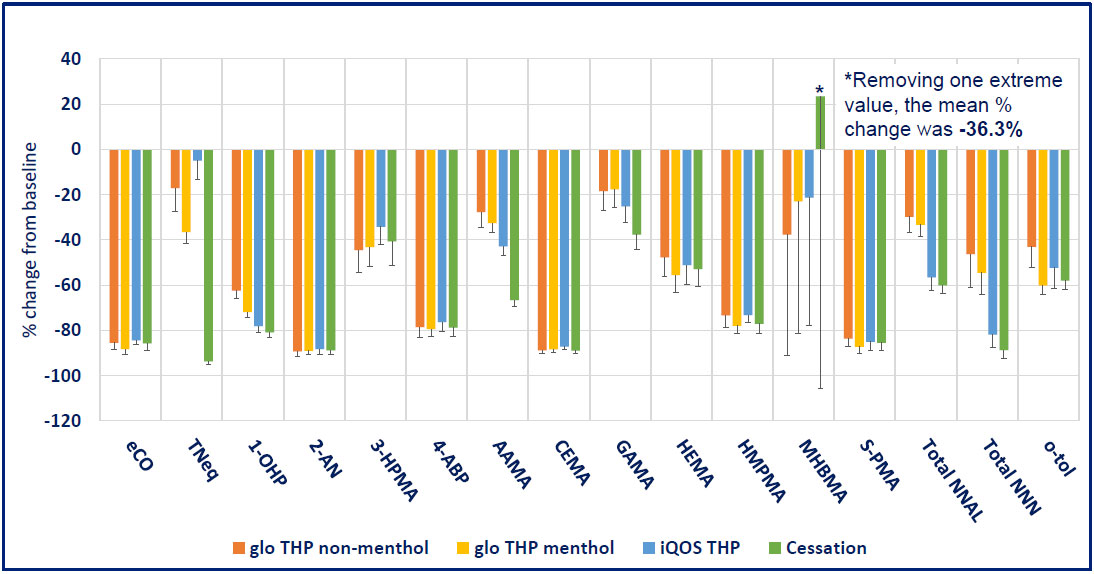
The results show that the concentration of certain chemicals in the urine was reduced in smokers who switched to glo. In some cases, these reductions were the same as those in smokers who quit (Figure 1). This suggests that smokers who switched to glo were exposed to less toxicants – in some cases, their exposure was the same as smokers who quit altogether.
“These results are very encouraging,” explains Murphy. “The next step will be to determine whether this reduction in exposure translates to a reduced biological effect, and in turn a reduction in adverse health effects for those smokers who switch completely to glo,” he said.
Future clinical studies will test for markers of biological effect, like cholesterol levels or heart rate (i.e. measurements that give an indication of general health). A reduction in biomarkers of biological effect could suggest that a reduction in exposure is having a positive impact on reducing the adverse health risks of smokers who switch completely.
“The results of one test are important,” said Murphy, “but it is the combination of the results of many different tests that start to give us a real feel for the bigger picture and the potential for glo to be reduced risk compared to a conventional cigarette.”
British American Tobacco has invested more than US$2.5 billion over the last six years in developing and commercializing a world-leading portfolio of products in the Next Generation Products (NGPs) category. British American Tobacco currently has NGPs in 17 markets with plans to be double the amount of markets we’re in by the end of 2018. BAT has a bold ambition to realize revenue of more than £5bn from NGPs by 2022.
Never miss a breakthrough: Join the SciTechDaily newsletter.
Follow us on Google and Google News.
1 Comment
Is Glo similar to other vaping apparatuses?
What types of second hand and third hand risks to health of others is there from vaping?