

In one of the most extreme environments on Earth—the Large Hadron Collider—normal electronics fail almost instantly. But engineers at Columbia University have created custom microchips that not only survive the collider’s intense radiation but play a pivotal role in unlocking the secrets of the universe.
These chips digitize the electrical whispers of particle collisions, helping physicists sift through billions of events to find clues about the Higgs boson and beyond. It’s a story of survival, precision, and human ingenuity at the frontiers of science.
LHC: A Particle Smashing Powerhouse
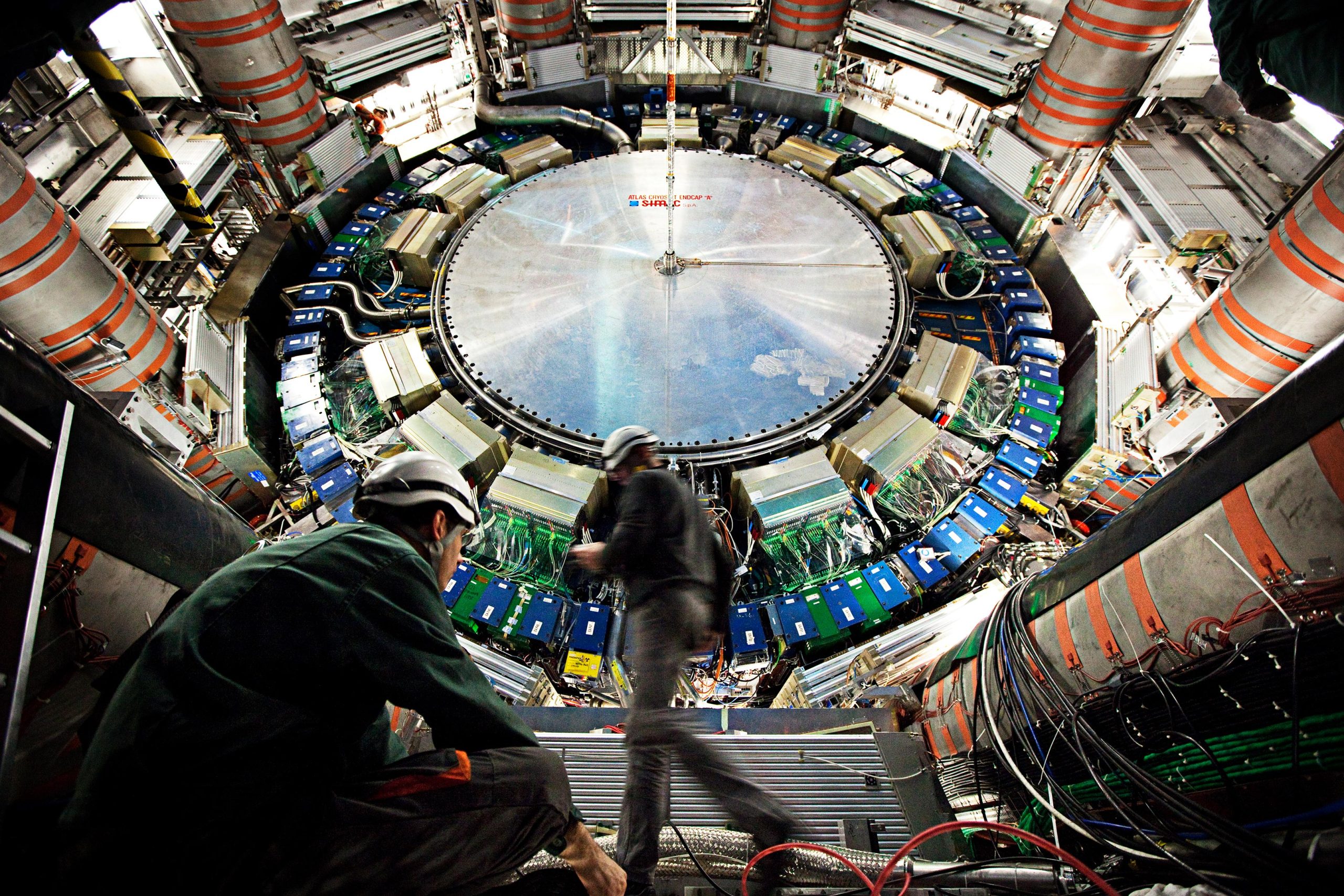
The Large Hadron Collider (LHC) is tough on electronics. Situated inside a 17-mile-long tunnel that runs in a circle under the border between Switzerland and France, this massive scientific instrument accelerates particles close to the speed of light before smashing them together. The collisions yield tiny maelstroms of particles and energy that hint at answers to fundamental questions about the building blocks of matter.
Those collisions produce an enormous amount of data — and enough radiation to scramble the bits and logic inside almost any piece of electronic equipment.
That presents a challenge to CERN’s physicists as they attempt to probe deeper into the mysteries of the Higgs boson and other fundamental particles. Off-the-shelf components simply can’t survive the harsh conditions inside the accelerator, and the market for radiation-resistant circuits is too small to entice investment from commercial chip manufacturers.
Columbia Engineers to the Rescue
“Industry just couldn’t justify the effort, so academia had to step in,” according to Peter Kinget, the Bernard J. Lechner Professor of Electrical Engineering at Columbia Engineering. “The next progress made by ATLAS will be triggered by one Columbia chip and measured by another.”
Kinget leads the team that designed specialized silicon chips that collect data in one of the harshest and most important environments in particle physics. Their most recent paper, describing this project, was published on July 1 in the IEEE Open Journal of the Solid-State Circuits Society.
“These sort of collaborations between physicists and engineers are very important to advancing our ability to explore fundamental questions about the universe,” according to John Parsons, professor of physics at Columbia University and leader of the Columbia team working on the ATLAS detector, one of the LHC’s massive instruments. “Developing state-of-the-art instrumentation is crucial to our success.”
Circuits that Resist Radiation
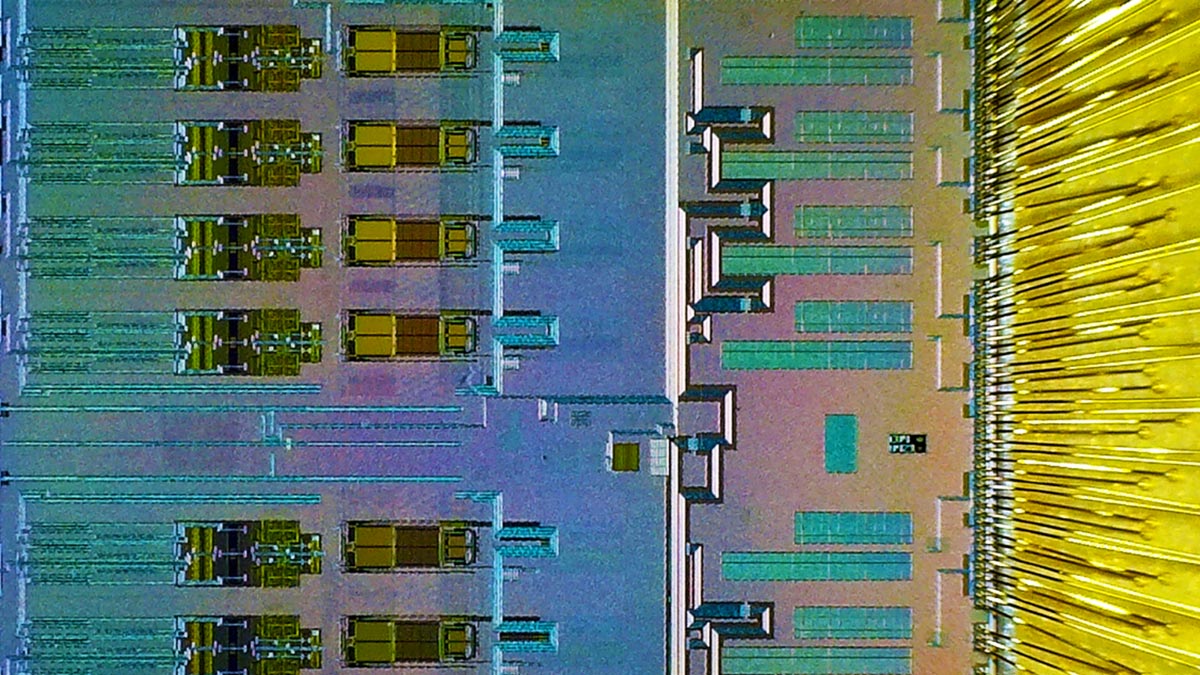
The devices the team designed are called analog-to-digital converters, or ADCs. Their task is capturing electrical signals produced by particle collisions inside CERN’s detectors and translating them into digital data that researchers can analyze.
In the ATLAS detector, the electrical pulses generated by particle collisions are measured using a device called a liquid argon calorimeter. This enormous vat of ultra-cold argon captures an electronic trace of every particle that passes through. Columbia’s ADC chips convert these delicate analog signals into precise digital measurements, capturing details that no existing component could reliably record.
“We tested standard, commercial components, and they just died. The radiation was too intense,” says Rui (Ray) Xu, a Columbia Engineering PhD student who has worked on the project since he was an undergraduate at the University of Texas. “We realized that if we wanted something that worked, we’d have to design it ourselves.”
Building Radiation-Resilient Chips
Instead of creating entirely new manufacturing methods, the team used commercial semiconductor processes validated by CERN for radiation resistance and applied innovative circuit-level techniques. They carefully chose and sized components and arranged circuit architectures and layouts to minimize radiation damage and built digital systems that automatically detect and correct errors in real time. Their resulting design is resilient enough to withstand the unusually severe conditions at LHC for more than a decade.
Two Columbia-designed ADC chips are expected to be integrated into the ATLAS experiment’s upgraded electronics. The first, called the trigger ADC, is already operating at CERN. This chip, initially described in 2017 and validated in 2022, enables the trigger system to filter about a billion collisions each second and to instantly select only the most scientifically promising events to record. It serves as a digital gatekeeper deciding what merits deeper investigation.
Precision for the Higgs and Beyond
The second chip, the data acquisition ADC, recently passed its final tests and is now in full production. The chip, which was described in an IEEE paper earlier this year, will be installed as part of the next LHC upgrade. It will very precisely digitize the selected signals, enabling physicists to explore phenomena like the Higgs boson, whose discovery at CERN made headlines in 2012 and led to the Nobel Prize in physics in 2013, but whose exact properties still hold mysteries.
Both chips represent the kind of direct collaboration between fundamental physicists and engineers.
“The opportunity as an engineer to contribute so directly to fundamental science, is what makes this project special,” Xu said.
Cross-Institutional Collaboration
It further created opportunities to collaborate across multiple institutions. The chips were designed by electrical engineers at Columbia and at the University of Texas, Austin, in close collaboration with physicists at Columbia’s Nevis Laboratories and the University of Texas, Austin.
Funded by the National Science Foundation and the Department of Energy, Columbia’s chips play a central role in a broader international collaboration coordinated in part by Columbia’s Nevis Laboratories. As research at CERN advances, Columbia-designed components will contribute to data acquisition systems that support physicists in analysing phenomena beyond the current limits of knowledge.
Reference: “A Radiation-Hard 8-Channel 15-Bit 40-MSPS ADC for the ATLAS Liquid Argon Calorimeter Readout” by Rui Xu, Jaroslav Bán, Sarthak Kalani, Chen-Kai Hsu, Subhajit Ray, Brian Kirby, Gabriel Matos, Julia Gonski, Andrew C. Smith, Daniel M. Williams, Kiley E. Kennedy, Alan Kahn, Michelle Contreras-Cossio, Lauren Larson, Michael Himmelsbach, Devanshu Panchal, Michael Unanian, Xiangxing Yang, Nan Sun, John Parsons, Timothy R. Andeen and Peter R. Kinget, 28 May 2025, IEEE Open Journal of the Solid-State Circuits Society.
DOI: 10.1109/OJSSCS.2025.3573904
Authors: Rui Xu, Jaroslav Bán, Sarthak Kalani, Chen-Kai Hsu, Subhajit Ray, Brian Kirby, Gabriel Matos, Julia Gonski, Andrew C. Smith, Daniel M. Williams, Kiley E. Kennedy, Alan Kahn, Michelle Contreras-Cossio, Lauren Larson, Michael Himmelsbach, Devanshu Panchal, Michael Unanian, Xiangxing Yang, Nan Sun, John Parsons, Timothy R. Andeen Jr., and Peter R. Kinget
Funding/Acknowledgments: This work was supported in part by the U.S. National Science Foundation under Grant PHY 1948993 and Grant PHY 2013070, and in part by the U.S. Department of Energy under Grant DE-SC0007890. The work of Rui Xu was supported in part by the NASA Space Technology Graduate Research Opportunity under Grant 80NSSC22K1176
Never miss a breakthrough: Join the SciTechDaily newsletter.
Follow us on Google and Google News.
3 Comments
As research at CERN advances, Columbia-designed components will contribute to data acquisition systems that support physicists in analysing phenomena beyond the current limits of knowledge.
Ask the researchers:
What is current limits of knowledge?
The so-called peer-reviewed publications (including Physical Review Letters, Science, Nature, etc) deliberately ignore the core mathematical structures of general relativity’s geometric dynamics, quantum field theory’s renormalization framework, cosmic inflation models, and quantum gravity theories all implicitly rely on the uniformity, continuity, and isotropy of background space, obstinately cling to the ideal fluid characteristics of space—inviscid, incompressible, and isotropic are unverified. Ask to these so-called peer-reviewed publications (including Physical Review Letters, Science, Nature, etc): Where should things in space come from? Do things in space originate from the dynamic evolution of space itself, or from God, Demons, or Angels?
These so-called peer-reviewed publications collude to propagate and doggedly adhere to the notion that two sets of cobalt-60 rotating in opposite directions—whether symmetrical or not—constitute mirror images of each other. In the physical world they (including Physical Review Letters, Nature, Science, etc.) construct, different particles can be defined as the same particle, and topological vortices and their twin antivortices can be defined as two vortices with completely different spatiotemporal manifolds. God, Demons, Angels, and their pet Cats have always dominated the highly acclaimed physical world of these so-called peer-reviewed publications. Let us continue to witness with facts the dirtiest and ugliest epoch in the history of science and humanity.
Correct knowledge will benefit researchers. If researchers are interested in knowledge, please browse https://zhuanlan.zhihu.com/p/1933828835322856603.
It’s a story of survival, precision, and human ingenuity at the frontiers of science. Ridiculous, yet it makes people unable to laugh.
It’s a story of survival, precision, and human ingenuity at the frontiers of science. Ridiculous, yet it makes people unable to laugh.