
Researchers create a compact, all-optical device with the lowest microwave noise ever achieved for an integrated chip.
The Challenge of Noise in Microwave Generation
Electronic devices for global navigation, wireless communications, radar, and precision timing need stable microwave sources to serve as clocks and information carriers. A key aspect to increasing the performance of these devices is reducing the noise, or random fluctuations in phase, that is present on the microwave.
“In the past decade, a technique known as optical frequency division has resulted in the lowest noise microwave signals that have been generated to date,” said Alexander Gaeta, David M. Rickey Professor of Applied Physics and Materials Science and professor of electrical engineering at Columbia Engineering. “Typically, such a system requires multiple lasers and a relatively large volume to contain all the components.”
Optical frequency division – a method of converting a high-frequency signal to a lower frequency – is a recent innovation for generating microwaves in which the noise has been strongly suppressed. However, a large table-top-level footprint prevents such systems from being leveraged for miniaturized sensing and communication applications that demand more compact microwave sources and are broadly adopted.
“We have realized a device that is able to perform optical frequency division entirely on a chip in an area as small as 1 mm2 using only a single laser,” said Gaeta. “We demonstrate for the first time the process of optical frequency division without the need for electronics, greatly simplifying the device design.”
Quantum and Nonlinear Photonics: The Core of Innovation
Gaeta’s group specializes in quantum and nonlinear photonics, or how laser light interacts with matter. Focus areas include nonlinear nanophotonics, frequency-comb generation, intense ultrafast pulse interactions, and generation and processing of quantum states of light.
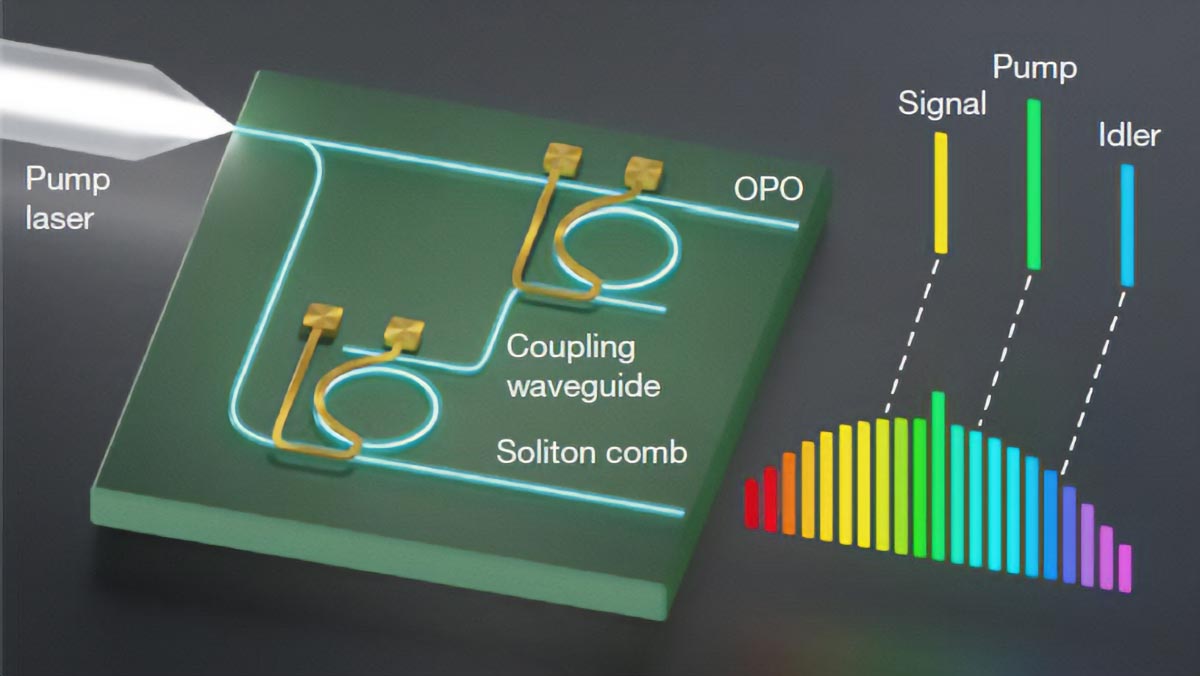
In the current study, his group designed and fabricated an on-chip, all-optical device that generates a 16-GHz microwave signal with the lowest frequency noise that has ever been achieved in an integrated chip platform. The device uses two microresonators made of silicon nitride that are photonically coupled together.
A single-frequency laser pumps both microresonators. One is used to create an optical parametric oscillator, which converts the input wave into two output waves – one higher and one lower in frequency. The frequency spacing of the two new frequencies is adjusted to be in the terahertz regime. As a result of the quantum correlations of the oscillator, the noise of this frequency difference can be thousands of times less than the noise of the input laser wave.
The second microresonator is adjusted to generate an optical frequency comb with a microwave spacing. A small amount of light from the oscillator is then coupled to the comb generator, leading to synchronization of the microwave comb frequency to the terahertz oscillator that automatically results in optical frequency division.
Potential Impact and Future Applications
The work from Gaeta’s group represents a simple, effective approach for performing optical frequency division within a small, robust, and highly portable package. The findings open the door for chip-scale devices that can generate stable, pure microwave signals comparable to those produced in laboratories that perform precision measurements.
“Eventually, this type of all-optical frequency division will lead to new designs of future telecommunication devices,” he said. “It could also improve the precision of microwave radars used for autonomous vehicles.”
Reference: “All-optical frequency division on-chip using a single laser” by Yun Zhao, Jae K. Jang, Garrett J. Beals, Karl J. McNulty, Xingchen Ji, Yoshitomo Okawachi, Michal Lipson and Alexander L. Gaeta, 11 March 2024, Nature.
DOI: 10.1038/s41586-024-07136-2
Gaeta, along with Yun Zhao — who was a graduate student and is now a post-doc in the Gaeta Lab — and research scientist Yoshitomo Okawachi, conceived the project’s core idea. Then, Zhao and post-doc Jae Jang designed the devices and performed the experiment.
The project was done in close collaboration with Eugene Higgins Professor of Electrical Engineering and Professor of Applied Physics Michal Lipson and her group. Karl McNulty from the Lipson group fabricated the photonic chip at both Columbia and Cornell University. TheTerremoto Shared High-Performance Computing Cluster, a service provided by Columbia University Information Technology (CUIT), was used to model the noise properties of optical parametric oscillators.
Never miss a breakthrough: Join the SciTechDaily newsletter.
Follow us on Google and Google News.