
Close Menu
    Facebook X (Twitter) Instagram
    SciTechDaily
    • Biology
    • Chemistry
    • Earth
    • Health
    • Physics
    • Science
    • Space
    • Technology
    Facebook X (Twitter) Pinterest YouTube RSS
    SciTechDaily
    Home»Space»Astronomers Discover the Oldest Galaxy Protocluster & It Features a Mythological Queen
    Space

    Astronomers Discover the Oldest Galaxy Protocluster & It Features a Mythological Queen

    By National Institutes of Natural SciencesSeptember 26, 2019No Comments4 Mins Read
    Facebook Twitter Pinterest Telegram LinkedIn WhatsApp Email Reddit
    Share
    Facebook Twitter LinkedIn Pinterest Telegram Email Reddit
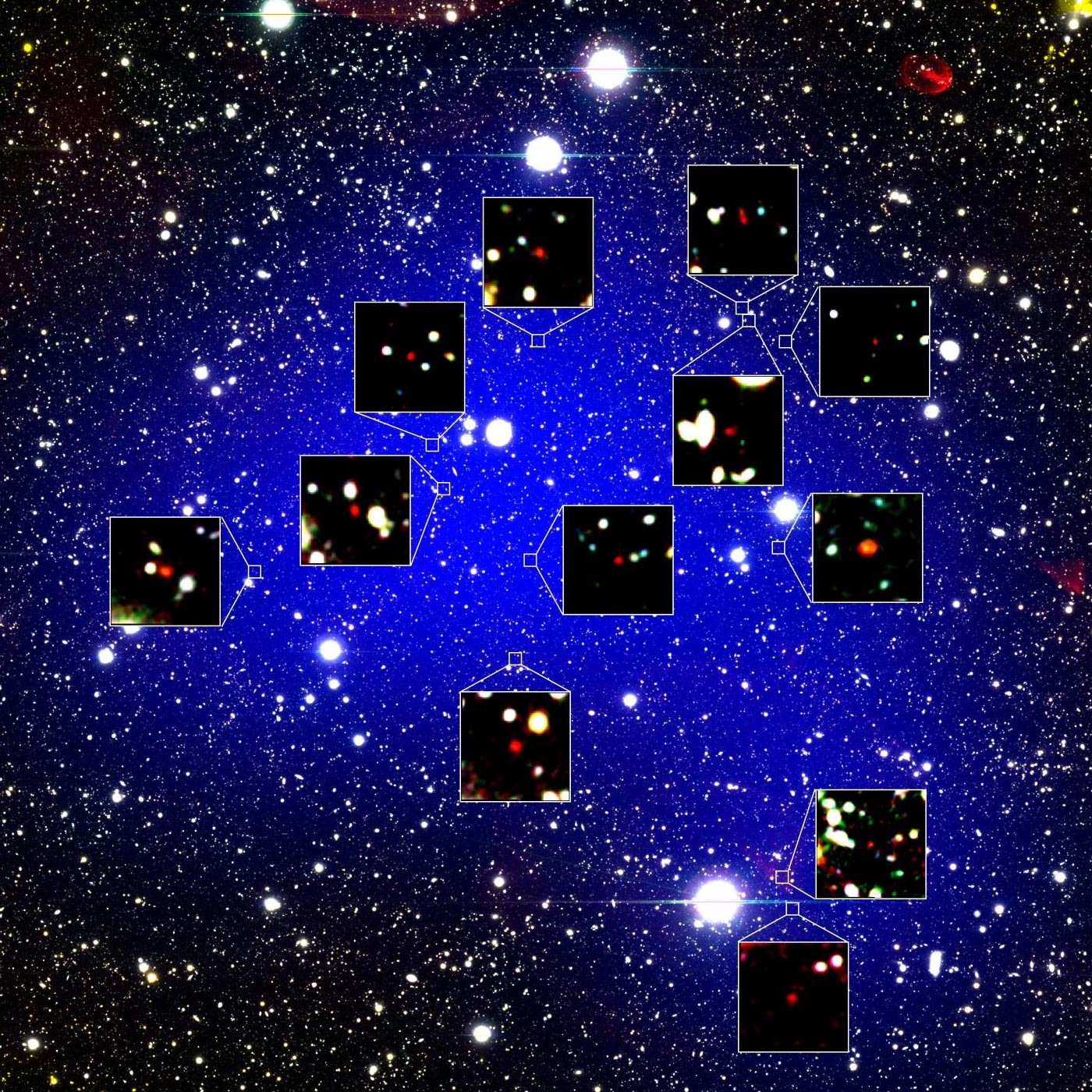
    Most Distant Protocluster Discovered by the Subaru Telescope
    The blue shading shows the calculated extent of the protocluster, and the bluer color indicates higher density of galaxies in the protocluster. The red objects in zoom-in figures are the 12 galaxies found in it. This figure shows a square field-of-view 24 arcminutes along each side (corresponding to 198 million light-years along each side at a distance of 13.0 billion light-years). Each zoom-in figure is 16 arcseconds along each side (corresponding to 2.2 million light-years). Credit: NAOJ/Harikane et al.

    Using the Subaru, Keck, and Gemini Telescopes, an international team of astronomers has discovered a collection of 12 galaxies that existed about 13.0 billion years ago. This is the earliest protocluster ever found. One of the 12 galaxies is a giant object, known as Himiko, which was discovered a decade ago by the Subaru Telescope and named for a mythological queen in ancient Japan. This discovery suggests that large structures such as protoclusters already existed when the Universe was only about 800 million years old, 6 percent of its present age.

    In the present Universe, galaxy clusters can contain hundreds of members, but how these clusters form is a big question in astronomy. To understand the formation of clusters, astronomers search for possible progenitors in the ancient Universe. A protocluster is a dense system of dozens of galaxies in the early Universe, growing into a cluster.

    Yuichi Harikane, a JSPS fellow at the National Astronomical Observatory of Japan who led the team of astronomers explains, “A protocluster is a rare and special system with an extremely high density, and not easy to find. To overcome this problem, we used the wide field of view of the Subaru Telescope to map a large area of the sky and look for protoclusters.”

    In the map of the Universe made by the Subaru Telescope, the team discovered a protocluster candidate, z66OD, where galaxies are 15 times more concentrated than normal for that era. The team then conducted follow-up spectroscopic observations using the W.M. Keck Observatory and Gemini North telescope, and confirmed 12 galaxies that existed 13.0 billion years ago, making it the earliest protocluster known to date.

    Interestingly, one of the 12 galaxies in z66OD was a giant object with a huge body of gas, known as Himiko, which was found previously by the Subaru Telescope in 2009. “It is reasonable to find a protocluster near a massive object, such as Himiko. However, we’re surprised to see that Himiko was located not in the center of the protocluster, but on the edge 500 million light-years away from the center,” said Masami Ouchi, a team member at the National Astronomical Observatory of Japan and the University of Tokyo, who discovered Himiko in 2009. Ironically, the mythological queen Himiko is also said to have lived cloistered away from her people. Ouchi continues, “It is still not understood why Himiko is not located in the center. These results will be a key for understanding the relationship between clusters and massive galaxies.”

    Reference: “SILVERRUSH. VIII. Spectroscopic Identifications of Early Large-scale Structures with Protoclusters over 200 Mpc at z ~ 6–7: Strong Associations of Dusty Star-forming Galaxies” by Yuichi Harikane, Masami Ouchi, Yoshiaki Ono, Seiji Fujimoto, Darko Donevski, Takatoshi Shibuya, Andreas L. Faisst, Tomotsugu Goto, Bunyo Hatsukade, Nobunari Kashikawa, Kotaro Kohno, Takuya Hashimoto, Ryo Higuchi, Akio K. Inoue, Yen-Ting Lin, Crystal L. Martin, Roderik Overzier, Ian Smail, Jun Toshikawa, Hideki Umehata, Yiping Ao, Scott Chapman, David L. Clements, Myungshin Im, Yipeng Jing, Toshihiro Kawaguchi, Chien-Hsiu Lee, Minju M. Lee, Lihwai Lin, Yoshiki Matsuoka, Murilo Marinello, Tohru Nagao, Masato Onodera, Sune Toft and Wei-Hao Wang, 30 September 2019, The Astrophysical Journal.
    DOI: 10.3847/1538-4357/ab2cd5

    Never miss a breakthrough: Join the SciTechDaily newsletter.
    Follow us on Google and Google News.

    Astronomy Galaxy Gemini Observatory National Institutes of Natural Sciences Subaru Telescope W. M. Keck Observatory
    Share. Facebook Twitter Pinterest LinkedIn Email Reddit

    Related Articles

    Surprisingly Young Galaxy – Discovered by AI – Breaks Low-Oxygen Record

    Surprisingly Recent Galaxy Discovered Using Machine Learning – May Be the Last Generation Galaxy in the Long Cosmic History

    Monster Billion Solar Mass Black Hole Found in the Early Universe

    New Spectrograph on Subaru Telescope Shows “Earth-Like” TRAPPIST-1 Planetary Orbits Not Misaligned

    More Than a Trillion Stars Reveal Cores of Massive Galaxies Had Already Formed 1.5 Billion Years After Big Bang

    Black Holes Stunt Growth of Dwarf Galaxies – Astronomers Surprised by 2,000,000 MPH Winds

    Record Breaking Observations Link Dark Matter to Galaxy Formation

    NASA Spots Giant Gathering of Galaxies Located 8.5 billion Light-Years Away

    New Image of Polar Ring Galaxy NGC 660

    Leave A Reply Cancel Reply

    • Facebook
    • Twitter
    • Pinterest
    • YouTube

    Don't Miss a Discovery

    Subscribe for the Latest in Science & Tech!

    Trending News

    Your Blood Pressure Reading Could Be Wrong Because of One Simple Mistake

    Astronomers Stunned by Ancient Galaxy With No Spin

    Physicists May Be on the Verge of Discovering “New Physics” at CERN

    Scientists Solve 320-Million-Year Mystery of Reptile Skin Armor

    Scientists Say This Daily Walking Habit May Be the Secret to Keeping Weight Off After Dieting

    New Therapy Rewires the Brain To Restore Joy in Depression Patients

    Giant Squid Detected off Western Australia in Stunning Deep-Sea Discovery

    Popular Sugar-Free Sweetener Linked to Liver Disease, Study Warns

    Follow SciTechDaily
    • Facebook
    • Twitter
    • YouTube
    • Pinterest
    • Newsletter
    • RSS
    SciTech News
    • Biology News
    • Chemistry News
    • Earth News
    • Health News
    • Physics News
    • Science News
    • Space News
    • Technology News
    Recent Posts
    • Hidden Warm Water Beneath Antarctica Could Rapidly Raise Global Sea Levels
    • Scientists Revive Ancient Chemistry Trick To Engineer Next-Generation Glass
    • Scientists Use AI To Supercharge Ultrafast Laser Simulations by More Than 250x
    • Scientists Just Found a Surprising Way To Destroy “Forever Chemicals”
    • Popular Supplement Ingredient Linked to Shorter Lifespan in Men
    Copyright © 1998 - 2026 SciTechDaily. All Rights Reserved.
    • Science News
    • About
    • Contact
    • Editorial Board
    • Privacy Policy
    • Terms of Use

    Type above and press Enter to search. Press Esc to cancel.