
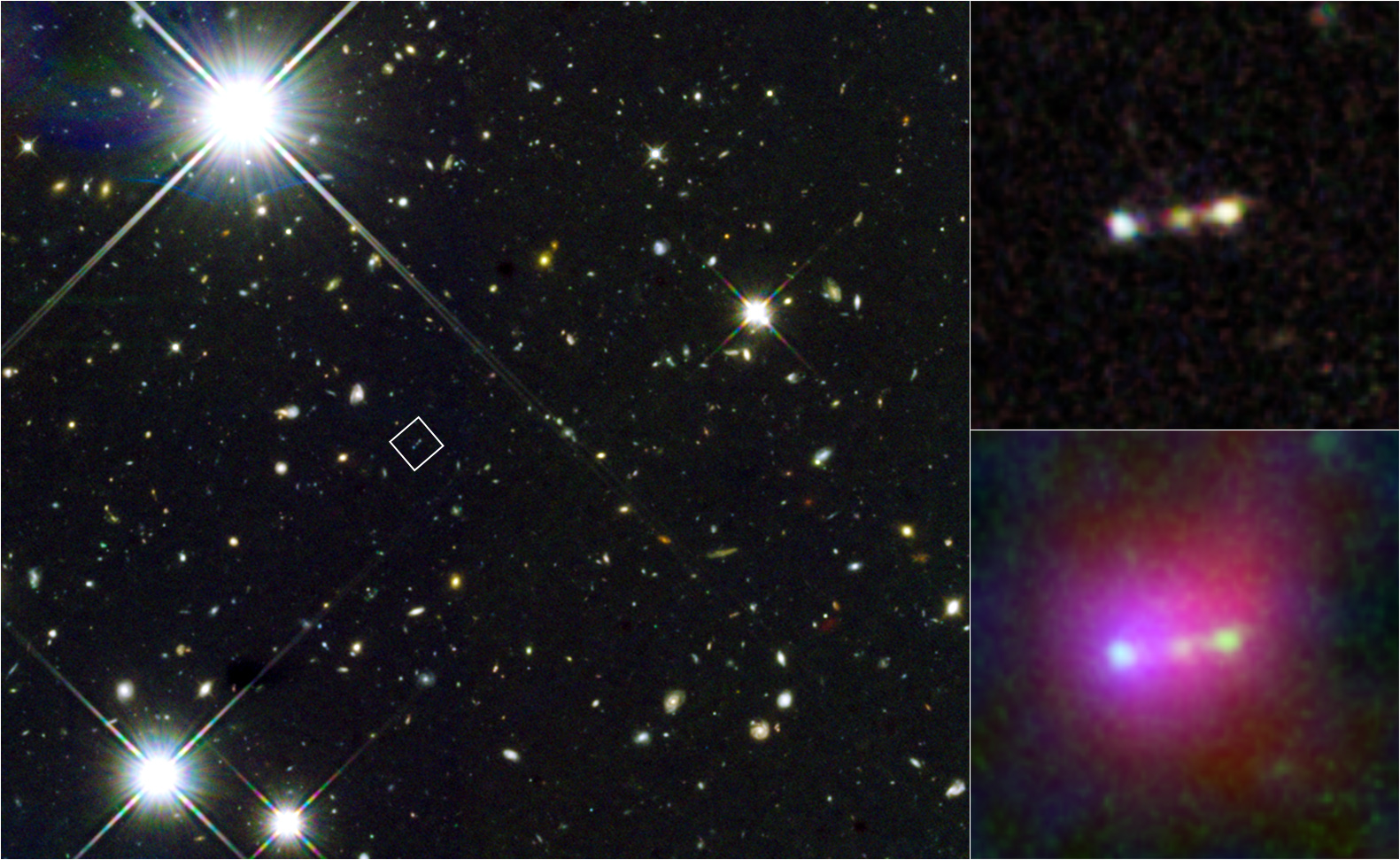
The image in the upper right is a close-up of Himiko with Hubble. The three infant galaxies are clearly resolved where only one was known to exist before. These objects are extremely energetic, suggesting they are undergoing a period of intense star formation. Credit: NASA/Hubble
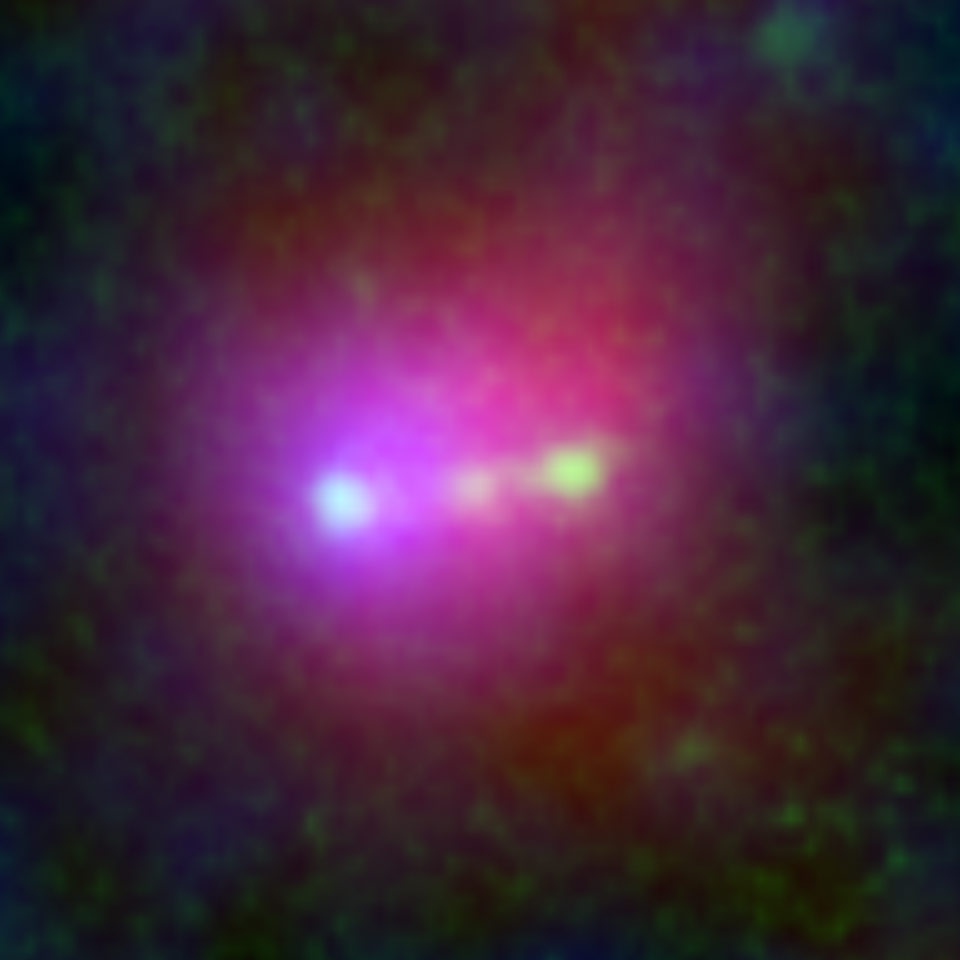
The image in the lower right is the same object with additional data from the Spitzer Space Telescope and Subaru Telescope on Mauna Kea in Hawaii. The halo of ionized hydrogen gas is clearly seen surrounding Himiko. Observations with the Atacama Large Millimeter/submillimeter Array (ALMA) telescope did not detect any telltale signature from carbon, suggesting that these three objects may be very primitive and have not had enough time to seed the intergalactic medium with heavy elements. Credit: NASA/Hubble; NASA/Spitzer; NAOJ/Subaru
Using the Hubble Space Telescope and the Atacama Large Millimeter/submillimeter Array, astronomers have discovered a trio of young galaxies nestled inside an enormous blob of primordial gas nearly 13 billion light-years from Earth.
The Subaru Telescope, an 8.2-meter telescope operated by the National Astronomical Observatory of Japan, has been combing the night sky since 1999. Located at the Mauna Kea Observatories in Hawaii, the telescope has been systematically surveying each degree of space, whether it looks promising or not, in search of objects worthy of further investigation. One of the most fascinating objects to emerge from the Subaru Telescope’s wide-field survey—Himiko—was discovered in 2009. Himiko, a “space blob” named after a legendary queen from ancient Japan, is a simply enormous galaxy, with a hot glowing gaseous halo extending over 55,000 light-years. Not only is Himiko very large, it is extraordinarily distant, seen at a time approximately 800 million years after the Big Bang, when the universe was only 6 percent of its present size and stars and galaxies were just beginning to form.
How could such an early galaxy have sufficient energy to power such a vast glowing gas cloud? In search of the answer to this question, Richard Ellis, the Steele Family Professor of Astronomy at Caltech, together with colleagues from the University of Tokyo and the Harvard-Smithsonian Center for Astrophysics, undertook an exploration of Himiko using the combined resources of the Hubble Space Telescope and the new Atacama Large Millimeter/submillimeter Array (ALMA) in Chile’s Atacama Desert. The data collected through these observations answered the initial question about the source of energy powering Himiko, but revealed some puzzling data as well.
“This exceedingly rare triple system, seen when the Universe was only 800 million years old, provides important insights into the earliest stages of galaxy formation during a period known as ‘Cosmic Dawn,’ when the Universe was first bathed in starlight,” said Richard Ellis, the Steele Professor of Astronomy at the California Institute of Technology and member of the research team. “Even more interesting, these galaxies appear poised to merge into a single massive galaxy, which could eventually evolve into something akin to the Milky Way.”
Researchers first detected this object, which appeared to be a giant bubble of hot, ionized gas, in 2009. Dubbed Himiko (after a legendary queen of ancient Japan), it is nearly 10 times larger than typical galaxies of that era and comparable in size to our own Milky Way. Subsequent observations with the Spitzer Space Telescope suggested that Himiko might represent a single galaxy, which would make it uncharacteristically massive for that period of the early Universe.
“The new observations revealed that, rather than a single galaxy, Himiko harbors three distinct, bright sources, whose intense star formation is heating and ionizing this giant cloud of gas,” said Masami Ouchi, an associate professor at the University of Tokyo who led the international team of astronomers from Japan and the United States.
Areas of such furious star formation should be brimming with heavy elements such as carbon, silicon, and oxygen. These elements are forged in the nuclear furnaces of massive, short-lived stars like those bursting into life inside the three galaxies detected by Hubble. At the end of their relatively brief lives, these stars explode as supernovas, seeding the intergalactic medium with a fine dust of heavy elements.
“When this dust is heated by ultraviolet radiation from massive newborn stars, the dust then re-radiates at radio wavelengths,” remarked Kotaro Kohno, a member of the team also with the University of Tokyo. “Such radiation is not detected in Himiko.”
“Surprisingly, observations with ALMA revealed a complete absence of the signal from carbon, which is rapidly synthesized in young stars. Given the sensitivity of ALMA, this is truly remarkable,” said Ouchi. “Exactly how this intense activity can be reconciled with the primitive chemical composition of Himiko is quite puzzling.”
The astronomers speculate that a large fraction of the gas in Himiko could be primordial, a mixture of the light elements hydrogen and helium, which were created in the Big Bang. If correct, this would be a landmark discovery signaling the detection of a primordial galaxy seen during its formation.
Ellis summed up the situation: “Astronomers are usually excited when a signal from an object is detected. But, in this case, it’s the absence of a signal from heavy elements that is the most exciting result!”
The ALMA data were taken as part of the early science program with only a portion of the array’s eventual full complement of 66 antennas. Future research with the complete ALMA telescope and the next generation of ground- and space-based observatories will look even further back in time, shedding more light on the origin and evolution of the first stars and galaxies. The results are published in the Astrophysical Journal.
ALMA, an international astronomy facility, is a partnership of Europe, North America, and East Asia in cooperation with the Republic of Chile. ALMA construction and operations are led on behalf of Europe by ESO, on behalf of North America by the National Radio Astronomy Observatory (NRAO), and on behalf of East Asia by the National Astronomical Observatory of Japan (NAOJ). The Joint ALMA Observatory (JAO) provides the unified leadership and management of the construction, commissioning, and operation of ALMA.
The National Radio Astronomy Observatory is a facility of the National Science Foundation, operated under cooperative agreement by Associated Universities, Inc.
Reference: “An Intensely Star-forming Galaxy at z ~ 7 with Low Dust and Metal Content Revealed by Deep ALMA and HST Observations” by Masami Ouchi, Richard Ellis, Yoshiaki Ono, Kouichiro Nakanishi, Kotaro Kohno, Rieko Momose, Yasutaka Kurono, M. L. N. Ashby, Kazuhiro Shimasaku, S. P. Willner, G. G. Fazio, Yoichi Tamura and Daisuke Iono, 11 November 2013, The Astrophysical Journal.
DOI: 10.1088/0004-637X/778/2/102
arXiv:1306.3572
Never miss a breakthrough: Join the SciTechDaily newsletter.
Follow us on Google and Google News.
1 Comment
This observation could also be providing evidence of me being correct in my various posits on the creation of our universe because, within the latter I proposed the our entire universe was in-situ, ‘Before the Bang’ and in accordance with that, such formations wouldn’t need any of the, ‘Lighter Elements’ to be involved, ergo no ‘Puzzle’, just simple, ‘Scientific’ facts emerging to prove that I have been right all along. It would also explain why these galaxies are so close together when if fact under existing posits such formations are impossible because each would be competing for gas and dust in the immediate surroundings and the latter is impossible in this case… But of course ‘My’ thoughts on Creation are counter to the current dogma which means that if I am right, then everything that has gone before would have to be changed! And the academia aren’t going to like that facet of ‘REALITY’ one bit because, it would leave and awful lot of the proverbial ‘Egg’ on an awful lot of, ‘Scientific Faces’…